
How AI Workflow Automation Cuts Administrative Overhead
AI workflow automation cuts administrative overhead by eliminating entire categories of manual work (scheduling, data entry, document processing, and reporting) that consume a large share of the average business owner’s week. That hidden overhead often never appears as a line item on the P&L.
Administrative tasks quietly consume a large share of the average business owner's week. AI workflow automation systematically reclaims that labor value.
Epiphany Dynamics is an AI automation agency: we help businesses find and fix operational bottlenecks with AI receptionists, lead follow-up, and workflow automation.
The free 30-minute AI Operations Audit is a conversation about a normal week in your business and where the work piles up. We find the one change that would give you the most time back and send you a plain-English plan for it. No forms and no pitch.
Book a free AI audit
Patrick Gibbs
AI workflow automation cuts administrative overhead by eliminating entire categories of manual work (scheduling, data entry, document processing, and reporting) that consume a large share of the average business owner’s week. That hidden overhead often never appears as a line item on the P&L. It shows up as slow response, delayed invoicing, staff exhaustion, and growth work that never gets done. This guide explains where the overhead actually lives, which automation mechanisms address each category, and how to sequence implementation for measurable results.
The Overhead Tax You’re Paying Without Realizing It
The typical small business owner spends a large share of their working hours on administrative tasks that generate zero direct revenue. As a planning exercise, track the time consumed by scheduling, data entry, document processing, invoicing, status updates, and follow-up emails. Then multiply that time by the opportunity cost of the person doing it. The number is often uncomfortable because it shows how much skilled capacity is being absorbed by work that software can handle.
Scale that across a team, and the overhead tax becomes a real operating constraint even if it never appears as a line item on your P&L. It doesn’t show up as a cost. It shows up as exhaustion, missed growth targets, and the persistent feeling that you’re sprinting while standing still. AI workflow automation doesn’t just shave time off tasks. It systematically eliminates entire categories of manual work. But getting from “AI will fix this” to an actual, measurable reduction in overhead requires understanding where the overhead lives, which automation mechanisms address which problems, and how to sequence implementation without creating more complexity than you started with. Our guide to automating repetitive tasks provides a practical implementation roadmap for exactly this.
Where Administrative Overhead Actually Lives
Most business owners dramatically underestimate their administrative load because it hides across dozens of micro-tasks spread throughout the day rather than appearing as one obvious time sink. Knowledge workers spend a large share of their workday on “work about work”: status updates, approval chains, meeting coordination, email management, and system updates. And a large share of routine administrative activity is technically automatable with tools already available; for purely administrative functions, the automatable share is higher still.
Breaking overhead into categories reveals where the highest ROI targets are:
- Document processing: Invoice intake, contracts, compliance forms, and onboarding documents. Manual review and data extraction burns staff capacity every time a document is opened, checked, re-keyed, and filed.
- Scheduling and coordination: Professionals sink hours every week into meetings and the back-and-forth of scheduling them, a coordination cost that adds up to real money across any organization.
- Data entry and CRM updates: Sales reps spend only a fraction of their week actually selling; the rest is administrative burden, with data entry alone consuming a meaningful slice of service and sales team time.
- Reporting and status communication: Weekly reports, client updates, internal dashboards. This is often templated work that adds limited analytical value when done manually.
The critical insight here is that these aren’t random inefficiencies: they’re structured, repeatable, rules-based processes. That’s exactly what automation is built to handle. For businesses where data entry is the primary drain, our guide on eliminating manual data entry with AI covers the specific tools and approaches that work.
How AI Workflow Automation Addresses Each Category
AI workflow automation is a category of tools, not a single product. Different mechanisms address different overhead problems, and conflating them leads to bad purchasing decisions. Here’s what actually does what:
Intelligent Document Processing (IDP)
Tools like AWS Textract, Azure Document Intelligence, and purpose-built platforms like Nanonets combine OCR with machine learning to extract structured data from unstructured documents. Unlike legacy OCR that required rigid, pre-defined templates, modern IDP handles variable invoice layouts, handwritten annotations, and multi-page contracts with high extraction accuracy at scale. A business implementing IDP for invoice processing can move routine extraction to software while keeping a person focused on exception review. That changes the work from repetitive copying to judgment-based oversight.
AI Scheduling and Calendar Intelligence
Tools like Reclaim.ai, Motion, and Cal.com’s AI scheduler don’t just book meetings. They learn priority hierarchies, protect focus time blocks, and reschedule proactively when conflicts emerge. For client-facing teams, AI scheduling eliminates the back-and-forth email chain entirely: a self-service booking link with intelligent availability logic replaces repeated manual coordination. The value is easiest to see by counting how many client interactions require scheduling help, then multiplying that by the time each coordination thread consumes.
Workflow Orchestration and Conditional Logic
Platforms like Make.com (formerly Integromat), n8n, and Zapier’s AI-enhanced flows connect CRM, email, project management, invoicing, and communication tools using conditional logic. The practical result: “When a new client signs a contract -> create project in Asana -> trigger onboarding email sequence -> add to billing cycle -> notify account manager” becomes fully zero-touch. What previously required a coordinator touching multiple systems becomes an automatic handoff. The error rate from manual hand-offs, an unavoidable feature of multi-system workflows, drops sharply because there is no human transfer of information between systems.
AI-Driven Reporting
Platforms like Rows, Coefficient, or native AI features within Notion and Monday.com generate narrative summaries and automatically flag anomalies rather than requiring manual data compilation across multiple sources. Finance teams can reduce repetitive reporting work once AI-assisted dashboards are configured and connected to live data sources. The highest-value application isn’t generating the report. It’s the AI identifying exceptions, outliers, and trends that a manual process would miss entirely.
Calculating the Real ROI Before You Spend a Dollar
The CFO-level test for any automation investment is straightforward: does the cost of the tool plus implementation time pay for itself in recovered labor, reduced errors, or increased capacity, and how quickly? Here’s a four-step framework you can run in an afternoon:
Step 1. Baseline your administrative load. Have team members track time by category using Toggl, Clockify, or a simple spreadsheet. The results are almost always sobering. Most teams are shocked by how much time disappears into low-value recurring tasks.
Step 2. Quantify fully-loaded cost. Don’t use base salary alone. Include benefits, payroll taxes, equipment, workspace, management overhead, and the opportunity cost of the work that person cannot do while handling admin.
Step 3. Estimate conservative recoverable capacity. AI workflow automation can eliminate or reduce a meaningful share of the time spent on targeted administrative functions, but the exact yield depends on workflow quality, exception volume, and integration reliability. Start conservatively.
Step 4. Compare against tool cost. Include software subscriptions, implementation time, maintenance, and vendor support. For a comprehensive breakdown of AI automation costs and pricing models, the ranges vary significantly by service type.
| Scenario | Admin Load Pattern | Primary Cost Driver | Automation Target | Value Signal |
|---|---|---|---|---|
| Solo Practitioner | Owner handles scheduling, intake, follow-up, and invoicing personally | Owner time pulled away from billable or growth work | Lead response, scheduling, invoicing, and client reminders | More owner attention available for revenue-producing work |
| Small Team | Admin spread across several people who already have core responsibilities | Shared intake, CRM updates, status reporting, and payment reminders | Fewer dropped balls and less internal coordination work | |
| Growing Company | Recurring admin work starts to justify dedicated staff | Document processing, orchestration, reporting, and exception routing | Growth can continue without adding admin headcount at the same pace |
Note: Recovered capacity is not necessarily headcount reduction. Most businesses use recovered time to absorb growth without additional hiring, which is frequently more valuable than direct cost elimination, since it preserves team continuity and institutional knowledge.
A Practical Implementation Roadmap
The most common reason AI workflow automation fails isn’t the technology. It’s sequencing. Companies attempt to automate everything simultaneously, create integration spaghetti across a dozen disconnected tools, and exhaust the team on configuration overhead that rivals the overhead they were trying to eliminate.
Phase 1: Audit and Prioritize
Map every recurring administrative task and score each on two axes: frequency (how often does it occur?) and time-per-instance. High-frequency, high-time-per-instance tasks are your immediate targets. Deliberately ignore low-frequency tasks in Phase 1: the setup complexity doesn’t justify the ROI until your automation infrastructure is mature.
Phase 2: One Workflow, Full Depth
Pick a single end-to-end workflow and automate it completely before touching anything else. Partial automation creates hybrid processes (part manual, part automated) that are often worse than fully manual because the hand-off points become invisible failure modes. If you’re automating client onboarding, automate the entire sequence: intake form → contract generation → CRM entry → project setup → welcome email sequence → billing configuration. Measure time-per-client before and after. That measurement is your proof of concept and your internal business case for Phase 3.
Phase 3: Connect the Core Systems
Once one workflow runs cleanly, identify the three or four systems your business lives in most: typically a CRM, an email platform, a project management tool, and an invoicing system. Build a central workflow orchestration layer using Make.com, n8n, or Zapier that routes data between them without human intervention. The goal is that no team member should ever manually copy information from one system to another.
Phase 4: Layer in Intelligence
Once data flows cleanly between systems, you can meaningfully add AI: automatic email classification and triage, intelligent document extraction, predictive scheduling, and anomaly detection in reporting. These capabilities only deliver real value on top of clean, reliable data pipelines. AI applied to inconsistent, manual-entry data produces unreliable outputs. The sequencing isn’t optional. It’s the difference between automation that compounds and automation that creates new problems.
For related material, see n8n Workflow Automation Agency: What They Build, What It Costs (2026).
Four Pitfalls That Burn Businesses
Automating broken processes. Automation doesn’t fix process problems. It amplifies them at speed. If your customer intake workflow is inconsistent, automating it locks in the inconsistency and makes it far harder to adjust. Standardize first. Automate second. Document what a successful execution looks like before you build any trigger logic. Our service business workflow automation guide walks through this standardization process step by step.
Tool proliferation without integration. Adding five separate AI tools that don’t connect to each other creates new administrative overhead: maintaining separate logins, reconciling conflicting data across platforms, managing subscriptions, and training the team on each interface. Every new tool should have a documented integration path into your existing stack before you adopt it. One connected platform beats five isolated point solutions every time.
Ignoring exception handling. Automation handles predictable cases best. Edge cases still require human judgment. If you don’t build clear escalation paths for situations like a document that doesn’t parse correctly, a contract clause that’s non-standard, or a client request that falls outside normal parameters, those edge cases become invisible failures that erode trust in the system. Exception monitoring isn’t optional; it’s a core component of every workflow, not an afterthought.
Measuring inputs instead of outcomes. “We deployed three automation tools” is not a success metric. Measure what actually changed: hours recovered per week, error rate reduction, time-to-invoice after service delivery, client onboarding cycle time. Without outcome metrics tied to real business performance, you can’t determine whether the investment is working or whether it’s creating the illusion of efficiency while the real problem persists somewhere upstream.
The Compounding Advantage
Administrative overhead isn’t inevitable. It’s a default state that compounds quietly until it’s consuming a material portion of your revenue capacity and team energy. The businesses gaining competitive ground right now are treating this as a systems problem, not a hiring problem or a “we just need to work harder” problem. They’re auditing their overhead honestly, sequencing automation by ROI, and measuring outcomes with the same discipline they apply to sales metrics.
The technology stack to do this at SMB scale has never been more accessible or cost-effective. The barrier isn’t budget or technical complexity. It’s the discipline to prioritize structured implementation over reactive fire-fighting. For businesses that want professional help accelerating this process, AI automation specialists like Epiphany Dynamics work specifically with service businesses to deploy these systems without requiring internal technical expertise.
Frequently Asked Questions
Q: What percentage of a typical small business owner’s week is consumed by administrative tasks?
The exact share depends on the business, but the pattern is consistent: scheduling, data entry, document processing, invoicing, status updates, and follow-up emails consume time that could otherwise go to billable work, client service, or growth. Track the categories directly and multiply them by the fully loaded cost or opportunity cost of the person doing the work.
Q: Which administrative workflow delivers the fastest ROI from AI automation for a small service business?
Document processing, specifically invoice and contract intake, often delivers the fastest measurable return because the manual work is repetitive, structured, and easy to baseline. Modern IDP platforms extract data with high accuracy and let a person focus on exceptions instead of routine copying. The business case is strongest when document volume is steady and the current process involves repeated review, re-keying, and filing.
Q: What is the right order to implement AI workflow automation to avoid creating new complexity?
Phase 1 is audit and prioritization (map and score recurring tasks by frequency and time-per-instance). Phase 2 is a single end-to-end workflow automated completely (not partially) before touching anything else. Partial automation creates hybrid processes with invisible failure modes at hand-off points. Phase 3 connects core systems through workflow orchestration so no team member manually copies data between platforms. Phase 4 layers in AI intelligence (classification, prediction, anomaly detection) only once clean data flows reliably between systems.
Q: What is the most common reason AI workflow automation fails to deliver its projected ROI?
Automating broken processes. Automation doesn’t fix process problems. It amplifies them at speed. If client intake is inconsistent, automating it locks in the inconsistency and makes it far harder to adjust. Standardize first, automate second, and document what a successful execution looks like before writing any trigger logic. The second most common failure is tool proliferation without integration: five separate AI tools that don’t connect to each other create new administrative overhead that rivals the overhead they were supposed to eliminate.
Q: What outcome metrics should a service business track to verify that workflow automation is actually working?
Hours recovered per week by category (not “we deployed three automation tools”), error rate reduction on the specific process automated, time-to-invoice after service delivery, client onboarding cycle time, and cost per transaction for document-heavy workflows. Without outcome metrics tied to real business performance, you cannot determine whether the investment is working or creating the illusion of efficiency while the actual problem persists somewhere upstream.
Patrick Gibbs
AI Automation Expert
Patrick Gibbs helps professional practices implement AI automation that captures more leads, books more appointments, and scales without adding overhead. He's the founder of Epiphany Dynamics and creator of the AI Front Desk system.
Related Solutions
Build this into a real workflow
Related Posts
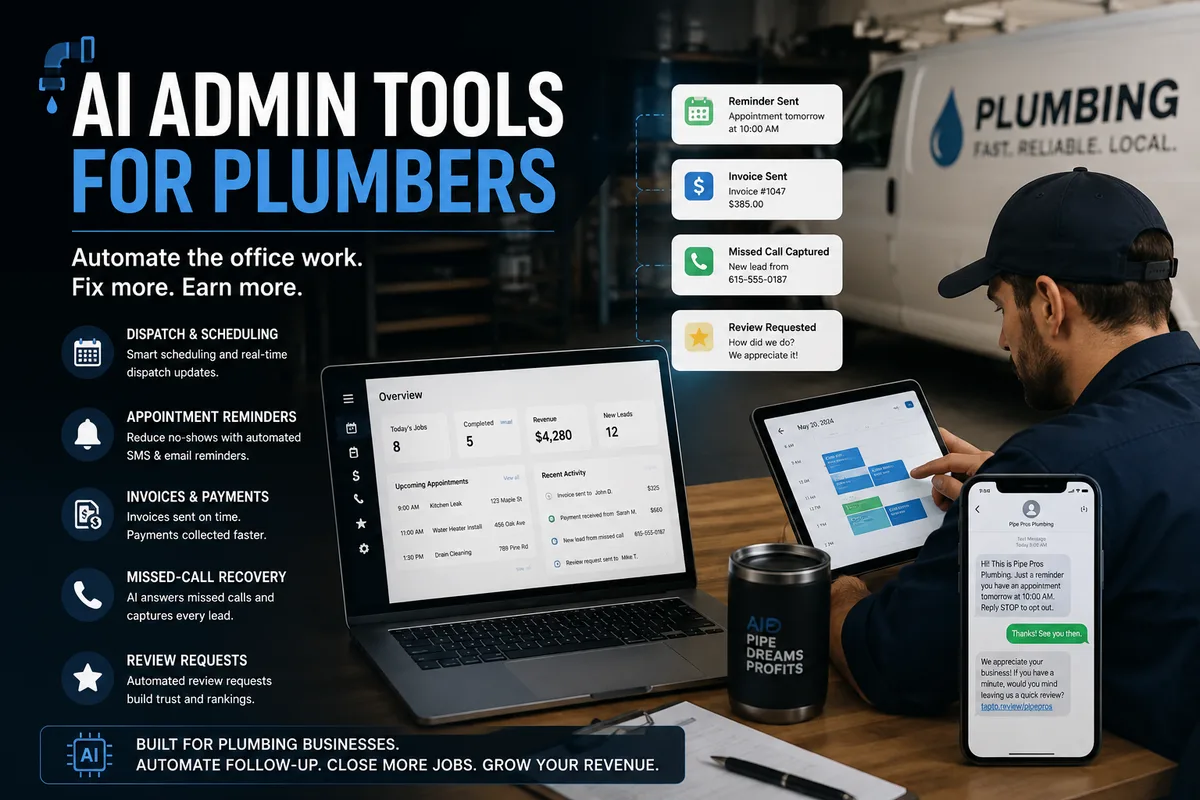
AI Admin Tools for Plumbers: What They Are and How to Choose
AI admin tools automate dispatch, reminders, invoicing follow-up, missed calls, and review requests for plumbers. What they do and how to choose.
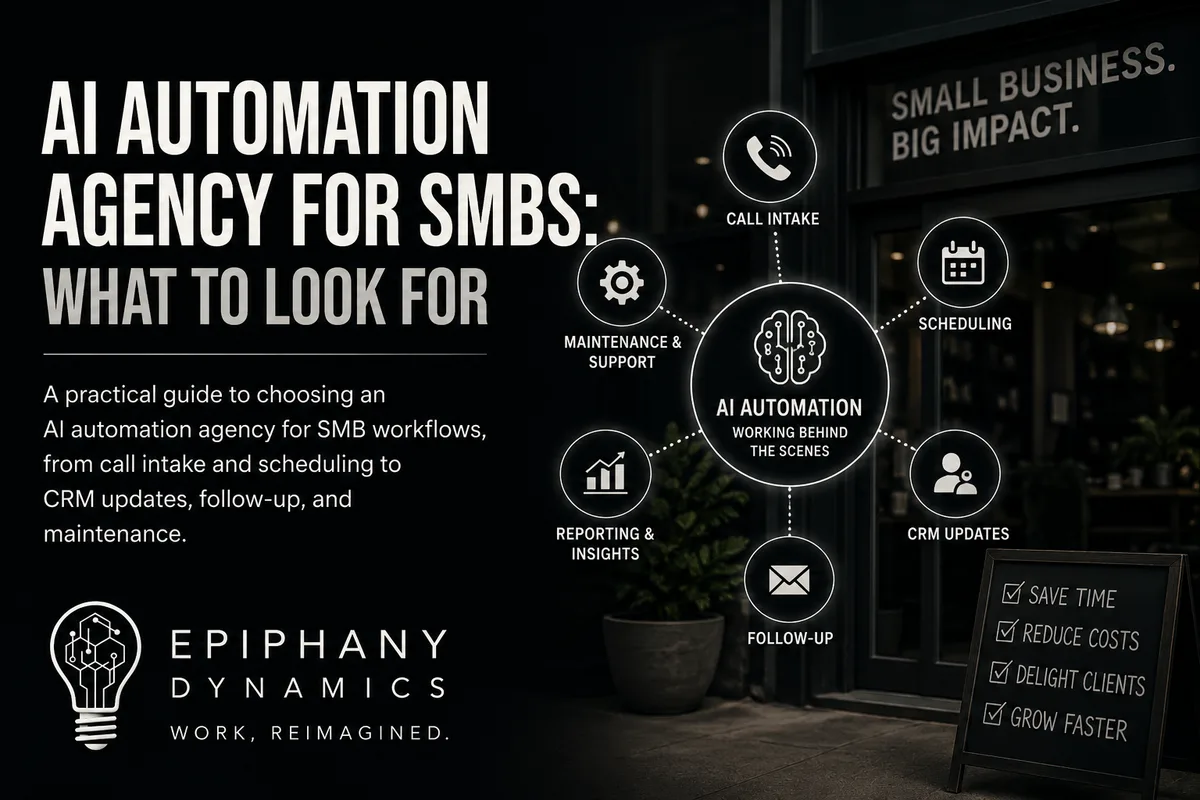
AI Automation Agency for SMBs: What to Look For
A practical guide to choosing an AI automation agency for SMB workflows, from call intake and scheduling to CRM updates, follow-up, and maintenance.
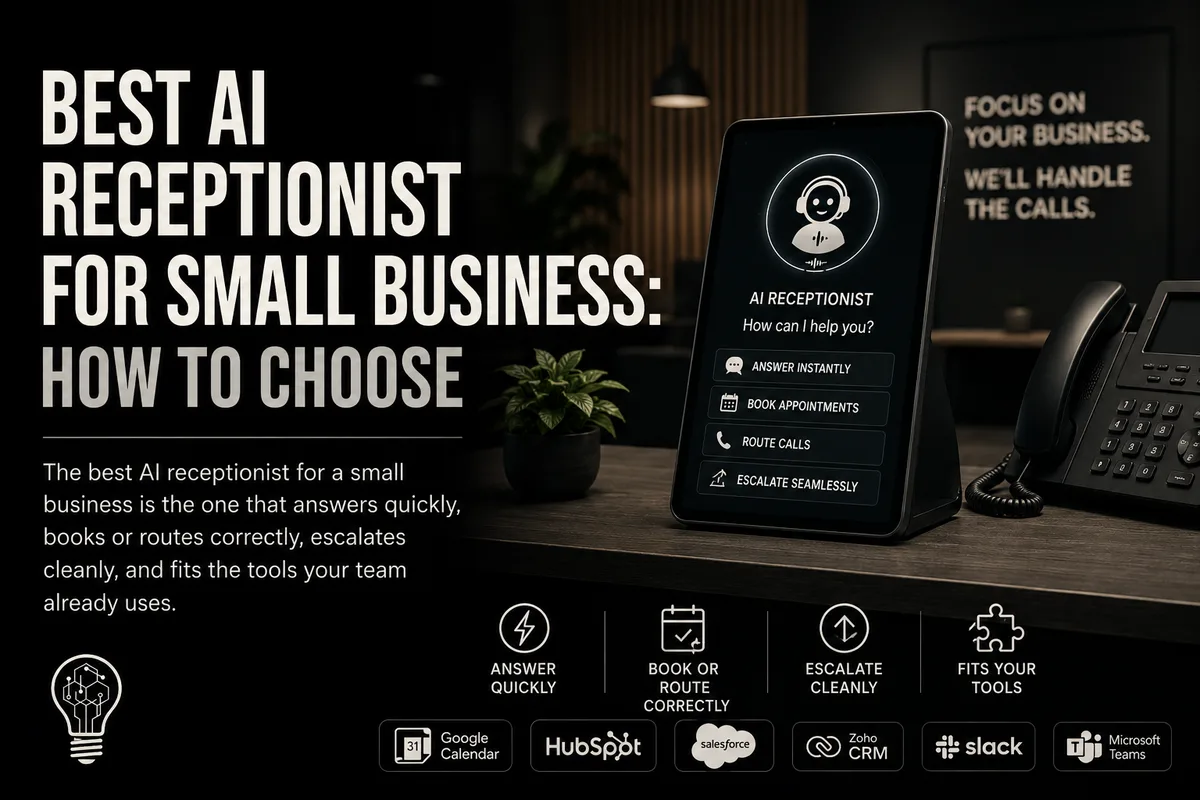
Best AI Receptionist for Small Business: How to Choose
The best AI receptionist for a small business is the one that answers quickly, books or routes correctly, escalates cleanly, and fits the tools your team.