
Business Growth
Service Business Workflow Automation: A Practical Guide
Service businesses lose a large share of billable capacity to manual admin work. This guide breaks down exactly which workflows to automate, in what order, and.
The free 30-minute AI Operations Audit is a conversation about a normal week in your business and where the work piles up. We find the one change that would give you the most time back and send you a plain-English plan for it. No forms and no pitch.
Book a free AI audit
Patrick Gibbs
Service businesses lose a large share of billable capacity to manual admin work: scheduling calls, invoicing, follow-up reminders, and status updates that generate zero direct revenue but consume real labor hours every week. Automating the five highest-impact workflows (lead response, appointment scheduling, post-job follow-up, invoicing, and job status updates) can produce a strong ROI case by reducing overhead and recovering missed revenue. This guide breaks down which workflows to automate first, in what order, what to expect from each, and how to build the ROI case before committing budget.
The Hidden Cost Eating Your Margin
Run this exercise at a residential HVAC company: track every hour spent on non-billable administrative work over a representative period. Count scheduling calls, manual invoicing, follow-up reminders, and job status updates. Then multiply the weekly hours by the fully loaded labor cost for the people handling that work. That is the overhead baseline automation has to beat.
This isn’t unusual. A large share of service-business overhead is repetitive, rule-based, and data-driven. The problem isn’t that automation is hard. The problem is that most service business owners don’t have a clear framework for where to start, what to expect, and how to avoid spending months integrating tools that don’t actually talk to each other. Our complete AI workflow automation guide for small businesses provides that framework.
The Five Core Workflows Worth Automating First
Not all automation is equal. The goal isn’t to automate everything: it’s to automate the workflows that are high-frequency, high-error-risk, and directly tied to client experience or revenue. Here are the five that consistently deliver the fastest returns across service businesses:
1. Lead Response and Initial Qualification
Lead-response research has established that leads contacted quickly are dramatically more likely to convert than those left waiting. Most service businesses respond only when someone has a free moment. An automated lead intake flow (web form submission triggers an immediate confirmation email, CRM record creation, and a qualification sequence) closes that gap without adding headcount. For businesses running paid ads, faster response routinely shows up as a lower cost-per-acquisition. Our guide to automating repetitive tasks provides a practical roadmap for implementing these changes.
2. Appointment Scheduling and Confirmation
Phone tag to schedule a service call creates avoidable staff time on every booking. Online self-scheduling with automated confirmation texts (sent immediately at booking) and reminder sequences (24 hours before, 2 hours before) addresses both the labor cost and the no-show problem. If a service business currently has a meaningful no-show problem, a two-touch reminder sequence can turn that leakage into a measurable before-and-after metric.
3. Post-Job Follow-Up and Review Requests
Review acquisition is a revenue-generating activity that almost nobody systematizes. A Google review request sent at the right moment, personalized with the technician’s name and job type, is usually stronger than a generic weekly blast. The same follow-up sequence can include upsell offers (annual maintenance plans, related services) triggered by job type. This workflow is pure margin: it requires no additional labor and compounds over time as your review count and average rating improve organic lead flow.
4. Invoicing and Payment Collection
Manual invoice processing in small businesses can consume meaningful fully loaded labor time per invoice. Automated invoicing (triggered on job completion, delivered via SMS and email, with staged payment reminders after the due date) gives you a clear way to compare pre-automation and post-automation processing cost. The labor savings can justify automation tool costs before you account for improved cash flow.
5. Job Status Updates and Internal Handoffs
Every time a client calls to ask “where is my technician?” is a failure of proactive communication and a drain on admin staff. Automated job dispatch notifications (SMS to client when tech is en route, with GPS ETA), status updates on job start and completion, and internal handoff triggers (job completed → billing queue → close-out checklist) eliminate much of this inbound contact. Businesses that implement this should track inbound “status check” calls before and after launch to quantify the reduction.
Running the Numbers: What Automation Actually Returns
Before committing budget, it’s worth building a simple ROI case. Use your own labor baseline, tool costs, and missed-revenue data instead of borrowing a generic benchmark.
| Workflow Automated | Current Cost Driver | Automation Effect | Metric to Track |
|---|---|---|---|
| Lead response / qualification | Manual callbacks and slow follow-up | Immediate capture, routing, and qualification | Lead response time and booked-call rate |
| Scheduling + reminders | Phone tag, missed confirmations, no-shows | Self-scheduling plus confirmation and reminder logic | No-show rate and staff scheduling time |
| Invoicing + collections | Manual invoice sends and payment chasing | Triggered invoices, reminders, and payment links | Days Sales Outstanding and AR follow-up time |
| Follow-up + review requests | Inconsistent post-job outreach | Triggered review, referral, and upsell messages | Review volume and repeat-service bookings |
| Job status communications | Inbound status-check calls and handoff gaps | Automatic client and internal updates | Status-check call volume and close-out lag |
To calculate ROI, add the current labor cost and missed-revenue cost for each workflow, then subtract tooling, setup, training, and maintenance. The cleanest payback period is your implementation cost divided by monthly savings and recovered revenue. That keeps the business case tied to your operation instead of a generic benchmark.
The Four-Phase Implementation Roadmap
The biggest mistake service businesses make with automation is trying to build everything at once. Six platforms, a custom integration project, and three months of setup later, nothing is actually running in production. A phased approach consistently outperforms big-bang deployments:
Phase 1. Foundation (Weeks 1-4)
Get a CRM in place that can serve as your system of record. Every contact, every job, every communication needs to live somewhere central. Without this, automation has nowhere to write or read data. Tools like HubSpot, Jobber, or ServiceTitan fit different levels of field service complexity. Do not customize heavily yet: just get it adopted and populated with real data.
Phase 2. Revenue-Critical Flows (Weeks 5-8)
Automate lead response and appointment confirmation first: these have the highest direct revenue impact and the fastest feedback loops. Build the flow, test it with real leads, watch the data for two weeks, then adjust. A/B test your confirmation message format. Measure show rates before and after. The goal here isn’t perfection: it’s proof of concept that builds internal confidence and organizational buy-in.
Phase 3. Operations and Margin (Weeks 9-14)
Layer in invoicing automation, job status communications, and post-job follow-up. These workflows touch every completed job, so errors here affect client relationships directly. Test with a subset of job types first (e.g., just residential service calls, not commercial contracts) and expand as you identify edge cases. Document every exception your automation can’t handle: these become the manual override procedures your team needs.
Phase 4. Optimization and Expansion (Month 4+)
With core workflows running, you now have real operational data. Use it. Which lead sources convert fastest? Which job types generate the most repeat business? Which technicians get the best review scores? Build secondary automation around what the data tells you: triggered win-back campaigns for clients inactive 90+ days, maintenance plan renewal sequences, referral request flows for high-satisfaction jobs. This is where automation compounds: each layer makes the previous layers more valuable.
Related on the blog: Google Sheets Automation Consultant: A Practical Guide for 2026.
Choosing the Right Tools Without Getting Overwhelmed
The automation tool landscape is legitimately confusing. The right answer depends heavily on what field service management software (if any) you’re already running, your tech comfort level, and whether your primary constraint is time or money. Here’s a practical framework for evaluating options:
- Native features first: If you’re already paying for Jobber, ServiceTitan, or HouseCall Pro, check what automation is built in before adding external tools. Most field service platforms have added scheduling reminders, review requests, and basic follow-up sequences.
- Middleware for gaps: When native features don’t cover a workflow, tools like Zapier, Make (formerly Integromat), or n8n can bridge systems without custom code. Zapier is easier to set up; Make is more powerful and significantly cheaper at volume; n8n can be self-hosted for near-zero tooling cost.
- Communication layer: SMS is often stronger than email for time-sensitive communications such as appointment reminders and tech en-route alerts. Twilio is the most flexible option; tools like SimpleTexting or Salesmsg are easier to implement for non-technical operators.
- Don’t over-engineer early: A working automation on a simple platform beats a theoretically perfect system that’s still in development months later. Optimize after you have real usage data, not before.
One thing worth stating plainly: the complexity of your automation stack should be proportional to the complexity of your operations. A solo operator needs a much lighter stack than a multi-location field team with dispatch, billing, inventory, and reporting complexity. Don’t borrow complexity from a larger playbook if you’re not at that scale yet.
The Practical Takeaway
Workflow automation isn’t a technology project: it’s a business discipline. The businesses that get measurable ROI from it aren’t the ones with the most sophisticated tech stack; they’re the ones that picked the right three workflows, implemented them cleanly, measured the results, and iterated. Start with lead response. Add scheduling. Add invoicing. Measure everything. The data will tell you what to do next. For help selecting the right platforms, our roundup of the best AI tools for service companies covers each tool category with practical ROI planning guidance.
If you’re unsure where to start, audit your own administrative overhead for two weeks. Track every task by type and time. The categories with the highest total hours and lowest skill requirement are your first automation candidates, almost without exception. The math tends to be persuasive once it’s on paper. For service businesses looking to scale without proportionally scaling headcount, this isn’t optional infrastructure anymore: it’s the operating model. Agencies specializing in this kind of implementation, like Epiphany Dynamics, have made it accessible even for operators without technical backgrounds, but the fundamentals are learnable and executable by any business owner willing to put in the initial setup work.
Frequently Asked Questions
Q: What are the highest-ROI workflow automations for a service business?
Lead response automation, appointment scheduling and reminders, and invoicing with automated payment follow-up are often the first places to look for payback. These three workflows can save meaningful staff time and reduce no-show and late-payment leakage when they match the actual bottlenecks in the business.
Q: How much does it cost to set up workflow automation for a service business?
The cost depends on your existing software, how many workflows you automate, whether native features are enough, and whether you need professional implementation. The payback period depends on your actual labor baseline, missed revenue, and implementation cost.
Q: What tools do service businesses use for workflow automation?
Common stacks include Jobber, ServiceTitan, or HouseCall Pro for field service management; Zapier or Make.com for connecting apps; and Twilio or SimpleTexting for SMS communications. The right tools depend on your existing software, business size, and whether you prioritize ease of setup or maximum flexibility.
Q: Can a service business automate workflows without a technical background?
Yes. Modern automation platforms like Zapier, HubSpot, and Jobber are designed for non-technical operators with drag-and-drop interfaces and pre-built templates. Most service business owners can build functional automations within a few hours, though more complex multi-step workflows may benefit from professional setup assistance.
Q: How long does it take to see results from workflow automation?
Lead response and scheduling automations can show measurable improvement quickly when the baseline problem is clear. Invoicing and collection automations can reduce payment lag within the first billing cycle. Full compounding benefits across all workflows take longer to measure accurately.
Patrick Gibbs
AI Automation Expert
Patrick Gibbs helps professional practices implement AI automation that captures more leads, books more appointments, and scales without adding overhead. He's the founder of Epiphany Dynamics and creator of the AI Front Desk system.
Related Solutions
Build this into a real workflow
Related Posts
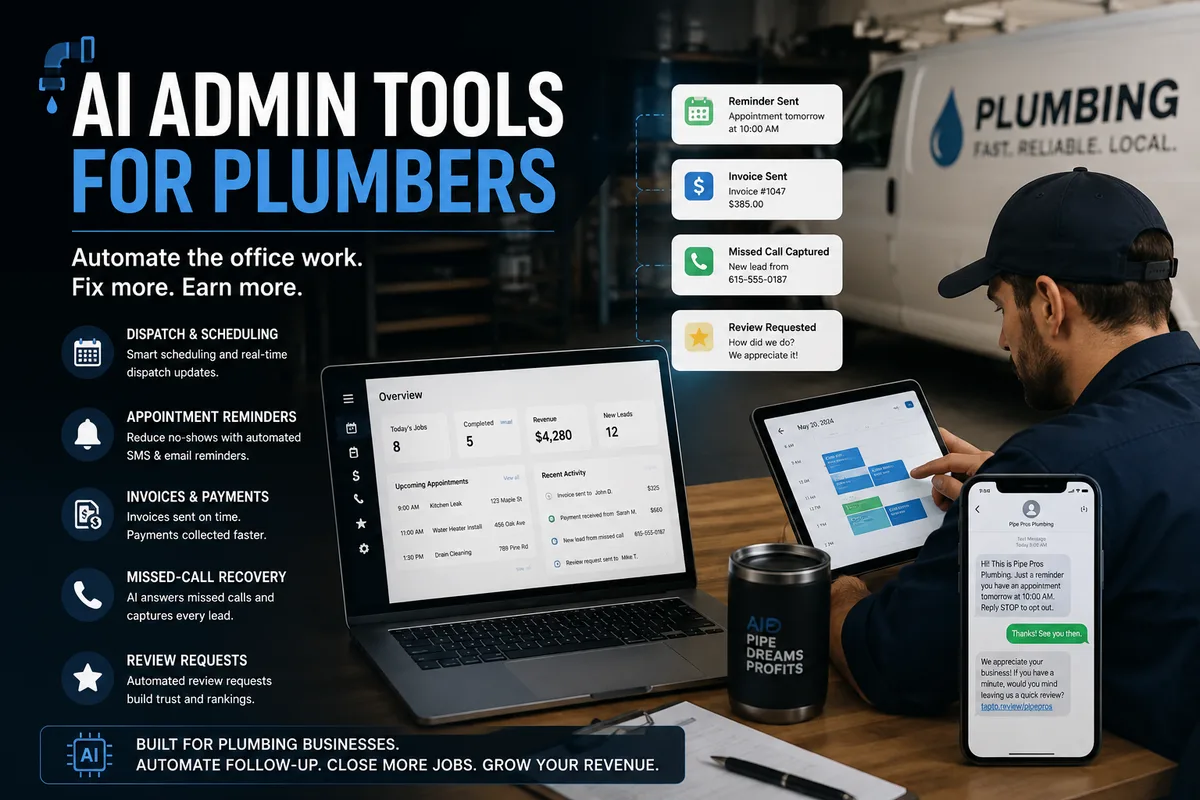
AI Admin Tools for Plumbers: What They Are and How to Choose
AI admin tools automate dispatch, reminders, invoicing follow-up, missed calls, and review requests for plumbers. What they do and how to choose.
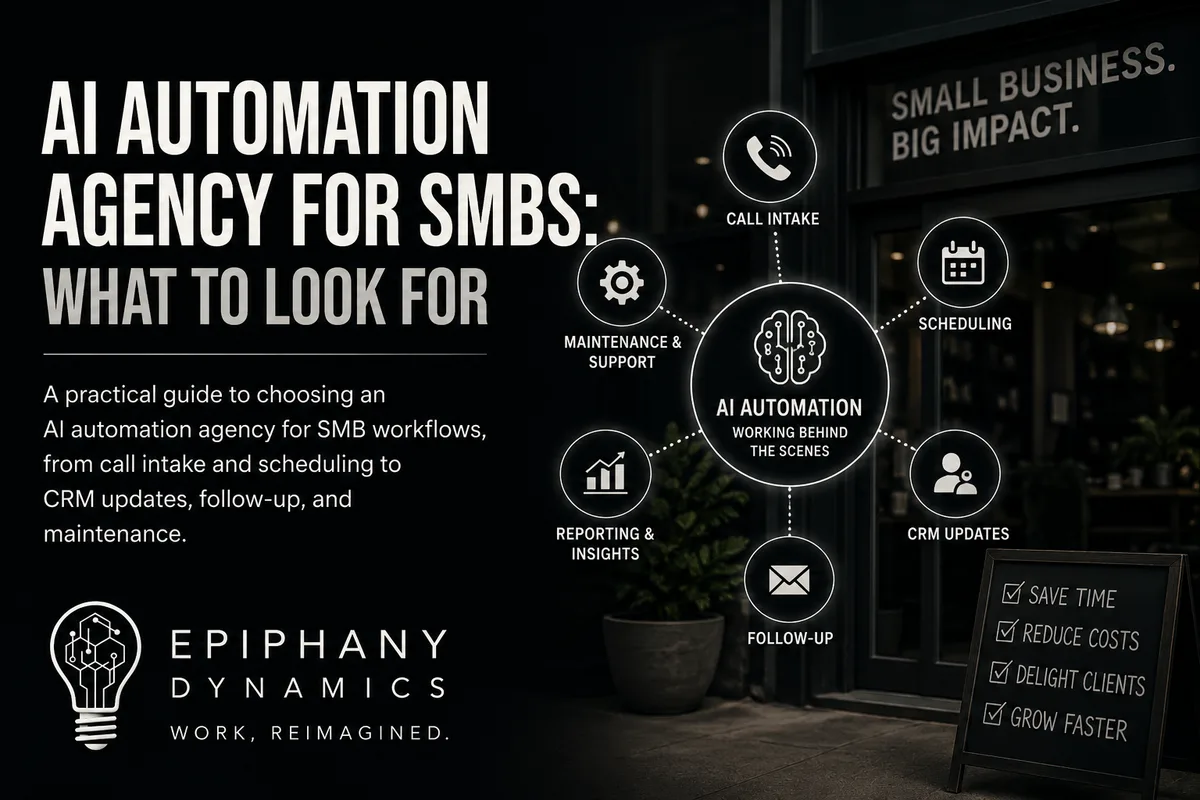
AI Automation Agency for SMBs: What to Look For
A practical guide to choosing an AI automation agency for SMB workflows, from call intake and scheduling to CRM updates, follow-up, and maintenance.
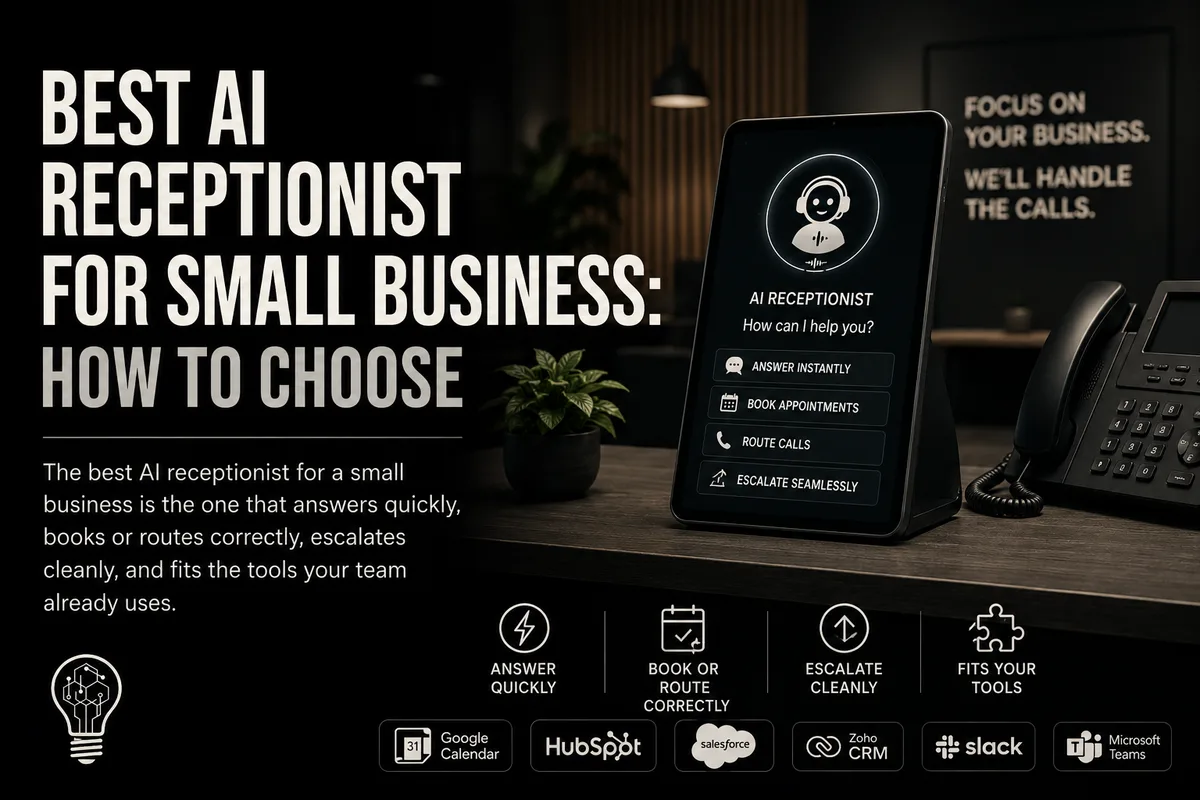
Best AI Receptionist for Small Business: How to Choose
The best AI receptionist for a small business is the one that answers quickly, books or routes correctly, escalates cleanly, and fits the tools your team.