
Industry Insights
Dental Practice Workflow Automation with AI: What Actually Works
Dental practices lose production and staff capacity to no-shows, billing errors, and recall gaps. AI workflow automation helps tighten those handoffs when it.
The free 30-minute AI Operations Audit is a conversation about a normal week in your business and where the work piles up. We find the one change that would give you the most time back and send you a plain-English plan for it. No forms and no pitch.
Book a free AI audit
Patrick Gibbs
Dental practices lose production and staff capacity to no-shows, insurance verification errors, and recall gaps. All three are systems problems that AI workflow automation is specifically designed to reduce. Automated scheduling, real-time insurance verification, and AI-driven recall campaigns can tighten the operational handoffs that drain the front desk. This post covers what actually works at each operational layer and a phased implementation framework to get there.
A general dentistry practice with multiple providers has a lot of production tied up in scheduling reliability. When patients no-show, cancel late, or fail to rebook, the damage is not just one empty slot. The front desk loses time, the schedule loses predictability, and the practice loses the downstream treatment that would have followed. That’s not only a staffing problem or a patient loyalty problem. That’s a systems problem, and one that AI-driven workflow automation is increasingly designed to solve.
But “AI for dentistry” has become a muddled term. It covers everything from diagnostic imaging software that flags interproximal decay to chatbots that answer patient questions overnight. This article focuses on the operational layer: the scheduling, communication, billing, and documentation workflows that consume the majority of your front desk’s day and drive the most measurable financial outcomes when properly automated.
Where Manual Workflows Bleed Revenue
Most dental practices track production numbers carefully but rarely audit where that production leaks. The three largest operational drains for most practices are no-shows, insurance verification errors, and patient recall gaps. Each one is addressable. None of them require a complete technology overhaul to fix.
No-shows and late cancellations are the most visible leak. The fix isn’t simply sending a reminder: it’s the timing, the channel mix, and whether your system is intelligent enough to fill a vacancy when a cancellation comes in. Manual confirmation calls rely on someone being available to make them, which front desks rarely are during peak scheduling windows. Practices that deploy AI answering services for dental solve both the reminder and the overflow problem simultaneously.
Insurance verification errors are the most expensive leak that practices rarely quantify. Front desk staff commonly spend a large chunk of every day on insurance-related tasks. Verification mistakes include submitting claims for procedures not covered under a patient’s current plan or missing prior authorization requirements. Most errors aren’t caused by negligent staff. They’re caused by staff checking eligibility too early, using stale information, or rushing through payer portals while the phone keeps ringing.
Patient recall gaps compound quietly over time. The standard recall cycle is the backbone of hygiene revenue, yet practices running manual recall systems often let lapsed patients drift until the schedule feels thin. A practice can model the value of recall automation by multiplying lapsed patients by expected rebooking rate and average hygiene value, then adding the downstream restorative and elective treatment those patients would have needed.
What AI Workflow Automation Actually Covers
In a dental context, AI automation typically means one or more of four distinct functional areas. Understanding what each actually does, versus what vendors claim it does, is the starting point for making a sound investment decision.
Intelligent scheduling and confirmation systems go beyond SMS reminders. Modern platforms like Weave, Lighthouse, and Dental Intelligence integrate with practice management software such as Dentrix, Eaglesoft, and Open Dental to automate multi-touchpoint confirmations across SMS, email, and voice. The AI layer analyzes no-show risk by patient history and prioritizes higher-risk patients for a live phone follow-up. Some systems automatically contact waitlisted patients when a slot opens, ranked by appointment compatibility and last-visit urgency.
Automated insurance verification tools like Vyne Dental and Apex EDI run eligibility checks before scheduled appointments, not just for new patients. They flag coverage changes, plan mismatches, and prior authorization requirements, then push that data directly into the patient chart before the provider walks into the operatory. Practices using these tools can reduce avoidable claim rejections when the integration and exception process are configured correctly.
Patient recall and reactivation campaigns powered by AI segment your patient database by last visit date, incomplete treatment plans, risk stratification, and trigger personalized outreach sequences accordingly. A patient with unfinished restorative work gets a different message than a routine hygiene overdue patient. Executed consistently, targeted automated campaigns help reactivate lapsed patients that manual recall often misses.
Ambient documentation and AI scribing is the newest category gaining traction in dental. Tools built on large language model architecture listen to patient-provider dialogue and generate structured clinical notes in real time, saving providers meaningful documentation time. To evaluate ROI, compare the provider time recovered against the tool cost, review burden, and compliance requirements.
A Phased Implementation Framework
Not every practice should automate everything simultaneously. Both the ROI math and the organizational capacity to absorb change favor a phased approach. Here’s a practical sequence that works for practices ranging from single-provider startups to multi-location group practices.
Phase One. Plug the No-Show Leak. Start with scheduling automation and multi-channel confirmation. Expected outcome: fewer no-shows, faster rescheduling, and better waitlist utilization, in line with what AI-powered appointment reminders deliver across service industries. Use your own appointment value, miss rate, and recovery rate to calculate the revenue case.
Phase Two. Automate Insurance Verification. Real-time eligibility and claims scrubbing should be evaluated against your claim volume, payer mix, write-off history, and staff time spent in portals. The business case comes from reducing preventable denials, catching plan mismatches earlier, and freeing staff from repetitive eligibility checks.
Phase Three. Recall and Reactivation. Automated recall platforms or managed recall services should be evaluated against your lapsed-patient pool, rebooking rate, hygiene value, and downstream treatment mix. The goal is not just one more hygiene visit. It is restoring the patient relationship before it disappears.
| Automation Area | Investment Driver | Revenue Lever | Measurement |
|---|---|---|---|
| Scheduling & Confirmations | Platform tier, messaging volume, PMS integration | Fewer no-shows and faster slot fills | No-show trend and filled cancellations |
| Insurance Verification | Claim volume, payer mix, clearinghouse integration | Fewer preventable denials and less portal work | First-pass claim rate and write-off trend |
| Patient Recall Automation | Patient count, channel mix, managed service level | More lapsed patients scheduled | Recall conversion and hygiene reappointment trend |
| Documentation AI | Provider count, specialty workflow, compliance review | Less provider documentation time | Chart completion time and note quality |
Integration Realities Nobody Talks About
The limiting factor in dental workflow automation isn’t the technology: it’s integration quality. The major practice management systems (Dentrix, Eaglesoft, Curve Dental, Open Dental) have different API architectures, and not every automation tool integrates cleanly with every PMS. Before purchasing any platform, confirm that “compatible with Dentrix” means a full bidirectional sync, not just a CSV export. Get that in writing and ask for a live demo on a demo database that mirrors your own setup.
Audit your data hygiene before you automate anything. AI systems are only as good as the data they process. A patient database with duplicate records, outdated mobile numbers, and missing insurance IDs will produce incorrect outputs regardless of how sophisticated the underlying model is. Before any automation launch, deduplicate your active patient list and verify contact information for your highest-value patient segments. This is unglamorous work, but it’s the difference between a tool that performs and one that gets blamed for failures it didn’t cause.
Designate an internal system owner. Automation doesn’t run itself during rollout. Assign one front desk team member as the system champion, responsible for reviewing flagged exceptions, monitoring trend data, and escalating anything the system can’t resolve autonomously. That recovered administrative time is what you point to when staff ask whether the system is actually helping.
Don’t automate a broken process. If your scheduling workflow is already chaotic (overbooking, poor block scheduling, inconsistent hygiene column utilization), adding automation will accelerate the chaos. Map your current workflows first, identify the specific friction points, and fix the underlying logic before automating it. Automation amplifies what’s already there, good or bad.
Measuring What Matters
Once systems are live, track a focused set of KPIs monthly. Broad production reports won’t tell you whether automation is working: you need leading indicators that surface trends before they hit the schedule.
- No-show rate: Track whether missed appointments are trending down after reminder automation.
- Same-day cancellation fill rate: What percentage of same-day openings get filled via waitlist automation?
- First-pass claim rejection rate: Track whether preventable claim issues fall after verification automation.
- Hygiene reappointment rate: Track whether completed hygiene visits are more consistently rescheduled at checkout.
- Recall conversion rate: Of patients contacted through automated recall, what percentage schedule?
- Provider documentation time: Track minutes per chart note before and after any AI scribing implementation.
Most dental analytics platforms (Dental Intelligence, Practice by Numbers, Dentrix Analytics) can surface these metrics in near real time. If you’re operating without a dedicated analytics layer, that’s the actual foundation to establish first. You cannot systematically improve what you are not measuring, and the practices achieving the strongest automation ROI are also the ones with the clearest visibility into their operational baselines. For a framework on quantifying these improvements, the AI automation cost and pricing guide covers how to benchmark returns across different workflow categories.
Read next: How to Evaluate AI Receptionists for Dental Practices: Criteria, PMS Integration, and Red Flags.
The Right Way to Think About This Investment
Dental practice workflow automation with AI is not about replacing your team. Your front desk’s human judgment (managing a distressed patient on the phone, escalating a complex billing dispute, recognizing that a long-time patient prefers morning slots and needs a longer appointment) doesn’t get automated. What gets automated is the repetitive scaffolding surrounding those moments: the reminder sequences, the eligibility checks, the recall outreach, the documentation. When that scaffolding runs itself, your team spends more time doing what only humans can do, and the financial metrics follow. Practices looking at the broader picture of reducing front desk costs with AI find that the savings compound across every touchpoint.
The practices seeing the strongest returns share one characteristic: they treat automation as infrastructure investment, not a software subscription that might be canceled if it doesn’t show instant results. They integrate deliberately, measure rigorously, and give systems time to calibrate against their actual patient behavior. Start with the highest-ROI lever for your specific situation, get that stabilized and measured, then layer in the next. That’s how you build a practice operation that runs smarter, not just faster.
For practices that want the efficiency gains without the overhead of enterprise-tier software or a full internal IT buildout, AI automation specialists who focus on healthcare operations are increasingly filling that gap, building lightweight, integrated systems calibrated to practice size, PMS, and specific workflow pain points. If you are weighing a partner build against more DIY tooling, start with what to look for in a dental AI automation agency before you shortlist vendors.
Frequently Asked Questions
Q: How much revenue does a typical dental practice lose annually to no-shows and late cancellations?
The loss depends on appointment value, no-show rate, schedule density, and whether the practice can fill late cancellations. A practical estimate multiplies missed appointments by average production value, then adds the downstream impact of unfilled hygiene, restorative, and elective treatment opportunities.
Q: What is the most expensive hidden cost in manual dental office operations?
Insurance verification errors. Front desk staff spend a large chunk of every day on insurance-related tasks, and verification mistakes can create preventable write-offs, rework, and patient frustration. Most errors happen because eligibility is checked too early or without a reliable exception process before treatment.
Q: How should a dental practice phase in AI workflow automation to minimize disruption?
Start with scheduling automation and multi-channel confirmation to address the most visible revenue leak. Add automated insurance verification once schedule data and patient contact records are clean, then layer in recall and reactivation automation. Each phase builds on clean data from the previous one, and each has measurable ROI before the next phase begins, a critical discipline for getting sustained internal buy-in.
Q: What is the most critical technical requirement before deploying any dental automation tool?
Confirming that the tool integrates bidirectionally with your practice management system (Dentrix, Eaglesoft, Curve Dental, or Open Dental) in real time, not just via CSV export. An automation tool that cannot write data directly to your PMS creates reconciliation work that offsets most of the efficiency gain. Confirm native integrations or documented API access, and insist on a live demo on a database that mirrors your own setup before signing anything.
Q: What KPIs should a dental practice track after deploying AI automation?
Track no-show rate, same-day cancellation fill rate via waitlist automation, first-pass insurance claim rejection rate, hygiene reappointment rate at checkout, and recall conversion rate from automated outreach. These leading indicators surface operational trends before they appear in monthly production reports.
Patrick Gibbs
AI Automation Expert
Patrick Gibbs helps professional practices implement AI automation that captures more leads, books more appointments, and scales without adding overhead. He's the founder of Epiphany Dynamics and creator of the AI Front Desk system.
Related Solutions
Build this into a real workflow
Related Posts
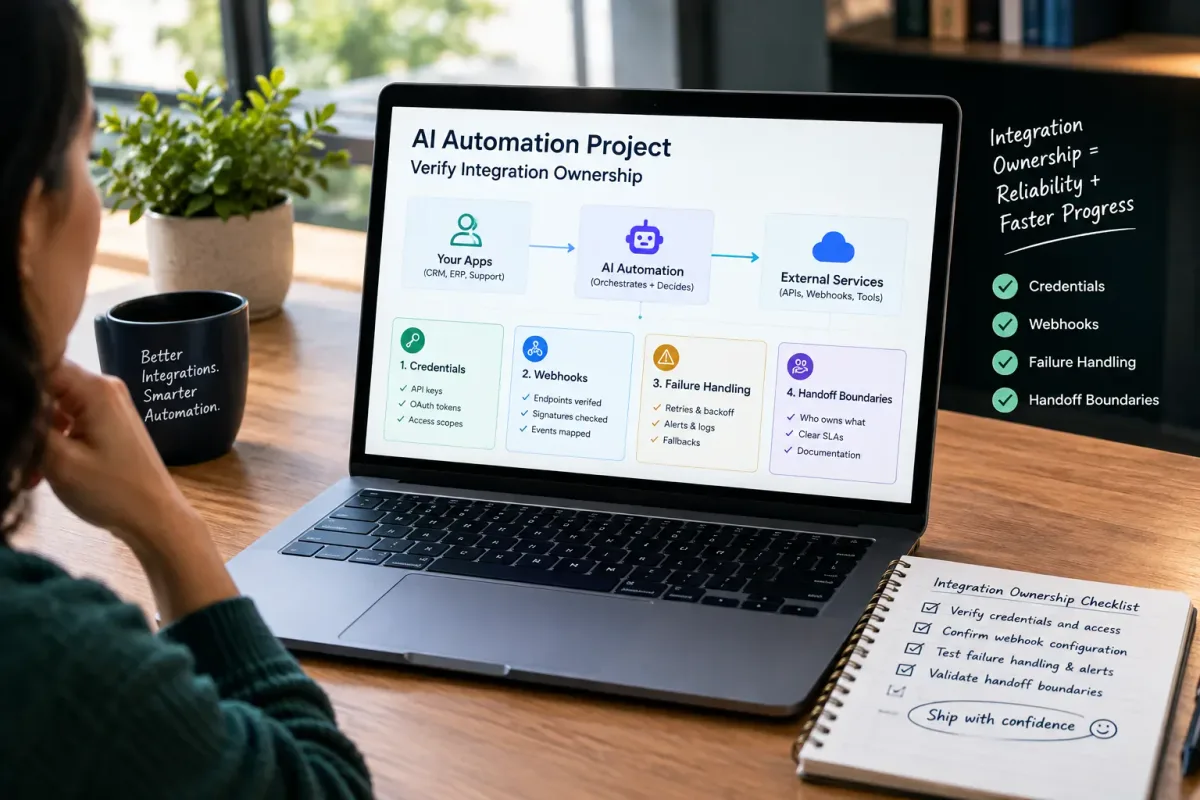
How Do I Verify Integration Ownership in an AI Automation Project?
Learn how to verify integration ownership in an AI automation project, including credentials, webhooks, failure handling, and handoff boundaries.

Is Epiphany Dynamics Legitimate for AI Automation?
Is Epiphany Dynamics legitimate for AI automation? Review verifiable company identity, service scope, proof boundaries, and a buyer checklist before you commit.
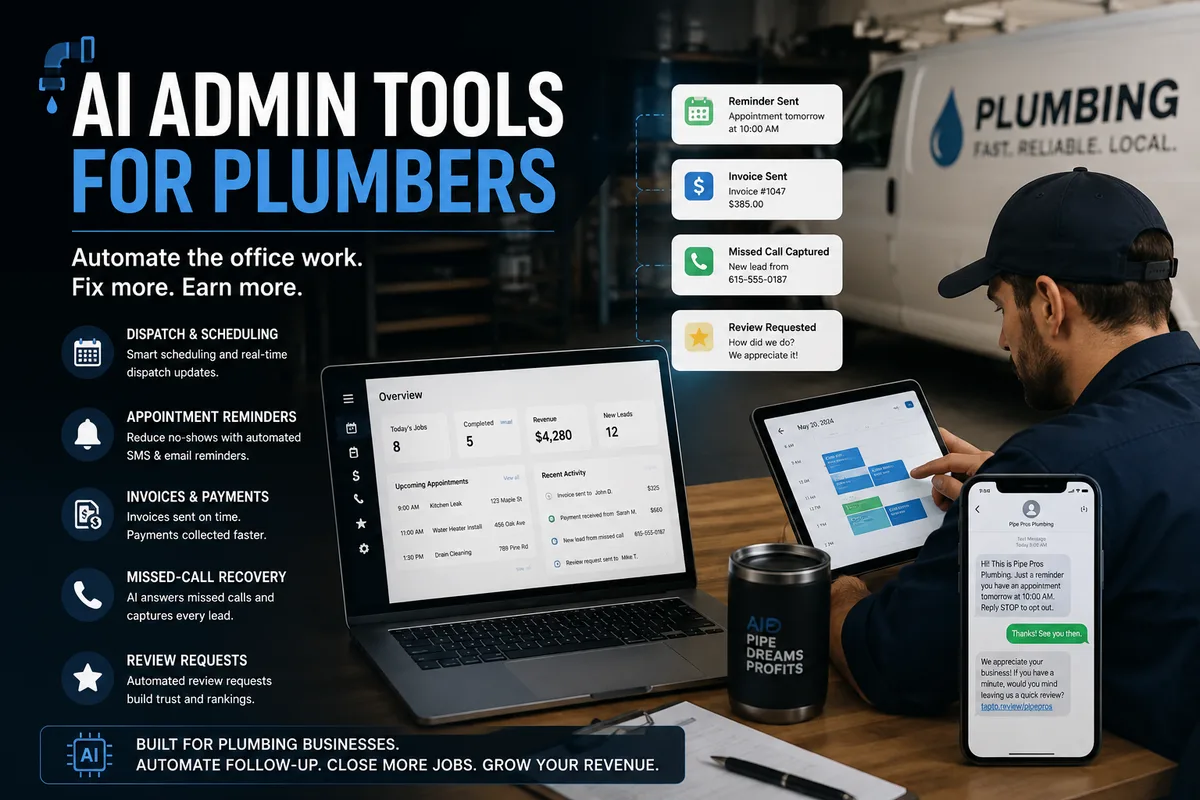
AI Admin Tools for Plumbers: What They Are and How to Choose
AI admin tools automate dispatch, reminders, invoicing follow-up, missed calls, and review requests for plumbers. What they do and how to choose.