
How to Hire an AI Consultant Without Wasting Your Budget in 2026
Hiring an AI consultant in 2026 can mean anything from tactical implementation help to a full boutique-firm engagement. The right hire ties AI work to a measurable operational problem.
AI consulting fees vary widely, and most businesses overpay when they cannot tell implementation help from slide-deck strategy.
Epiphany Dynamics is an AI automation agency: we help businesses find and fix operational bottlenecks with AI receptionists, lead follow-up, and workflow automation.
The free 30-minute AI Operations Audit is a conversation about a normal week in your business and where the work piles up. We find the one change that would give you the most time back and send you a plain-English plan for it. No forms and no pitch.
Book a free AI audit
Patrick Gibbs
Hiring an AI consultant in 2026 can mean anything from tactical implementation help to a full boutique-firm engagement. The right hire ties AI work to a measurable operational problem. The wrong one delivers a slide deck and disappears. The difference is identifiable before you sign anything.
Most businesses seeking AI consulting help are already behind. They waited for certainty before committing, and that reasonable instinct tends to backfire. The gap between companies using AI effectively and those dabbling with it is widening, and by 2026 it's showing up directly in margins and headcount.
This guide is for owners and operators facing a real hiring decision, not collecting more information. For a detailed breakdown of what different specialists charge, see our AI consultant hourly rate guide for 2026. It covers when a consultant is actually worth the cost, what the engagement should look like, and how to spot practitioners selling confidence instead of capability.
When Hiring an AI Consultant Actually Makes Sense
You need an AI consultant when your team lacks the depth to evaluate AI tools objectively, when you're facing a high-stakes build-or-buy decision, or when internal implementation attempts have already failed. Curiosity about AI doesn't justify the spend. A specific operational problem with a measurable cost does.
Not every AI problem requires a consultant. Our AI automation cost and pricing guide covers what off-the-shelf tools cost versus custom implementations. Plenty of businesses would do better with an off-the-shelf tool and hands-on testing. The clearest signal that you need outside expertise: the decision involves significant money or a core revenue process, and your internal team doesn't have the experience to evaluate options without being swayed by vendor pitches. Vendors will tell you whatever closes the deal. A good consultant won't.
Situations where consultants are clearly worth it: custom model development on proprietary data, enterprise platform evaluations where sales teams are actively managing your perception, AI integration with legacy systems that have undocumented dependencies, regulated industries where AI outputs carry compliance risk (healthcare, finance, legal), and projects that have already failed once internally. Where they're not worth it: choosing between two SaaS tools with free trials, adding AI features to a process that already works, or seeking validation for a decision you've already made.
What an AI Consultant Actually Does
An AI consultant audits your data infrastructure, maps automation opportunities to business outcomes, recommends or builds solutions, and validates that outputs meet your requirements. Expect deliverables like gap analyses, vendor evaluations, proof-of-concept builds, and implementation roadmaps. A presentation-only engagement is a strategy engagement, not an implementation one.
The role varies significantly by specialization. A machine learning engineer hired as a consultant focuses on model selection, training data quality, and evaluation metrics. A business-focused AI consultant focuses on process analysis, tool selection, and adoption. Both use the same title. Knowing which you need before you post the job description avoids weeks of misaligned work.
| Phase | Engagement Stage | Deliverable |
|---|---|---|
| Discovery | Early scope | Workflow audit, data inventory, opportunity map |
| Analysis | Recommendation stage | Vendor shortlist, build-vs-buy analysis, ROI projections |
| Implementation | Build and rollout | Deployed solution, staff training, performance baseline |
The discovery phase reveals more than technical capability. It shows whether the consultant is listening. A good one surfaces problems you didn't know you had. A mediocre one tells you what AI could theoretically do for a business like yours, which is generic and useless. Watch for this distinction early, because it predicts the rest of the engagement. One thing consistently underestimated: any consultant who doesn't account for change management in their scope is setting you up to fail on your own timeline. AI tools don't fail because the technology is wrong. They fail because staff doesn't trust them or quietly routes around them.
Related reading: How to Automate Your Gym or Fitness Studio: Grow Without the Grind (2026).
How to Evaluate Candidates Before You Hire
Ask every candidate for documented past implementations with measurable outcomes, not testimonials. Request a sample deliverable from a past engagement. Ask how they handled a project that went wrong. Consultants who can't answer those questions with specifics are selling confidence, not a track record.
The evaluation should feel like an audit. You're determining whether this person understands your industry's specific constraints, not AI in the abstract. A consultant with deep healthcare experience and limited e-commerce exposure might not be right for your DTC brand, regardless of how credentialed their portfolio looks from a distance.
Questions that actually reveal capability:
- "Walk me through a project where your initial recommendation turned out to be wrong." (Anyone claiming this has never happened isn't being straight with you.)
- "Do you have referral agreements or financial relationships with any tools you typically recommend?" (Conflicts of interest exist. You need to know about them upfront.)
- "How do you handle data that's incomplete or inconsistent?" (Most real-world data is a mess. This separates people who've done real implementations from those who've only done demos.)
- "How do you define success before the engagement starts?" (Good consultants set KPIs at kickoff, not after deployment, when the framing is far easier to manipulate.)
What It Costs and What ROI Looks Like
Independent AI consultants and boutique firms price work differently, so compare scope before comparing rates. Before signing, calculate what the target process currently costs in loaded labor, error handling, delay, and management attention. Then compare the proposed engagement against the specific value it is supposed to unlock.
| Variable | What to Use |
|---|---|
| Time spent on target process | Your team's actual baseline workload |
| Loaded labor cost | Payroll, benefits, taxes, and overhead |
| Status quo cost | Current operating cost before automation |
| Expected automation scope | The share of work the project can realistically remove or reroute |
| Annual value from automation | Recovered labor, reduced error cost, faster throughput, or new capacity |
| Consulting engagement cost | Quoted build, advisory, and maintenance cost |
| Break-even point | Engagement cost divided by expected monthly value |
That structure is useful for a process like prior authorization follow-ups, where automation can move repetitive status checks and documentation work out of staff queues. The numbers will not always work cleanly, but running the calculation before you commit is how you find out whether the economics are even in the ballpark.
On pricing signals: unusually low rates for specialized AI work often mean junior delivery or a productized package that may not fit your situation. Premium rates for average-complexity projects need to be justified by very specific past implementations, not name recognition. Hourly rate is a rough signal in both directions, not a guarantee of quality.
Red Flags Worth Walking Away From
Walk away from any AI consultant who guarantees specific ROI percentages before understanding your data, who pushes a single vendor solution without evaluating alternatives, or who can't explain their methodology in plain language. These patterns indicate the consultant is running a standard playbook, not solving your actual problem.
ROI guarantees are the clearest warning sign. No consultant can guarantee business outcomes before auditing your data, understanding your workflows, and scoping the actual implementation. A guaranteed cost-reduction claim in a first call is selling confidence. The honest answer to "what ROI can I expect?" is: "Let's define the KPIs first, then I'll tell you what's realistic based on your actual situation." Anyone who skips that step isn't accounting for the specifics of your operation.
Tool lock-in pressure is worth watching closely. Some consultants are referral partners for specific platforms. That's not automatically disqualifying, but if they recommend the same solution for every client or get defensive when you ask about alternatives, they're optimizing for their commission. The best practitioners sometimes recommend tools they don't personally implement, because it's the right answer for the situation. That kind of recommendation is a signal someone is actually trying to solve your problem rather than close a upsell.
Finally, any consultant who can't explain what they're building in terms a non-technical stakeholder can evaluate is hiding behind jargon. "We're building a model that predicts which leads are most likely to convert, so your sales team calls them first" is something you can make a real decision about. "We're deploying a gradient-boosted ensemble classifier on your CRM data" is not, even if it describes the exact same project. Clarity here is not a nicety. It's how you maintain oversight of a significant project.
The AI consulting market has enough experienced practitioners that you don't need to accept vague agreements or consultants who treat your project as a template from a previous engagement. Boutique firms focused specifically on implementation, like Epiphany Dynamics, have built practices around making AI work in real businesses rather than producing strategy documents that collect dust. Whatever direction you go, do the homework before you sign. The talent is out there. What separates good outcomes from bad ones is how carefully you look before you commit. Our guide on how to test AI automation before scaling provides the structured framework for evaluating any tool or partner.
See the AI consultant hourly rate guide for 2026 for rate ranges by specialization. Check the AI automation cost and pricing guide for tool costs across every category. For platform comparisons, see the best AI tools for service companies.Frequently Asked Questions
Q: What's the difference between hiring an independent AI consultant versus a boutique firm?
Independent consultants offer flexibility for proof-of-concept work or specific problem-solving; boutique firms provide end-to-end implementation, continuity, and accountability for results. Choose independent help for tactical guidance and a firm for transforming core processes or integrating with legacy systems where failure is costly.
Q: How much will an AI consultant realistically save us, and when should we see results?
Properly scoped implementations should tie savings to specific operational levers: reduced manual work, fewer errors, faster throughput, or better lead capture. If a consultant can't articulate the specific cost or capacity change before signing, they're not ready to start.
Q: What are the biggest red flags that an AI consultant is all talk and no execution?
Red flags include leading with how impressive AI is rather than solving your problem, vague timelines, no measurable success metrics, and strategy decks with minimal implementation. The right consultant articulates measurable outcomes and realistic timelines before the contract is signed.
Q: Should we try implementing AI internally first, or hire a consultant from the start?
Experiment internally with off-the-shelf tools if your team has capacity and you're evaluating low-risk opportunities: this clarifies requirements before you spend on outside help. Hire immediately if evaluating expensive enterprise solutions, integrating with undocumented legacy systems, or building custom models on proprietary data.
Patrick Gibbs
AI Automation Expert
Patrick Gibbs helps professional practices implement AI automation that captures more leads, books more appointments, and scales without adding overhead. He's the founder of Epiphany Dynamics and creator of the AI Front Desk system.
Related Solutions
Build this into a real workflow
Related Posts
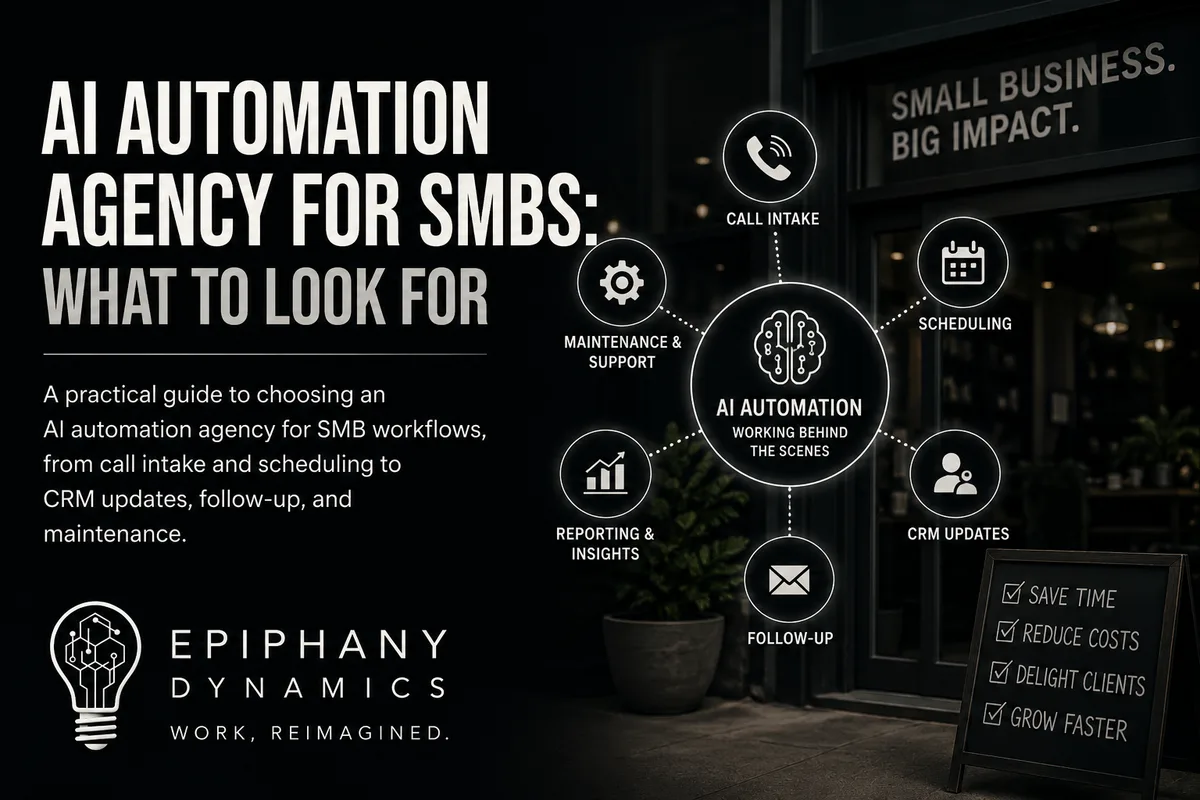
AI Automation Agency for SMBs: What to Look For
A practical guide to choosing an AI automation agency for SMB workflows, from call intake and scheduling to CRM updates, follow-up, and maintenance.
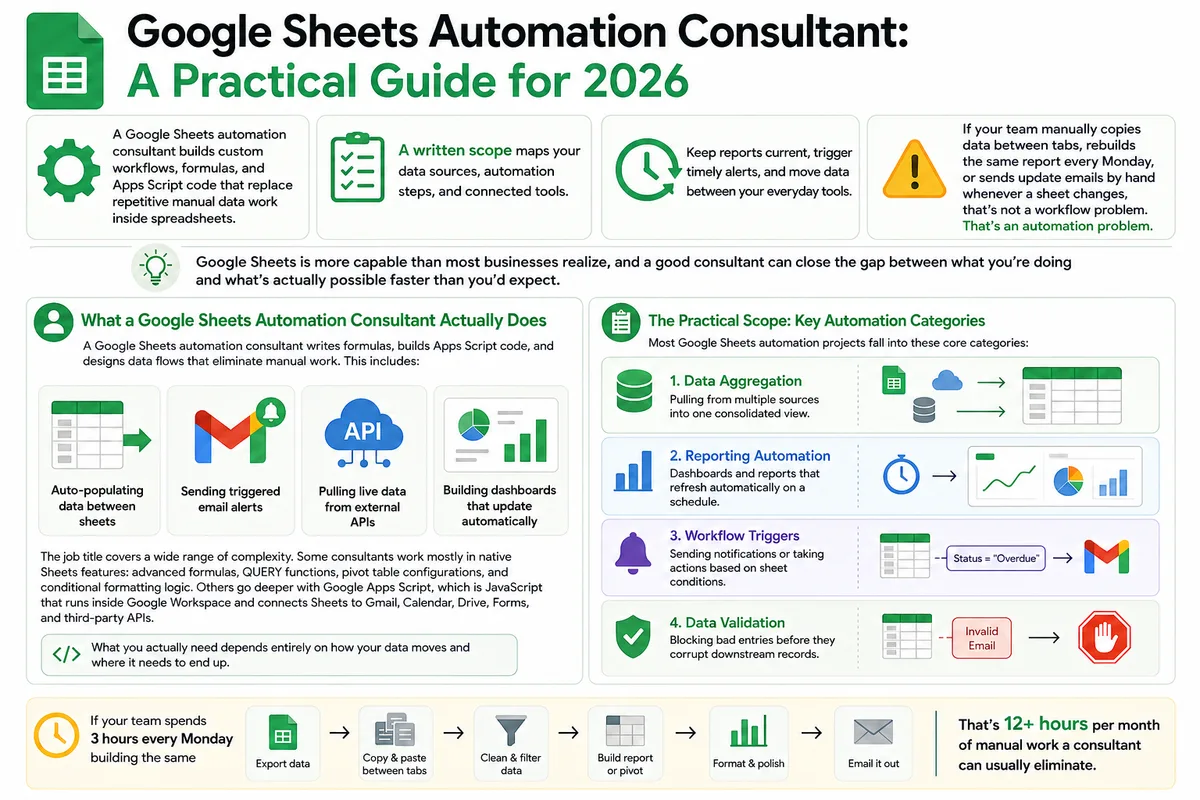
Google Sheets Automation Consultant: A Practical Guide for 2026
Most businesses don't track what spreadsheet work actually costs them. Here's what a Google Sheets automation consultant does in 2026, how to judge the value.
Business Process Automation Consultant for Small Business
Hiring the wrong automation consultant wastes thousands. Here's what small business owners need to know about process, cost, ROI, and how to vet the right one.