
Is an AI Receptionist Worth It? The Real ROI in 2026
For service businesses with meaningful inbound call volume, an AI receptionist can earn back its cost when it recovers calls that would otherwise hit voicemail. The ROI math depends on how many calls you're currently missing, what each missed call costs you, and how much judgment your callers need from a human.
An AI receptionist can be worth it when missed calls, after-hours demand, and routine call volume outweigh the subscription and setup risk.
Epiphany Dynamics is an AI automation agency: we help businesses find and fix operational bottlenecks with AI receptionists, lead follow-up, and workflow automation.
The free 30-minute AI Operations Audit is a conversation about a normal week in your business and where the work piles up. We find the one change that would give you the most time back and send you a plain-English plan for it. No forms and no pitch.
Book a free AI audit
Patrick Gibbs
For service businesses with meaningful inbound call volume, an AI receptionist can earn back its cost when it recovers calls that would otherwise hit voicemail. The ROI math depends on how many calls you're currently missing, what each missed call costs you, and how much judgment your callers need from a human.
The question isn't really whether the technology is impressive. It's whether the math works for your specific situation. And that answer varies more than most vendors will tell you.
This article breaks down the practical economics: what AI receptionists cost, what they do well, where they fail, and how to calculate the ROI for your own business rather than relying on someone else's cherry-picked implementation example.
What an AI Receptionist Actually Does (and Doesn't Do)
An AI receptionist answers inbound calls 24/7, books appointments, handles FAQ responses, qualifies leads, and routes urgent calls to a human. It can handle a large share of routine small business call volume without human involvement. What it cannot do: exercise real judgment in emotionally charged situations, negotiate terms, or handle requests that require contextual reasoning your specific industry demands.
The core function is call answering and intake. A caller phones your business, the AI picks up within 2 rings, converses naturally using voice AI, and either resolves the call or transfers to a live person. For routine scenarios like booking an appointment, confirming a time slot, or getting hours and pricing, most callers never realize they've spoken with a machine. For a detailed breakdown of what these platforms offer at different price tiers, the AI front desk cost and capabilities guide covers the main options clearly.
Modern platforms integrate with scheduling software to book in real time, send SMS follow-ups automatically, and qualify leads based on criteria you set (service area, job type, budget). What gets oversold is emotional intelligence. AI can follow a script reliably, but it cannot improvise meaningfully when a caller says something unexpected. Industries where calls frequently involve distressed or urgent callers need to think carefully about where the handoff to a human happens and make that transition fast and smooth.
The Real Cost of a Human Receptionist in 2026
A full-time receptionist costs more than base salary. Add payroll taxes, benefits, PTO, training, management time, and turnover risk, and the fully loaded cost becomes a staffing model rather than a simple wage line. That cost still leaves phones unanswered on evenings, weekends, sick days, and peak-volume moments.
| Cost Category | Human Receptionist Cost Driver | AI Receptionist Cost Driver |
|---|---|---|
| Base salary / subscription | Market wage or salary | Subscription tier and usage |
| Payroll taxes | Employer tax load | Not a payroll expense |
| Health insurance | Employer contribution | Not applicable |
| PTO | Paid leave coverage | Not applicable |
| Training and onboarding | Hiring, ramp, and coaching | Configuration and launch support |
| Turnover cost (annualized) | Recruiting, vacancy, and retraining | Vendor-switching and tuning risk |
| Total annual cost | Salary plus loaded employment costs | Subscription plus setup and usage |
The salary alone isn't the whole picture. Turnover in admin roles can create recruiting, onboarding, vacancy, and lost-productivity costs that never show up neatly on a payroll report. If you've replaced a front desk person recently, you already know how much that disruption costs operationally. The detailed cost-driver comparison across HVAC, dental, plumbing, and legal is in the AI vs. human receptionist ROI comparison.
Coverage gaps matter as much as the cost difference. A human receptionist covers a standard schedule, while your phones may ring before opening, after closing, on weekends, and during peak windows when the front desk is already occupied. If you're not capturing those calls, you're handing revenue to competitors regardless of how capable your daytime staff is.
See AI Receptionist for Roofing Companies: Real Costs and ROI in 2026 for more in this area.
Where Businesses Actually See ROI
After-hours call capture can account for a large share of total missed revenue for service businesses. No-show reduction through automated reminders can protect booked revenue. Staff time recovery adds labor capacity that can be redeployed to higher-value work. Compare those three levers against the subscription, setup effort, and operational risk before deciding whether the system is worth it.
After-hours capture is where the biggest numbers often come from. Use your own call logs to estimate how many after-hours inquiries currently go to voicemail, then multiply by your booking rate and average ticket value. More detail on the staff time recovery piece is in how businesses are cutting phone staff costs with AI.
No-show reduction compounds over time and is often underestimated. Small wellness and medical clinics can model the upside by comparing their current no-show rate against a lower post-reminder assumption. Even a modest reduction can protect revenue the clinic already earned but was losing between booking and appointment. The AI didn't add patients. It stopped losing ones already on the calendar.
The Honest Limitations
AI receptionists struggle with complex multi-step requests, emotionally upset callers, and anything requiring off-script judgment. Expect some calls to still need a human. Businesses that deploy AI expecting to fully eliminate their front desk end up with customer experience problems. The right model is AI handling volume, humans handling exceptions and relationship-critical conversations.
The failure modes are predictable once you know them. Callers who don't follow expected conversational paths cause the most friction. Someone calling about pricing who pivots mid-call to negotiating a package deal, or a patient trying to describe a complex symptom to get triaged correctly, these scenarios push AI past its limits. Callers don't get what they need and hang up frustrated. Designing the escalation trigger well matters more than which AI platform you choose.
Accent and speech recognition is better than it was a few years ago, but it's not perfect. Callers with heavy accents, elderly callers who speak slowly, or anyone on a weak cell connection will experience more friction than they would with a human. Vendors rarely raise this because it's hard to quantify before you see your own call data. A short pilot with full call recordings is the only reliable way to know how your specific caller base handles the technology before committing to a longer contract.
How to Calculate Whether It's Worth It for Your Business
The calculation needs four inputs: monthly call volume, your current missed call rate, average revenue per booking, and your booking rate from answered calls. Multiply missed calls per month x booking rate x average revenue. Then compare that modeled leak against your AI subscription cost and implementation risk.
Here's how to run the numbers with your own inputs:
- Monthly missed calls: pull this from your call logs
- Booking rate from answered calls: use your CRM or scheduling history
- Average revenue per job: use your own invoices
- Recoverable monthly revenue: missed calls x booking rate x average revenue x realistic recovery share
Compare that modeled recovery against the quote, usage tier, setup fee, and management time for the AI receptionist. Do not assume perfect capture; apply a conservative recovery assumption before making a buying decision. The actual revenue cost of unanswered calls, broken down by industry, is documented in the analysis of what unanswered calls cost businesses monthly.
The businesses where AI receptionists don't pencil out are those with very low call volume, very low average job values, or industries where nearly every call requires complex human judgment from the first minute. One factor worth adding to your calculation: scalability during peak periods. A human receptionist has a practical ceiling on concurrent calls. AI handles concurrent calls without adding another seat. How HVAC companies handle busy-season call surges without hiring shows what that looks like when volume suddenly doubles and a human team simply can't keep up.
The honest takeaway is this: AI receptionists are worth evaluating for service businesses with meaningful call volume and any real after-hours leak. The technology isn't perfect, and it won't replace every interaction your front desk handles. But when a subscription can reopen calls that previously went to voicemail, the math is worth running honestly. If you want help sizing that ROI for your specific numbers before committing to anything, Epiphany Dynamics works with service businesses across verticals to run that calculation honestly.
Frequently Asked Questions
Q: How much does an AI receptionist cost per month?
AI receptionist pricing depends on call volume, minutes used, integrations, support level, and whether setup is included. Compare the vendor quote against the fully loaded cost and coverage limits of a part-time human receptionist, not just against base wages.
Q: How many calls can a single AI receptionist handle daily?
Most platforms can manage concurrent calls depending on complexity and resolution speed, with small service businesses often running a single AI line before adding more capacity. Scaling beyond that usually involves activating another AI line rather than replacing the first.
Q: Will customers realize they're talking to an AI receptionist?
For routine interactions like booking appointments, confirming hours, or retrieving pricing, most callers don't detect it, as modern voice synthesis and conversational AI are nearly indistinguishable from human speech. Most platforms disclose the AI upon transfer to a live agent or upfront in the greeting, which typically builds trust better than undisclosed automation.
Q: Does an AI receptionist integrate with the calendar software we already use?
Most major platforms directly integrate with common calendar, CRM, and scheduling tools in real time, auto-syncing availability and confirming bookings in your existing schedule. If your software has an API or Zapier connection available, an AI receptionist can usually integrate, but custom systems need a deeper technical review.
Patrick Gibbs
AI Automation Expert
Patrick Gibbs helps professional practices implement AI automation that captures more leads, books more appointments, and scales without adding overhead. He's the founder of Epiphany Dynamics and creator of the AI Front Desk system.
Related Solutions
Build this into a real workflow
Related Posts
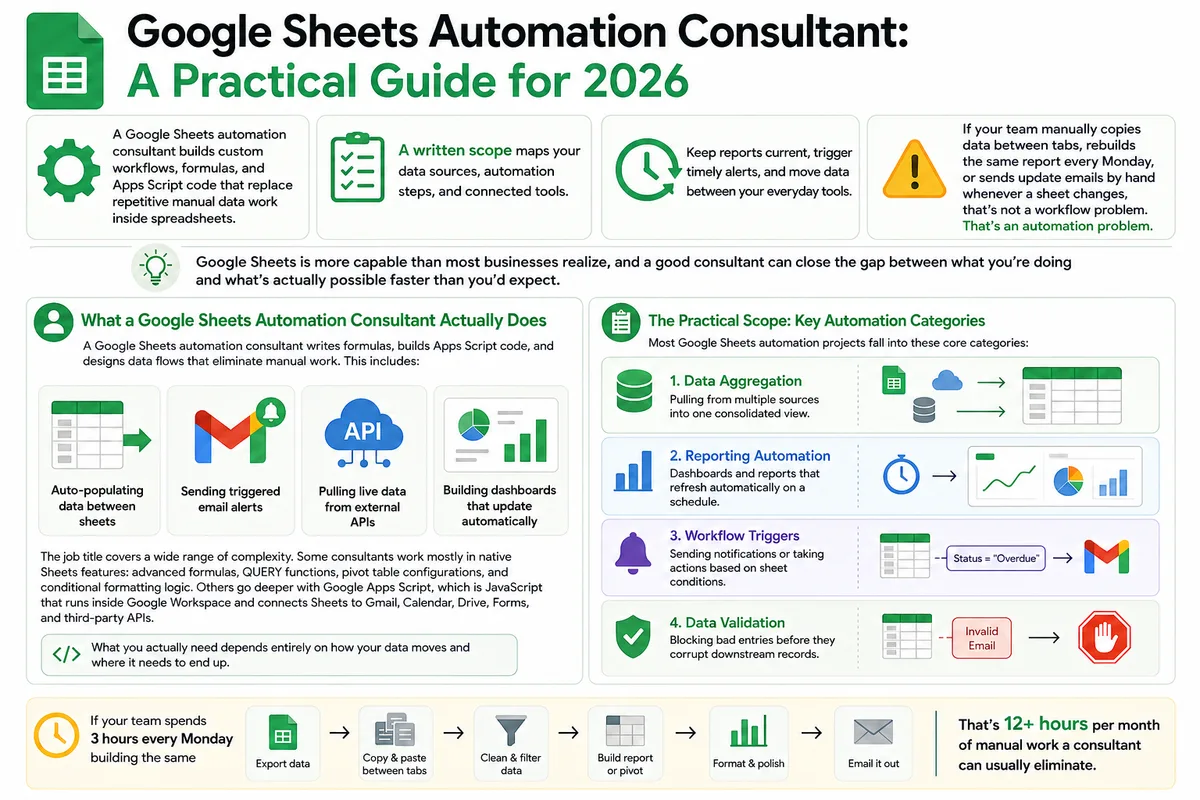
Google Sheets Automation Consultant: A Practical Guide for 2026
Most businesses don't track what spreadsheet work actually costs them. Here's what a Google Sheets automation consultant does in 2026, how to judge the value.
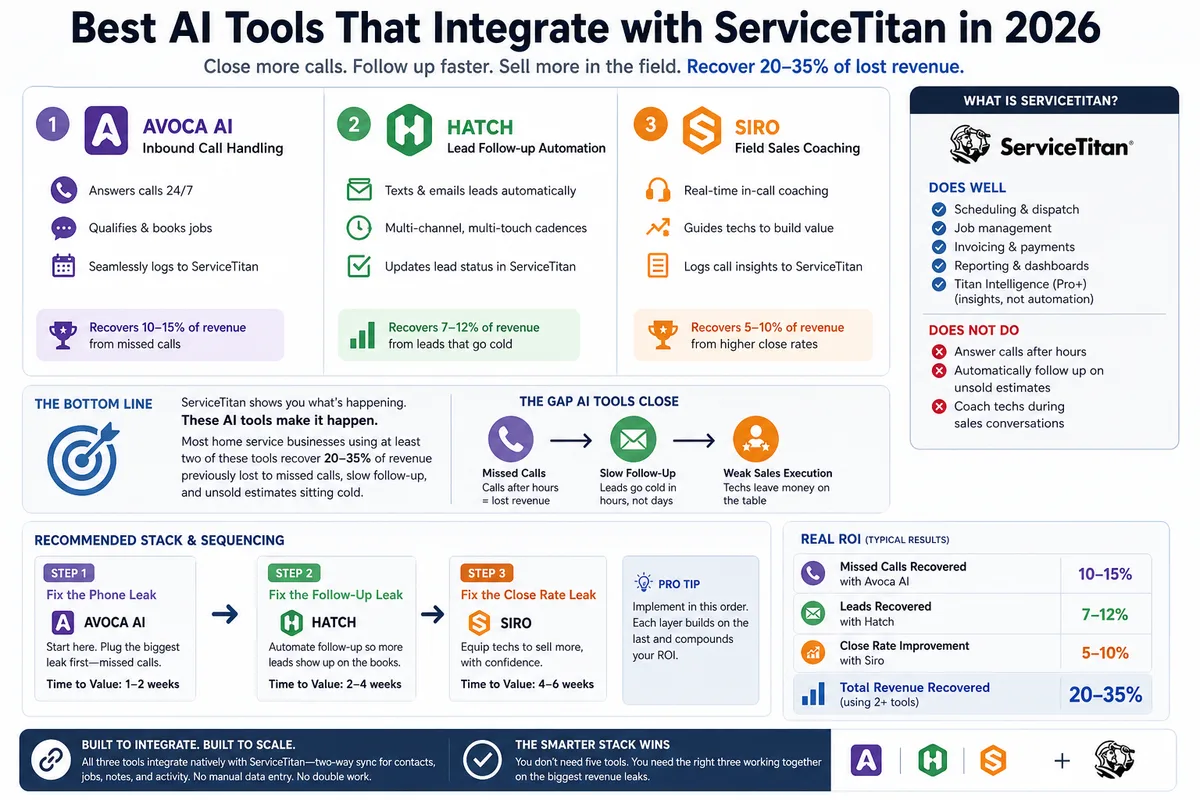
Best AI Tools That Integrate with ServiceTitan in 2026
Most ServiceTitan shops miss a meaningful share of inbound calls and leave most estimates unsold. These AI tools close those gaps inside ServiceTitan.
n8n Workflow Automation Agency: What They Build, What It Costs (2026)
Zapier pricing drove you to n8n. Now you're wondering if hiring an agency to build it makes sense. Here's what they build, what projects cost, and how to.