
Unanswered Business Calls: Calculating the True Revenue Cost
Most callers who can’t reach a business on the first attempt won’t call back: they find a competitor within minutes, making unanswered calls the highest-cost revenue leak in most service businesses. Inbound phone leads convert to paying customers at many times the rate of web form submissions, which means every missed call is a lost conversion at your most valuable channel.
Most callers who can't reach a business won't call back. If you haven't calculated what that means in dollars for your operation, this breakdown will change.
Epiphany Dynamics is an AI automation agency: we help businesses find and fix operational bottlenecks with AI receptionists, lead follow-up, and workflow automation.
The free 30-minute AI Operations Audit is a conversation about a normal week in your business and where the work piles up. We find the one change that would give you the most time back and send you a plain-English plan for it. No forms and no pitch.
Book a free AI audit
Patrick Gibbs
Most callers who can’t reach a business on the first attempt won’t call back: they find a competitor within minutes, making unanswered calls the highest-cost revenue leak in most service businesses. Inbound phone leads convert to paying customers at many times the rate of web form submissions, which means every missed call is a lost conversion at your most valuable channel. This breakdown quantifies what that pattern costs by industry, why the damage compounds far beyond a single transaction, and what it actually takes to close the answering gap.
The Call That Never Gets Answered
A potential customer picks up their phone, dials your number, and waits. It rings, rolls to voicemail, and they hang up without leaving a message. They Google the next result. Soon, they’ve booked with your competitor. HVAC contractors experience this acutely, with a large share of calls arriving after-hours. That sequence plays out constantly across small and mid-size businesses, and most owners have no precise idea how much revenue that silent pattern is costing them each month.
Phone calls remain the single highest-converting inbound channel for most service businesses. Industry research consistently finds that inbound phone leads convert to paying customers at many times the rate of web form submissions. That gap exists because a caller has already made a decision: they’re not browsing, they’re buying. Every unanswered call is a conversion event at your most valuable channel that simply never happened.
The Callback Problem: Most Lost Callers Do Not Wait Around
The most actionable rule of thumb in this space is behavioral: a large share of callers who cannot reach a business on the first attempt will not wait around. They may not retry. They may not leave a voicemail and wait patiently. They search for the next available provider and move on. For businesses in competitive local markets (HVAC, dental, legal services, aesthetics, restaurants) that caller may be booked with someone else by the time your voicemail notification appears.
The callers who do call back often skew toward existing customers and non-urgent inquiries. That’s not always the pool driving growth. New customer acquisition, the engine of many service businesses, depends disproportionately on first-touch call handling. Miss that moment and you’re not just losing a single transaction; you’re losing the potential relationship that would have followed.
Consumer research on calling experiences consistently finds that people who run into a difficult calling experience are likely to call a competitor. “Difficult” includes going to voicemail, being placed on hold too long, or reaching a confusing automated menu. The bar for retaining a live caller is not high, but it does require someone, or something, to actually pick up.
Industry-Specific Revenue Leakage: The Numbers by Vertical
The revenue impact of missed calls is heavily shaped by average transaction value and the nature of the buying decision. A dental practice losing a new patient inquiry doesn’t just lose one cleaning: it loses the relationship value that would have followed. An HVAC company missing a summer emergency call could be turning away a high-value replacement opportunity. Context matters enormously when calculating actual exposure.
The table below maps the inputs you need by vertical. Use your own transaction values, conversion rates, and missed-call volume rather than borrowing a generic benchmark:
| Industry | Transaction Value Driver | Conversion Driver | Missed-Call Driver | Revenue at Risk Model |
|---|---|---|---|---|
| HVAC / Plumbing | Emergency job value, replacement value, and repeat service value | Urgency and availability | After-hours and peak-season surges | Missed qualified calls x booking rate x average job value |
| Dental Practice | New patient value, hygiene value, and downstream treatment | Schedule availability and intake quality | Front-desk overflow and after-hours inquiries | Missed new-patient calls x booking rate x average patient value |
| Med Spa / Aesthetics | Consultation value, treatment value, and repeat visits | Speed, consult availability, and financing questions | Lunch, evening, and campaign spikes | Missed consult calls x booking rate x average treatment value |
| Legal Services | Case value and practice area | Urgency, fit, and intake quality | After-hours and court-day coverage gaps | Missed qualified calls x retained-client rate x average case value |
| Real Estate Agency | Commission value and lead source quality | Response speed and market timing | Showings, weekends, and open-house overflow | Missed qualified calls x appointment rate x expected commission value |
| Restaurant / Food Service | Reservation value, party size, catering, and events | Availability and speed | Lunch rush, dinner rush, and weekend spikes | Missed booking calls x booking rate x average party value |
What the table illustrates is that the problem isn’t confined to high-ticket industries. Even lower-ticket businesses can see meaningful loss when unanswered calls repeat consistently and callers have easy alternatives.
The Voicemail Illusion: Why It Doesn’t Save You
Many business owners treat voicemail as a safety net. The data says otherwise. Research on caller behavior consistently finds that most callers who reach voicemail will hang up without leaving a message, and younger callers are even less likely to leave one. The reason is behavioral: voicemail signals unavailability, creates uncertainty about callback timing, and demands effort that callers simply refuse to invest when alternatives are one Google search away.
Even among the minority who do leave a message, callback speed expectations have tightened significantly. Consumer surveys consistently find that the overwhelming majority of consumers expect a response within a day, and in service industries with urgent needs, that window compresses to a couple of hours before the caller proceeds elsewhere. Most businesses can’t consistently hit that window during peak operational hours when staff are most occupied with existing customers.
There’s also a signal quality problem with voicemail. The callers who leave messages skew toward existing customers with non-urgent needs. The highest-intent new prospects, the ones actively comparing options and ready to book today, are precisely the callers most likely to hang up and move on. Your voicemail inbox can appear populated while your most valuable leads quietly disappear into a competitor’s schedule.
When Calls Go Unanswered: The Hidden Pattern
Missed calls don’t distribute randomly. They cluster in predictable windows that most businesses can map but haven’t fully addressed. The three primary miss-event periods are:
- Lunch coverage gaps: Staff turnover at front desks, reduced coverage, and a spike in consumer availability create a high-volume, low-answer-rate collision window for many businesses.
- After-hours demand: Consumer call activity often continues after closing, precisely when most businesses are closed and lines go to voicemail or ring out entirely.
- Hold abandonment: Calls that are technically answered but placed on hold can still become lost revenue when the caller gives up. These calls register as “answered” in your logs but are functionally lost.
Lean-staffed businesses face a compounding version of this problem. A solo plumber, a small law office with one receptionist, a med spa with two front-desk staff managing patient intake simultaneously: these operations are structurally unable to answer every call during busy periods. The miss events aren’t accidents; they’re baked into the staffing model. Without a systematic fix, they repeat every single business day.
Additional reading: How to Answer Calls for Home Service: The Complete Playbook for Converting Callers Into Customers.
Calculating Your Own Revenue Exposure
Before evaluating solutions, it’s worth quantifying the actual problem. The following formula provides a reasonable first-pass estimate of annual revenue at risk from missed calls:
Annual Revenue at Risk = missed qualified calls x no-callback assumption x conversion rate x average transaction value, annualized
Use your own inputs:
- Monthly call volume from your phone system or call tracker.
- Miss rate from call logs.
- No-callback assumption based on your callback history.
- Conversion rate for live-answered calls.
- Average transaction value from your CRM or accounting system.
That figure is the opportunity cost of a call-handling problem, and it doesn’t include the compound value of repeat customers or referrals that never materialized. For any business weighing whether to invest in a phone coverage solution, this calculation answers the question quickly and clearly.
The inputs are available to any business. Call tracking platforms like CallRail or Aircall, Google Business Profile call data, or even a manual review of phone records can establish a baseline miss rate. Most businesses that run this calculation for the first time aren’t shocked by a dramatically high miss rate: they’re shocked by how repeated misses compound over time. Use our cost of missed calls calculator to find your exact exposure.
Speed-to-Lead: The Window That Closes Faster Than You Think
Even for businesses that call leads back rather than catching them live, timing is a critical variable. Research on the 5-minute rule for speed-to-lead reinforces this. The widely cited Harvard Business Review study “The Short Life of Online Sales Leads” found that companies contacting web leads within one hour were nearly seven times more likely to qualify the lead than those that waited even an hour longer, and more than sixty times more likely than those waiting a day or more. For phone leads, which are already higher intent than web submissions, that curve is steeper.
When a caller can’t reach you and you return the call an hour later, you’re competing against the appointment they may have already booked with a competitor. The window between a missed call and competitive loss is measured in minutes, not hours, in most service markets. This reality makes passive solutions (voicemail, callback queues, end-of-day follow-ups) structurally inadequate in high-competition environments where multiple providers are equally accessible.
AI Voice Technology: What’s Changed in the Last Two Years
The historically available solutions to missed call problems (after-hours answering services, live receptionist outsourcing, IVR systems) each solved part of the problem while introducing new friction. Answering services add per-minute costs and human latency. IVR trees frustrate callers with rigid menus. Live receptionists scale poorly during call surges. For most small businesses, comprehensive call coverage was either too expensive, too clunky, or both.
AI voice technology has materially shifted that calculus. Modern AI voice systems, built on large language models with real-time speech synthesis, move well beyond scripted response trees into natural, context-aware dialogue. A well-configured AI voice agent can:
- Answer continuously with no hold time
- Qualify inbound leads by asking relevant questions and capturing intent before any human involvement
- Book appointments directly into scheduling systems (Google Calendar, Calendly, Jane App, Mindbody, etc.)
- Route urgent calls to on-call staff via SMS alert or live call transfer
- Handle high-frequency FAQ inquiries (hours, pricing, location, services) without consuming staff time
- Log call data and transcripts automatically to CRM systems
The ROI math is straightforward. Compare the revenue recovered from previously lost calls against the full cost of the system, including subscription, usage, setup, monitoring, and escalation handling. Unlike staffing solutions, AI systems don’t scale linearly with call volume; a surge in inbound calls doesn’t require a proportional scramble to add headcount.
Quality varies significantly across providers. Meaningful differentiators include conversational latency (the delay mid-dialogue), handling of off-script inquiries, integration depth with existing business tools, and the ability to customize voice and persona to match the brand. Any business evaluating these tools should insist on live demos using their actual use cases (not canned walkthroughs) and should specifically test how the system handles calls that go off-script, which is the norm rather than the exception in real-world service environments.
Building a System That Doesn’t Miss
Solving the missed call problem is as much a process decision as a technology one. Even with AI voice coverage, businesses benefit from a structured approach across all call handling channels. A practical framework:
- Audit your miss rate first. Deploy a call tracking number or review your existing phone records to establish a baseline. Without this number, every solution evaluation is guesswork.
- Map your miss-event windows. Identify when calls go unanswered. Lunch, after-hours, and surge events are the most common culprits and the easiest to address systematically once named.
- Match coverage to the window. Not every gap requires the same solution. After-hours volume may justify full AI voice handling; a lunch-hour surge may need only an overflow queue to a scheduling link via SMS.
- Define what “handled” means. An answered call is not necessarily a handled call. Define the target outcome (appointment booked, lead qualified, message taken with a response SLA) and measure against that, not answer rate alone.
- Close the feedback loop. Review call recordings or AI interaction logs during rollout. Identify recurring questions or edge cases the system handles poorly and refine the configuration accordingly.
The businesses best positioned to capture value from improved call handling are those in competitive local markets where the difference between winning and losing a customer is often as simple as who picked up. That advantage is no longer reserved for large businesses with full receptionist teams. The infrastructure now exists at price points accessible to a two-person service operation, and the gap between businesses that deploy it and those that don’t will widen as adoption grows.
The question isn’t whether unanswered calls are costing your business money: they are. The question is whether you know the actual number, and whether the cost of solving it is less than the cost of continuing to lose it quietly. Here’s a practical guide on how to recover revenue from missed calls once you have that number. For most businesses that run the calculation honestly, the answer is the same. Agencies like Epiphany Dynamics work specifically on these implementation challenges if you want a built-for-you path rather than a DIY one.
Roofing teams can turn this estimate into a record review with the roofing revenue guide and missed-call calculator. Keep potential bookings separate from completed, paid jobs.
Frequently Asked Questions
Q: What percentage of callers who can’t reach a business on the first attempt will call back?
Caller-behavior research consistently finds that many callers who cannot reach a business on the first attempt will not wait around. They search for the next available provider and move on. The callers who do come back often skew toward existing customers and non-urgent inquiries, not always the new customer acquisition that drives growth.
Q: How do I calculate the actual annual revenue at risk from my business’s missed calls?
Use this formula: missed qualified calls x no-callback assumption x conversion rate x average transaction value, annualized. Use your own call volume, miss rate, callback history, conversion rate, and average transaction value rather than borrowing a generic HVAC example.
Q: When do missed calls cluster most heavily during the business day?
Three primary miss-event windows account for many unanswered calls: lunch coverage gaps, after-hours demand, and hold abandonment. These windows matter because they can register as normal operational noise while quietly creating lost revenue.
Q: Why is voicemail not an effective solution for the missed call problem?
Research on caller behavior consistently finds that most callers who reach voicemail hang up without leaving a message, and younger callers are even less likely to leave one. Even among the minority who do leave messages, consumer surveys consistently find that the overwhelming majority expect a response within a day, but in service industries with urgent needs, the window compresses to a couple of hours before the caller proceeds elsewhere. The callers most likely to leave voicemail skew toward existing customers with non-urgent needs, precisely the opposite profile from the new high-intent prospects driving growth.
Q: What is the speed-to-lead advantage that AI voice technology provides over traditional call-back workflows?
A Harvard Business Review study found that companies contacting web leads within one hour were nearly seven times more likely to qualify the lead than those that waited even an hour longer, and more than sixty times more likely than those waiting a day or more. For phone leads, already higher intent than web submissions, that curve is steeper. AI voice reduces response latency: the call is answered, intent is captured, and a calendar invite can be sent before the caller has had time to search for a competitor.
Patrick Gibbs
AI Automation Expert
Patrick Gibbs helps professional practices implement AI automation that captures more leads, books more appointments, and scales without adding overhead. He's the founder of Epiphany Dynamics and creator of the AI Front Desk system.
Related Solutions
Build this into a real workflow
Related Posts
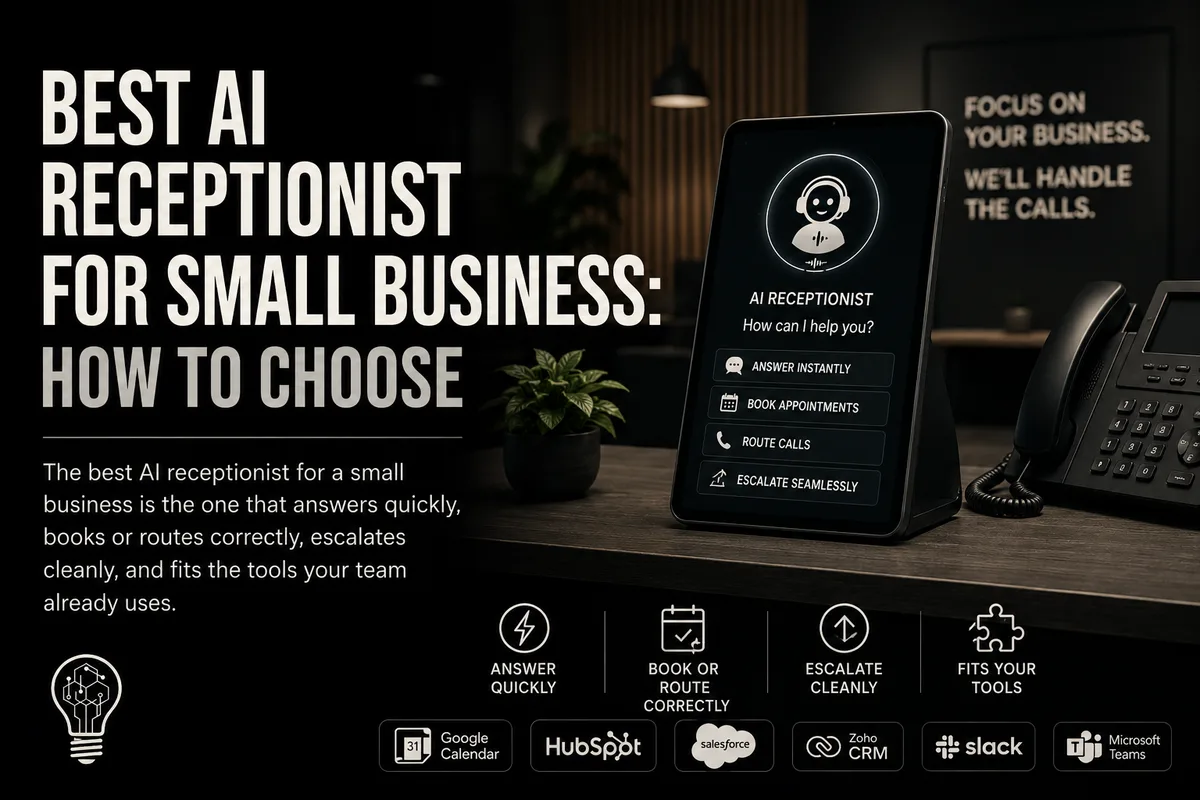
Best AI Receptionist for Small Business: How to Choose
The best AI receptionist for a small business is the one that answers quickly, books or routes correctly, escalates cleanly, and fits the tools your team.
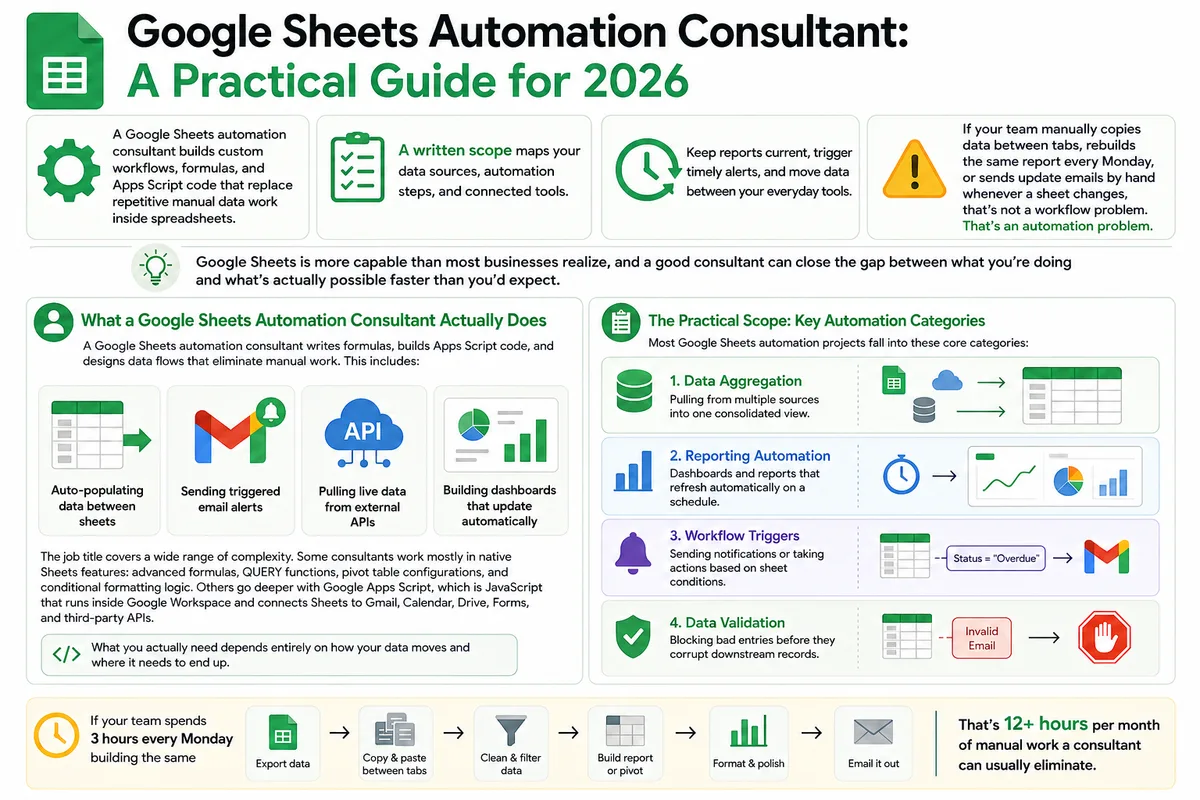
Google Sheets Automation Consultant: A Practical Guide for 2026
Most businesses don't track what spreadsheet work actually costs them. Here's what a Google Sheets automation consultant does in 2026, how to judge the value.

Business Process Automation Consultant for Small Business
Hiring the wrong automation consultant wastes thousands. Here's what small business owners need to know about process, cost, ROI, and how to vet the right one.