
The Real Reasons Service Businesses Switch to Generative AI
Service businesses don’t adopt AI out of enthusiasm. They hit a specific operational wall first: missed calls, staff time lost to appointment reminders, or a senior estimator rewriting the same proposal over and over.
Service businesses don't adopt AI out of excitement. They hit a specific wall first: missed calls, bloated labor costs, proposals that eat half a day.
Epiphany Dynamics is an AI automation agency: we help businesses find and fix operational bottlenecks with AI receptionists, lead follow-up, and workflow automation.
The free 30-minute AI Operations Audit is a conversation about a normal week in your business and where the work piles up. We find the one change that would give you the most time back and send you a plain-English plan for it. No forms and no pitch.
Book a free AI audit
Patrick Gibbs
Service businesses don’t adopt AI out of enthusiasm. They hit a specific operational wall first: missed calls, staff time lost to appointment reminders, or a senior estimator rewriting the same proposal over and over. The switch to generative AI is driven by a hard look at where money is leaking through tasks that are repetitive, time-consuming, and don’t require human judgment. This piece covers the real triggers, the cost math most businesses skip, and where implementations actually pay off.
The Wall Most Owners Hit First
Most service business owners don’t sit down one day and decide to “explore AI.” They hit something specific first. A roofing contractor loses a serious job because nobody answered the phone before the day started. A dental office manager realizes her front desk is spending too much time on appointment reminders. A landscaping company owner notices his lead estimator is rewriting essentially the same proposal over and over.
The switch to generative AI in service businesses rarely comes from enthusiasm about technology. It comes from a hard look at where money is leaking out, and the uncomfortable realization that the leaks are mostly in tasks that are repetitive, time-consuming, and don’t require human judgment. Understanding what’s really driving the shift matters, because it shapes what gets implemented, what actually works, and where businesses end up disappointed. Our roundup of the best AI tools for service companies covers which platforms deliver the fastest ROI by business type.
Where the Pain Actually Shows Up
Front-Desk and Phone Operations
The highest inbound call volume for home services and trades often hits during awkward coverage windows, exactly when owners are in the field, driving, or unavailable. Miss those windows and you’re not missing a call. You’re missing a job, and in most cases, that job is going to whoever picks up next.
A traditional answering service and an AI voice agent have different cost structures, coverage limits, and integration depth. Our AI automation cost and pricing guide breaks down how to compare each tool category across tiers. The math improves further when you factor in that AI agents don’t put callers on hold, don’t get frustrated at the end of a shift, and can pull up a customer’s service history before the caller finishes their first sentence.
Proposal and Estimate Generation
For businesses that send custom proposals, the time drain is measurable. Use your own proposal count, fully loaded estimator cost, and drafting time to calculate the leak. A GPT-based template system trained on previous proposals can reduce the mechanical drafting work, but the defensible ROI comes from your own baseline and review process, not someone else’s example.
The quality concern that comes up constantly in these conversations is legitimate but often overstated. Generative AI doesn’t replace the judgment that goes into pricing a job or scoping a project. It replaces the mechanical work of putting that judgment into a well-structured document. Those are different things, and conflating them leads to bad implementation decisions.
Lead Follow-Up
Sales-follow-up research has repeatedly found that most businesses give up on a lead after roughly one attempt, while leads that receive persistent, structured follow-up convert at a far higher rate than single-touch outreach. Most businesses know this and still under-follow-up anyway. The gap isn’t discipline. It’s time. Automated follow-up sequences handle the structured outreach at scale, and staff only gets pulled in when a lead responds with something that requires an actual decision.
The Cost Math Most Businesses Skip
Most ROI conversations around AI in service businesses stay abstract. The table below shows where to compare costs across four common operational tasks:
| Task | Traditional Approach | Cost Driver | AI Approach | Cost Driver |
|---|---|---|---|---|
| Inbound call handling | Answering service | Retainer, minutes, and overage | AI voice agent | Subscription, usage, and integrations |
| Appointment reminders | Staff time | Hourly labor and interruption cost | Automated AI messaging | Tooling, message volume, and setup |
| Proposal drafting | Estimator drafting time | Proposal count x loaded labor cost | AI-assisted drafting with human review | Tooling plus review time |
| Review request campaigns | Manual post-job outreach | Staff time and missed review lift | Automated post-job flow | Messaging tool and setup |
A service business running all four of these manually should compare loaded labor, missed response windows, and error costs against the quote for a well-configured AI stack. The useful number is not a generic benchmark; it is the gap between your current operating cost and the cost of the automated workflow.
The more interesting figure is what happens on the revenue side. When you stop missing calls during peak hours and close more estimates because follow-up actually happens, the upside can dwarf the cost savings. The cost savings pay for the tool. The revenue recovery is the actual story.
Implementation costs matter here too. A basic AI phone and booking flow has a different scope than custom proposal generation or full CRM-integrated follow-up. Model each build from the quoted setup cost, monthly operating cost, expected labor savings, and measured revenue recovery before assuming payback.
What Generative AI Is Actually Bad At Here
A lot of early implementations fail, and the failures are predictable once you’ve seen enough of them.
The first issue is prompt quality. An AI receptionist trained on vague instructions produces vague responses. Callers asking something slightly outside the expected script get confused, frustrated, or dropped. The businesses that get this right invest real time up front defining how the AI should handle specific scenarios: existing customer calling about a past job, caller requesting emergency service after hours, caller trying to negotiate price before booking. The businesses that get it wrong treat the AI like a plug-and-play product and wonder why it feels robotic.
Another consistent failure point is handoff gaps. AI captures leads and drops them into a CRM that nobody checks consistently. Outbound follow-up sequences fire but nobody monitors the replies. This isn’t an AI problem. It’s a process design problem that AI makes more visible, because the volume of interactions goes up. More automation without better oversight just means more things slipping through at higher speed.
The subtler problem is automating the wrong process first. If your current proposal workflow is disorganized, building an AI version of a disorganized workflow doesn’t fix anything. Generative AI amplifies what’s already there. A well-structured process gets faster and cheaper. A broken process just breaks faster, at greater volume.
Additional reading: How Businesses Use AI in 2026: What’s Actually Working.
Where to Start If You’re Serious About This
Run a short time audit. Log every task that gets repeated often, noting how long it takes, who does it, and whether the output requires judgment or just execution of a known formula. Most businesses find their clearest candidates in two places: inbound lead capture and proposal generation. Both have obvious inputs and outputs. Both have measurable costs. Both have limited downside if the first implementation isn’t perfect.
Pick one. Build something simple. Measure the result after a defined test period. Expand from there only if the first thing demonstrably worked. The 2026 voice AI adoption data for service businesses shows the same pattern. The businesses seeing real returns from generative AI aren’t the ones that went all-in on a giant custom build. They’re the ones that automated a specific recurring problem, measured whether it actually solved it, and compounded from there.
The question worth asking before any tool decision: which task in this business is the most expensive, the most repetitive, and the least dependent on real human judgment? That’s the right starting point. A focused time audit answering that question is worth more than any amount of research on specific AI platforms.
What’s Actually Driving the Shift
Labor costs for routine tasks keep going up. Customer expectations for response speed keep going up. Margins in most service industries have been flat or compressing for years. Generative AI doesn’t solve all of that. It solves specific, high-repetition problems that used to require paid human attention, at a cost point that can make the math work for service businesses with repeatable workflows.
The businesses that get this right understand exactly what they’re automating and why. They don’t buy the hype, but they also don’t dismiss the real operational value sitting in front of them. If you’re working through where AI fits in your service operation, or whether your current setup has gaps worth addressing, it’s worth a conversation with an agency that works specifically with service businesses. Firms like Epiphany Dynamics do exactly that kind of diagnostic work.
Frequently Asked Questions
Q: What business problem most commonly drives service businesses to adopt generative AI?
The trigger is almost always a specific, painful operational gap rather than enthusiasm about technology: missed calls, manual appointment reminders, or estimators rewriting essentially the same proposal again and again. Businesses that implement AI successfully identify one high-cost, high-repetition problem and solve it, not “explore AI” as an abstract initiative.
Q: How much can AI cut proposal generation time for service businesses?
Measure your current proposal count, drafting time, review time, and fully loaded estimator cost before projecting savings. The key insight: AI replaces the mechanical work of structuring judgment into a document, not the judgment itself.
Q: What is the true ROI of automating inbound call handling for a service business?
The true ROI of automating inbound call handling depends on missed-call volume, booking rate, average job value, and the cost of the answering option you compare against. The larger ROI driver is usually incremental revenue from recaptured after-hours leads, not just cheaper call handling.
Q: What generative AI applications fail most often for service businesses?
The two most consistent failure patterns are poor prompt quality (vague AI receptionist instructions produce vague responses that confuse callers) and handoff gaps (AI captures leads but drops them into a CRM nobody checks). Both are process design failures, not technology failures. Automating a broken process just makes it fail faster at higher volume. Fixing the underlying process before building the automation is not optional.
Q: How should a service business identify its first AI automation to implement?
Run a short time audit. Log every task that repeats often, with duration and whether it requires judgment or follows a known formula. Most businesses find their best first candidates in inbound lead capture or proposal generation: both have obvious inputs and outputs, measurable costs, and limited downside if the first version needs iteration. Pick one, build something simple, measure it after a defined test period, then expand only if it demonstrably worked.
Patrick Gibbs
AI Automation Expert
Patrick Gibbs helps professional practices implement AI automation that captures more leads, books more appointments, and scales without adding overhead. He's the founder of Epiphany Dynamics and creator of the AI Front Desk system.
Related Solutions
Build this into a real workflow
Related Posts
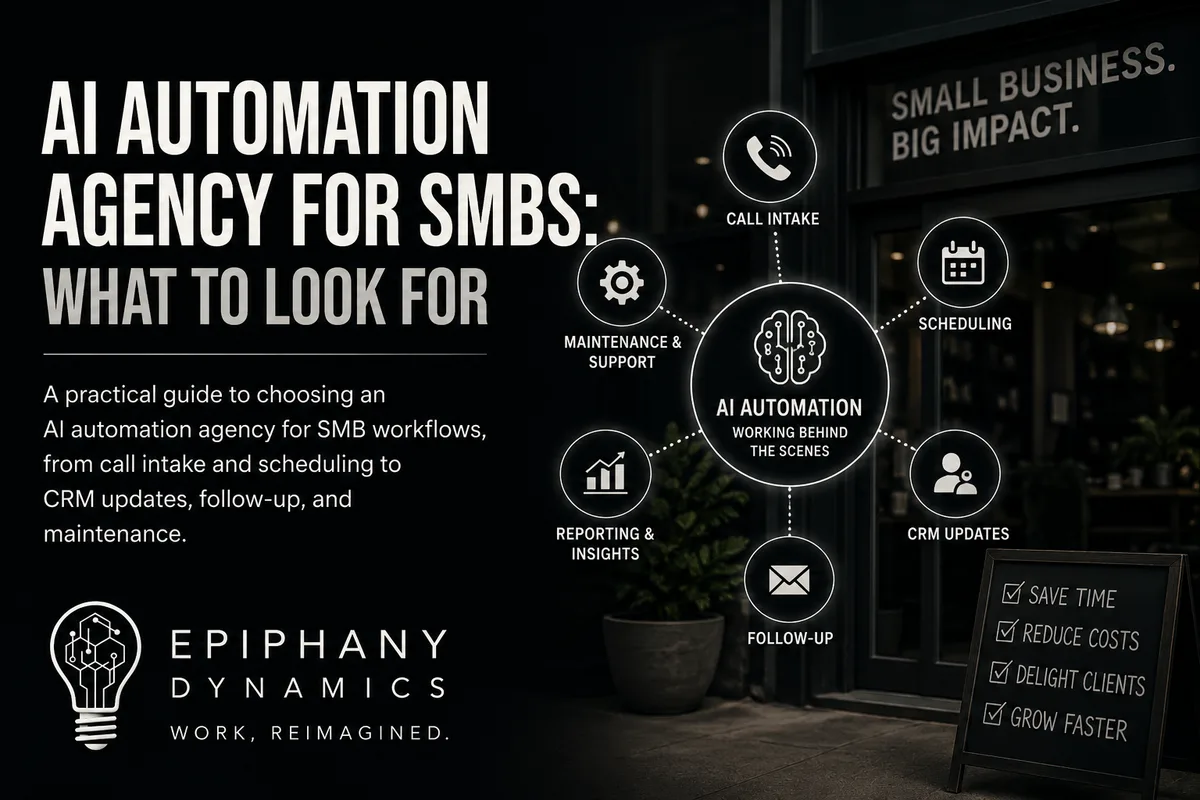
AI Automation Agency for SMBs: What to Look For
A practical guide to choosing an AI automation agency for SMB workflows, from call intake and scheduling to CRM updates, follow-up, and maintenance.
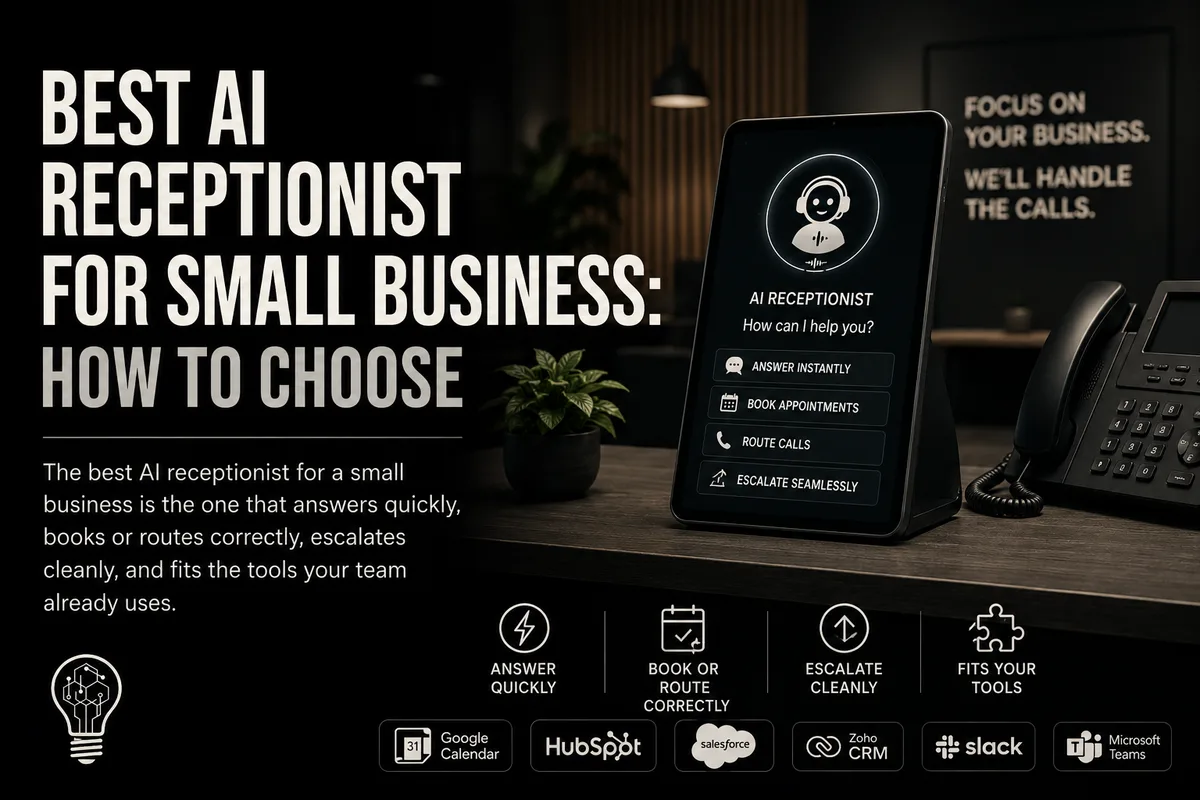
Best AI Receptionist for Small Business: How to Choose
The best AI receptionist for a small business is the one that answers quickly, books or routes correctly, escalates cleanly, and fits the tools your team.
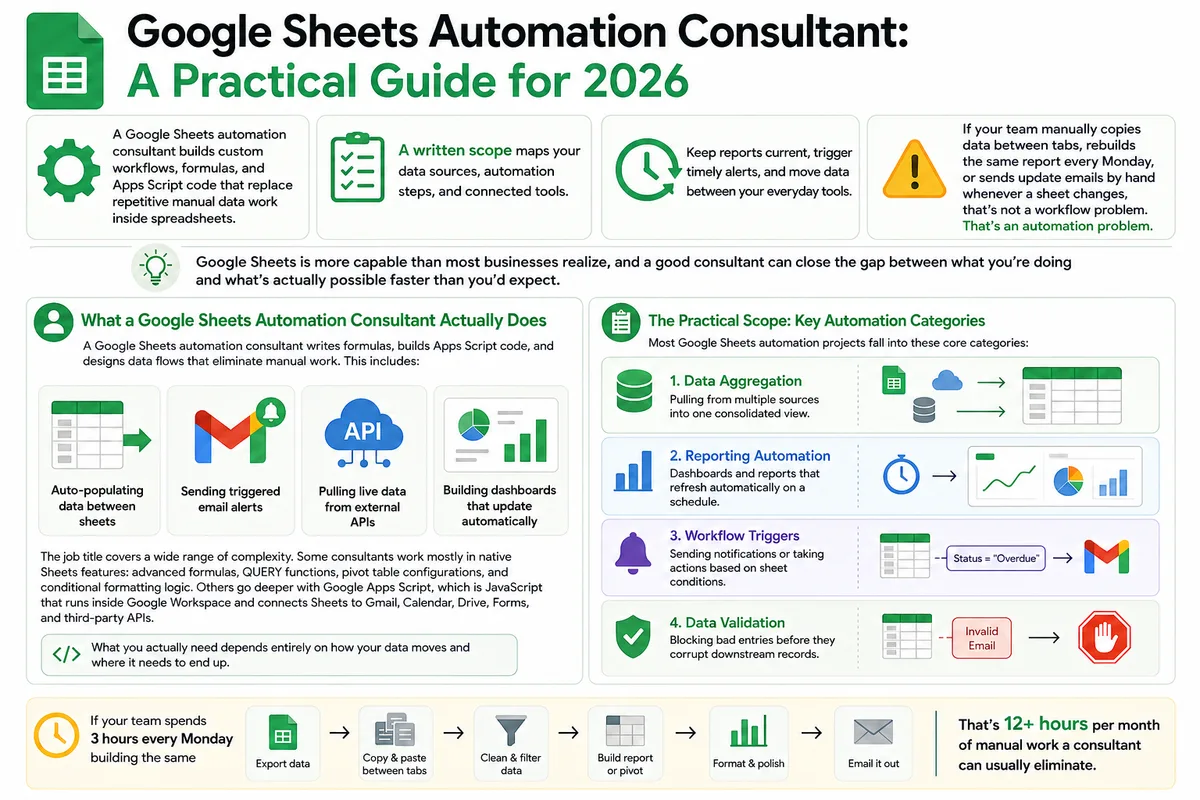
Google Sheets Automation Consultant: A Practical Guide for 2026
Most businesses don't track what spreadsheet work actually costs them. Here's what a Google Sheets automation consultant does in 2026, how to judge the value.