
Industry Insights
Answering Service for Home Services: Real Costs and ROI in 2026
Most callers who reach voicemail won't leave a message. For home service contractors, every missed call is a job going to a competitor.
The free 30-minute AI Operations Audit is a conversation about a normal week in your business and where the work piles up. We find the one change that would give you the most time back and send you a plain-English plan for it. No forms and no pitch.
Book a free AI audit
Patrick Gibbs
An answering service for home services ensures inbound calls get a live response or an automated intake workflow instead of voicemail. The best option depends on your call volume, dispatch complexity, after-hours demand, and whether you need human judgment, AI triage, or a hybrid of both.
If you run a plumbing, HVAC, electrical, or general contracting business and your phone goes to voicemail after hours, you're not just missing calls. You're handing jobs to whoever picks up next on Google. When answering coverage needs to connect with dispatch, scheduling, and follow-up, compare providers against the home services AI agency checklist.
A caller with a water heater problem isn't going to leave you a message and wait until morning. They're going to call the next number on the list. And when they reach someone live, that's where the job goes. This is not a theory. It's what happens every day, and most contractors already know it. They just haven't fixed it yet.
The Revenue You're Losing Every Time a Call Goes to Voicemail
Home service contractors can lose significant revenue to missed calls, especially when average job values are high and callers move quickly to the next company. The leak should be modeled with your average ticket value, close rate, and actual missed-call count instead of relying on a generic benchmark.
The math isn't complicated once you sit down and run it. Take your average job revenue. Multiply by your close rate on answered calls. Multiply by how many calls you're actually missing per week. The number most contractors land on the first time they do this is uncomfortable, and that's before accounting for repeat customers you never built a relationship with in the first place.
In home services, the inquiry usually goes to the first business that actually responds. Harvard Business Review's lead-response research is still widely referenced because it shows how quickly qualification odds fall when follow-up is delayed. Home services is a speed game. The contractor who picks up wins, almost regardless of price.
Beyond the lead response problem, there's the trust signal. When someone calls about a burst pipe after hours and gets voicemail, they don't just call someone else. They form an opinion about your company. Even if you call back later, you're starting that conversation already behind. And if they've already booked someone else by then, the callback is awkward for everyone.
Human Answering Services vs. AI Phone Systems: A Real Comparison
Human answering services for home contractors usually trade higher-touch call handling for more variable staffing and usage costs. AI phone systems trade human judgment for consistent routing, simultaneous call handling, and deeper scheduling integration. The right comparison is not a generic price range; it is how each option performs against your real call mix.
Human answering services have been around for decades and they work. A real person on the line can de-escalate a panicked homeowner, adapt to genuinely weird edge cases, and hold a conversation that feels natural. Those are real advantages. The tradeoffs are cost, consistency, and what happens when call volume spikes.
Most human services charge in a way that can vary with usage. During a heat wave when your HVAC business pulls in a surge of after-hours calls, the bill you didn't budget for can arrive at the end of the month. Agent quality also varies. One shift handles calls exactly how you trained them. The next shift doesn't know the difference between an emergency and a routine estimate request, and routes everything the same way.
AI systems flip those tradeoffs. Flat monthly pricing, consistent behavior regardless of call volume, and direct integrations with your CRM or scheduling software mean the caller's info and appointment show up in your system automatically. The downside is that edge cases get handled less gracefully. An upset caller, a confusing situation, or something genuinely off-script gets routed awkwardly where a well-trained human would have handled it cleanly. That's a real limitation, not marketing spin. You can dig deeper into this comparison in this breakdown of AI receptionist platforms versus traditional human answering services if you want to see how the models stack up at different call volumes.
| Factor | Human Answering Service | AI Phone System |
|---|---|---|
| Monthly cost | Recurring staffed-service cost, often usage-sensitive | Platform, setup, usage, and tuning |
| Simultaneous calls | Limited by staffing | Unlimited |
| After-hours coverage | Yes (with plan) | Yes, if configured |
| CRM/scheduling integration | Manual or email-based | Direct API integration |
| Call consistency | Varies by agent and shift | Consistent every call |
| Edge case handling | Strong | Limited |
| Cost during peak volume | Unpredictable (per-minute) | Fixed regardless of volume |
| Setup time | Usually fast if scripting is simple | Depends on integrations and call-flow testing |
For contractors with low after-hours volume, a human service may be enough. Once call volume climbs or dispatch routing gets more structured, the math often tilts toward AI or a hybrid setup where AI handles triage and a live person handles complex escalations.
What a Home Service Answering Service Actually Needs to Do
An effective home service answering service must identify emergency versus routine calls, collect caller name, address, and callback number, check real technician availability, book or confirm appointments, and route job details directly to dispatch. Any service that just takes a message and emails it to you is a voicemail with extra steps, and you're still losing jobs.
The message-taking version of an answering service is more common than it should be. The operator answers, gets the customer's name and number, and sends you an email that says "John called about his AC, please call back." That might be acceptable if you're returning calls immediately. It's not acceptable if you're on a job and John is already on the Google results page calling the next contractor.
What you actually need is triage with routing logic. Emergency calls (no heat in winter, active water leak, electrical issue with a burning smell) need to reach a live person or trigger an on-call escalation immediately. Routine requests (seasonal tune-up, new install estimate, minor repair) should go into the booking flow and land in your schedule automatically. The difference between those two categories isn't obvious to a generic answering service that doesn't know your business. It has to be built into the script or the AI logic explicitly.
The piece that gets skipped most often is real availability checking. If a service takes a booking for a window when your tech is already booked, you've created a scheduling conflict that your office has to fix manually. That means callbacks, rebooking conversations, and frustrated customers. The better systems connect directly to your scheduling platform and only offer time slots that are actually open. For contractors running HVAC or plumbing operations, the full walkthrough on automating an HVAC business covers how to connect phone answering to dispatch, scheduling, and follow-up in one workflow.
Running the Numbers: Is an Answering Service Worth It?
The ROI math for an answering service is straightforward; the hard part is accurately counting how many calls you're currently missing. Compare monthly service cost, missed-call volume, booking rate, average job value, and dispatch complexity against the revenue you can realistically recover.
Most contractors underestimate how many calls they miss. If you're running a basic phone plan with no call tracking, you genuinely don't know. Setting up call analytics for a representative window usually surfaces a number that's higher than expected. Many consumers who search for a local service business end up calling directly from the search results. A meaningful share of those calls go unanswered, particularly in evenings and on weekends when the bulk of consumer research happens.
Here's a simple way to run the ROI estimate for your own business:
- Estimate missed calls per week from real call logs
- Multiply by your measured close rate on answered calls
- Multiply by your average job value
- Compare that revenue leak against the answering service quote and oversight effort
Treat the formula as a planning model, then replace each input with your own call data. The gap between what an answering service costs and what missed calls cost can get large quickly when average ticket values are high.
How to Switch Answering Services Without Breaking What's Working
Most home service contractors can get the technical setup done quickly, but scripting and testing matter more than speed. The hard part is scripting call flows that match how you actually quote, dispatch, and handle edge cases. Contractors who skip the scripting phase end up with confused customers and a callback queue that defeats the whole purpose of setting up coverage in the first place.
Start with a call audit before you configure anything. Listen to recent inbound calls and write down what your best receptionist (or you) actually says. What questions get asked? What information gets collected before booking? How are emergencies identified versus routine requests? That language should be the foundation of whatever script or AI prompt gets built. A generic template will give you generic results, and your customers will notice immediately that something feels off.
The setup process for a typical home service contractor looks like this:
- Select the service, forward your main number, and configure basic call routing including business hours, on-call escalation contacts, and a FAQ baseline
- Test with real calls while monitoring closely; have a backup plan for anything that doesn't route correctly
- Tune based on what's actually failing; most systems need real caller feedback before the script feels natural
- Let it run independently only after call logs show the routing and booking flows are stable
The integration piece gets skipped more than any other step. If your answering service isn't writing directly to Jobber, ServiceTitan, Housecall Pro, or whatever you use, someone on your team is manually entering that call data. Manual entry gets missed. It gets delayed. It creates the same problems you set up the service to solve. The complete playbook for converting home service callers into customers covers what the actual call script should include, which questions matter most before a booking, and how to handle emergency versus routine requests differently. If you're also evaluating specific tools, the AI phone answering tool evaluation guide walks through how to compare options against your actual requirements rather than marketing claims.
Related reading: AI Answering Service for Contractors: What to Compare in 2026.
The Bottom Line
The ROI case for a home service answering service depends on a simple comparison: monthly service cost versus the modeled value of recovered jobs. Match the service type to your call volume, CRM setup, and how complex your average call actually is. Then prioritize the scripting phase over everything else in the setup process.
Every contractor reading this already knows they miss calls. The question is whether the cost of fixing it is less than the cost of ignoring it. For many home service businesses operating at real volume, it is. The monthly cost of even a premium answering setup can be small compared to the value of missed jobs over a year.
The right choice between human, AI, and hybrid depends on your specific situation. Human services handle complexity better and make sense at lower call volumes or in businesses where de-escalation is a regular part of the job. AI systems are more cost-effective as volume scales and offer tighter integration with scheduling software. A hybrid setup, where AI handles initial triage and routes true emergencies to a live person, is worth considering when you want coverage without unpredictable monthly bills. For contractors who want to see what a purpose-built AI answering workflow looks like for home services specifically, Epiphany Dynamics builds these systems for contractors who are done figuring it out on their own.
Frequently Asked Questions
Q: How much does an answering service cost for a home services business?
Costs depend on call volume, dispatch complexity, after-hours coverage, integrations, and whether you choose human answering, AI triage, or a hybrid. Human services provide personalized dispatch and relationship handling, whereas AI systems automate triage, booking, and after-hours coverage. Your choice depends on call volume, budget, and whether you need live dispatch or automated coverage.
Q: How many calls do contractors actually miss per month without answering service coverage?
A home services business should start by pulling actual phone records and counting how many calls roll to voicemail each week. From there, multiply missed calls by your measured booking rate and average ticket value. Most customers contact the first business that responds, making every unanswered call a potential job handed to a competitor.
Q: What's the difference between AI phone systems and human answering services for contractors?
AI systems automate appointment scheduling, triage, and dispatch, while human services employ staff to handle calls with judgment and personalization. AI scales well for call spikes and after-hours coverage; human services excel at building customer relationships and handling complex dispatch scenarios. Most contractors use AI for basic coverage or pair it with human dispatch during peak hours.
Q: Can answering services actually handle appointment booking and routing calls to technicians?
Yes. Both AI and human answering services can confirm emergencies, schedule appointments, collect job details, and route calls to available technicians in real-time. AI systems integrate with calendar software to prevent double-booking and can qualify leads before technician follow-up, reducing low-quality callbacks. This automation is especially valuable for HVAC and plumbing businesses managing complex inbound demand across multiple service categories.
Patrick Gibbs
AI Automation Expert
Patrick Gibbs helps professional practices implement AI automation that captures more leads, books more appointments, and scales without adding overhead. He's the founder of Epiphany Dynamics and creator of the AI Front Desk system.
Related Solutions
Build this into a real workflow
Related Posts
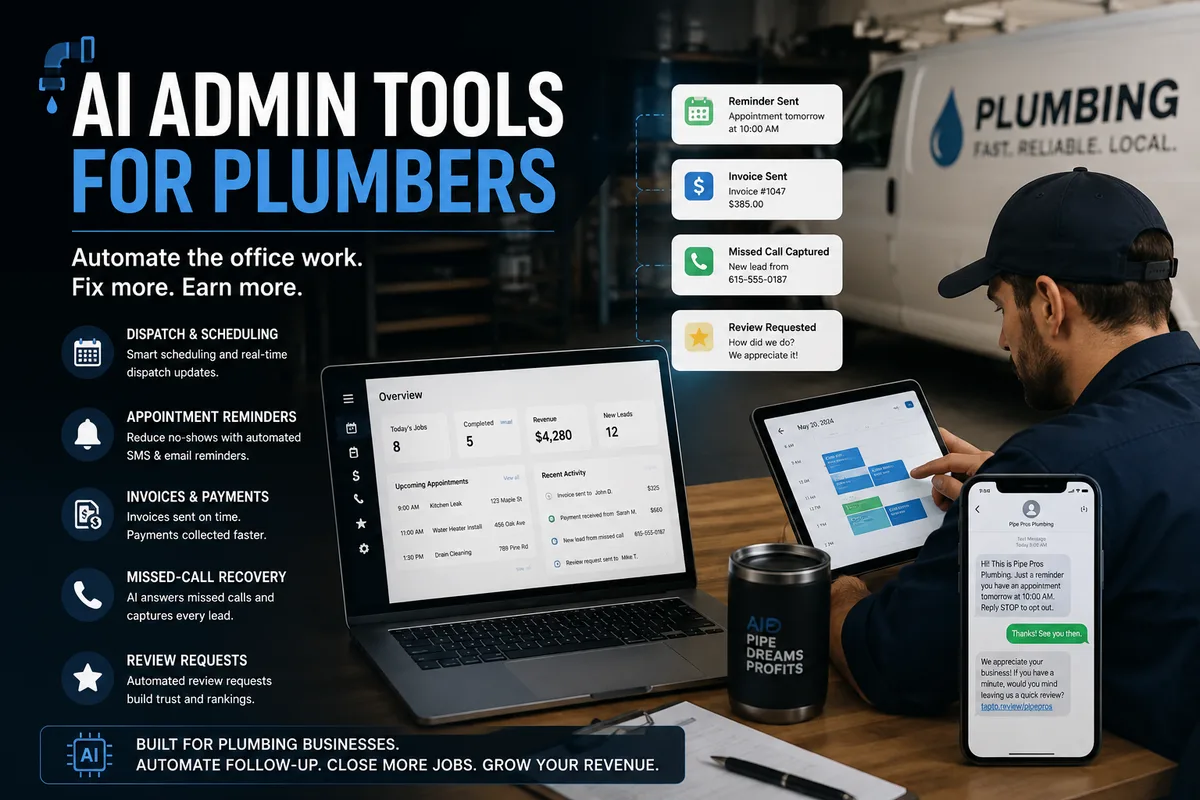
AI Admin Tools for Plumbers: What They Are and How to Choose
AI admin tools automate dispatch, reminders, invoicing follow-up, missed calls, and review requests for plumbers. What they do and how to choose.
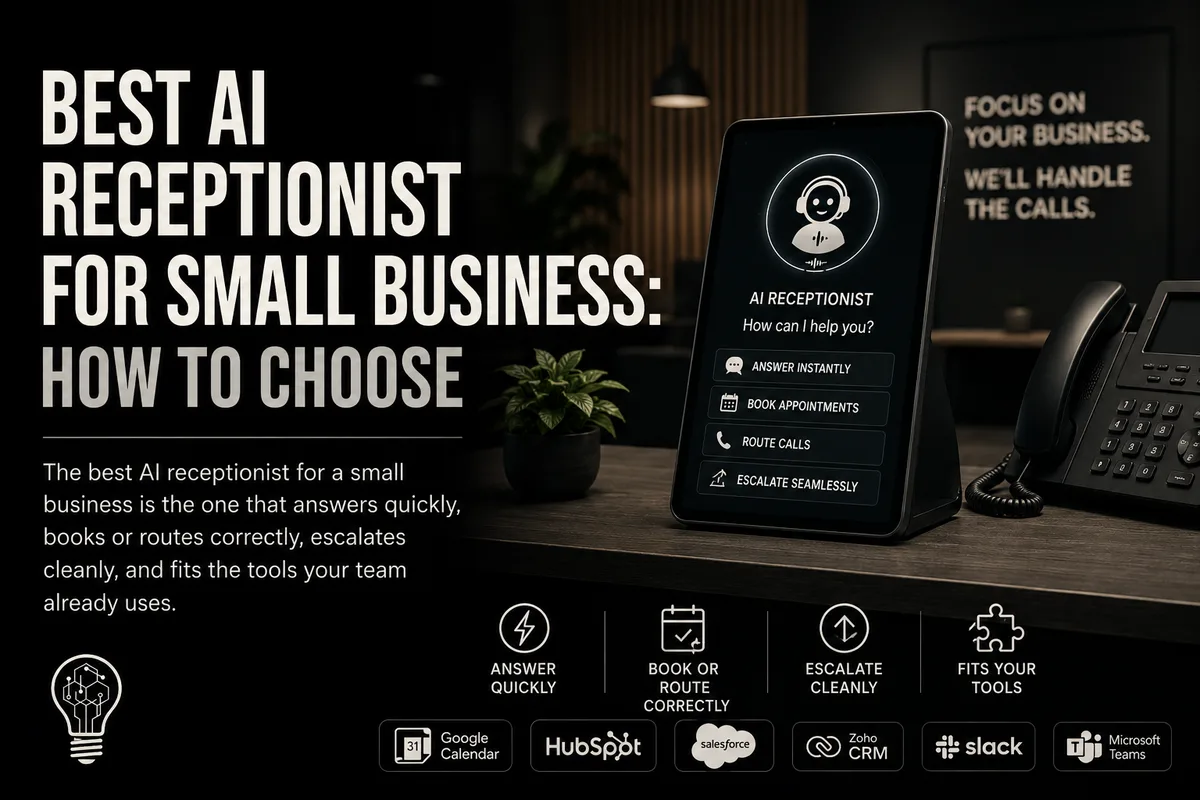
Best AI Receptionist for Small Business: How to Choose
The best AI receptionist for a small business is the one that answers quickly, books or routes correctly, escalates cleanly, and fits the tools your team.
Insurance Eligibility Automation for Physical Therapy Clinics
Eligibility automation for physical therapy clinics verifies benefits before the patient arrives, cuts front desk phone work, and can lower claim denial risk.