
How to Build an Automation ROI Calculator That Actually Works
Most automation ROI projections fail because they measure time saved instead of dollars recovered, and miss half the real costs, including error rates, fully loaded labor, and the maintenance overhead most businesses never budget for. A reliable automation ROI calculator requires five specific inputs: fully loaded labor cost per hour, actual hours saved per week, error cost per incident, implementation cost, and ongoing maintenance.
Most automation ROI projections miss half the costs. Here's a framework built on real inputs: fully loaded labor rates, error costs, and the maintenance.
Epiphany Dynamics is an AI automation agency: we help businesses find and fix operational bottlenecks with AI receptionists, lead follow-up, and workflow automation.
The free 30-minute AI Operations Audit is a conversation about a normal week in your business and where the work piles up. We find the one change that would give you the most time back and send you a plain-English plan for it. No forms and no pitch.
Book a free AI audit
Patrick Gibbs
Most automation ROI projections fail because they measure time saved instead of dollars recovered, and miss half the real costs, including error rates, fully loaded labor, and the maintenance overhead most businesses never budget for. A reliable automation ROI calculator requires five specific inputs: fully loaded labor cost per hour, actual hours saved per week, error cost per incident, implementation cost, and ongoing maintenance. This framework shows how to calculate it correctly with your own numbers.
Most automation projects start with optimism and end with vague claims. “We saved a bunch of time” sounds like a win until someone asks the follow-up questions: saved time from what, worth how much per hour, and what did the automation cost to build, deploy, and maintain over the past year?
The honest answer is that most businesses don’t know. They feel like automation is working because things move faster. That feeling isn’t ROI. For phone-based service businesses, start by understanding the true cost of missed calls: it’s often the highest-ROI automation target. Building a real automation ROI calculator forces you to define value in dollars before you commit to a project, and gives you a benchmark to measure against once the system is running.
Why “Time Saved” Is the Wrong Primary Metric
The instinct to measure time is understandable. Hours are visible. Software costs show up on invoices. But time only converts to financial value when you know what that time costs you and where it gets redirected after automation takes over.
Consider a billing team that spends a meaningful block of time manually reconciling invoices. Automating that task frees capacity. If those employees are salaried and their freed time doesn’t shift to higher-value work, the financial gain is close to zero. You’ve made their jobs easier, which matters for morale and retention, but you haven’t changed the cost structure or increased output.
Contrast that with a customer service team where automation handles enough inbound tickets to avoid another hire or let team members close more complex cases per day. In that scenario, the ROI becomes measurable and substantial. The difference isn’t the automation itself. It’s whether the freed capacity generates something you can put a dollar value on.
The Five Inputs Your ROI Calculator Needs
A reliable calculation requires five specific data points. Skip any of them and the result is a guess dressed up as analysis.
The first is fully loaded labor cost per hour. Not just salary. Include benefits, payroll taxes, overhead, and management burden. Use that loaded cost, not the salary figure, when building your calculation.
Second is hours saved per week, and you should be conservative here. People consistently underestimate how much time they spend on repetitive tasks. Track actual hours for two weeks before you commit to a projection. Self-reported estimates, especially from people who are enthusiastic about the automation project, tend to run high.
Third is error cost. Manual processes have error rates. A data entry mistake might create a small support cost, or it might trigger a chargeback, refund, lost customer, or rework cycle. Estimate the average cost per error and your current weekly error count. This number often surprises people when they actually calculate it.
Fourth is implementation cost, which includes software, setup time (internal or external), integration work, and training. Don’t forget the opportunity cost of whoever manages the project internally. That time has a cost even when no external invoice is generated.
The fifth input is ongoing maintenance cost. APIs change, upstream systems update, and workflows break. Plan for maintenance from the start rather than treating it as a surprise later.
A Worked Example
Figures in this section are illustrative planning assumptions, not measured industry data.
A small e-commerce business wants to automate order confirmation emails, inventory updates, and shipping notifications. A part-time coordinator currently handles this manually. Here are the inputs to collect:
- Coordinator hourly rate: your fully loaded labor cost
- Hours currently spent per week: your measured baseline
- Estimated hours still needed for exceptions after automation: your conservative post-launch assumption
- Weekly orders processed: your order volume
- Current manual error rate: your observed error count x average cost per error
- One-time implementation cost: software, setup, integration, and training
- Monthly subscription: the actual tool and support quote
| Metric | Before Automation | After Automation |
|---|---|---|
| Weekly labor hours | Your baseline | Your post-launch assumption |
| Weekly labor cost | Baseline hours x loaded labor cost | Remaining hours x loaded labor cost |
| Weekly error cost | Error count x average error cost | Remaining errors x average error cost |
| Total weekly cost | Labor cost + error cost | Remaining labor + remaining error cost |
| Weekly savings | Before cost minus after cost | |
Annual savings equals weekly savings multiplied across the operating period. First-year total cost equals setup plus subscription, support, monitoring, and maintenance.
ROI = (Annual Value Generated - Annual Total Cost) / Annual Total Cost x 100
That formula shows why labor-intensive, error-prone manual processes are often the best automation targets. Stress-test your assumptions before you approve the build. What the model actually gives you is a framework for deciding whether to start and what assumptions you’re betting on.
The core formula to remember: ROI = (Annual Value Generated - Annual Total Cost) / Annual Total Cost × 100
Where “annual value generated” is the sum of labor savings, error cost reduction, and any direct revenue impact from the automation.
The Hidden Costs That Break Projections
Several costs get routinely omitted from automation ROI calculations. These are the ones that turn confident forecasts into break-even disappointments.
Transition cost. When you automate a process, someone has to learn the new system, document the exceptions, and handle edge cases that the automation can’t manage. This takes real time that doesn’t appear in implementation estimates. Include transition overhead in your first-year cost figure.
Dependency chain risk. Automations built on third-party APIs are brittle by nature. When Stripe updates its API, when a supplier changes their CSV export format, or when an upstream system adds a new required field, your workflow breaks. Downtime in an automated process often costs more than the manual version would have for that same period, because nobody is watching it fail in real time. Tool stability should factor into selection decisions, not just licensing price.
Process debt. Many businesses automate a broken process. If your invoicing workflow has manual workarounds baked in because of a quirk in your billing software, automating it will either fail at those workarounds or lock the bad process into code. Cleaning up the underlying process before automation is possible is often the largest single cost on the list, and it belongs in your ROI calculation from day one.
Also on the blog: Zapier Pricing in 2026: Tasks, Plan Limits, and Cost Drivers.
When the Numbers Don’t Support Moving Forward
Not every automation project is worth doing. The ROI framework is just as useful for deciding against a project as it is for green-lighting one.
The process runs too rarely. Setup and maintenance costs will outpace savings unless individual instances are very high-value, like large purchase orders or contract review workflows where a single error has significant financial consequences.
The exception rate is too high. If a meaningful share of customer inquiries require human judgment, automating only the clean routine work may make sense. Automating the full queue and hoping the system manages edge cases reliably creates service problems that cost more than the labor savings. A clean partial automation beats a messy one that overreaches.
The payback period is too long. When your calculation shows fast payback, the project has a strong case. When payback stretches too far, look seriously at whether a process redesign achieves the same result without locking you into ongoing maintenance.
Putting This Into Practice
The goal of an automation ROI calculator isn’t to generate a number that justifies a decision you’ve already made. It’s to surface the assumptions you’re making and test whether they hold under realistic conditions.
Run the calculation twice: once with best-case estimates, and once with pessimistic ones that lower the savings and raise the cost assumptions. If the ROI is still positive under the pessimistic scenario, the project has a solid foundation. For a complete breakdown of automation costs and what to expect, see our AI automation cost and pricing guide. If it only works under ideal conditions, you’re betting on everything going right. Automation projects rarely honor that bet.
Track actual results after deployment. Most businesses implement automation and never revisit the original projection. Six months after go-live, run the actual numbers against the forecast. The gap between projected and actual is diagnostic. It tells you something important about how your team evaluates projects, and that feedback loop makes future calculations more accurate over time.
The businesses that get consistent returns from automation aren’t using fancier tools, whether it’s AI workflow automation to reduce overhead or automating repetitive tasks. They’re more rigorous about measurement, and they’re willing to walk away when the numbers don’t justify moving forward. That discipline, applied before the build starts, is what separates results from expensive lessons. Some automation agencies build these ROI calculations into their standard scoping process, which is a useful model to borrow even if you’re handling implementation entirely in-house.
Frequently Asked Questions
Q: What is the most important metric for measuring automation ROI?
Time saved is not the primary metric: time only converts to financial value when you know what that time costs and where it goes after automation. The more useful metric is the net monthly value recovered: (Hours saved x fully loaded hourly cost) + (Error reduction x average cost per error) - monthly tooling cost. Run this calculation with conservative estimates, then again with pessimistic ones. If ROI is positive under pessimistic conditions, the project has a solid foundation.
Q: What is a “fully loaded” labor cost and why does it matter for ROI calculations?
Fully loaded cost includes base salary plus benefits, payroll taxes, overhead allocation, equipment, management time, and any role-specific costs. Using salary alone understates the true cost of manual work and can make automation appear less compelling than it actually is when you run the numbers.
Q: When should an automation project not move forward based on ROI analysis?
Three clear stop signals: the process runs too rarely for the setup cost, the exception rate is high enough that automation creates more supervision than relief, or the payback period is too long to justify ongoing maintenance. In those cases, a process redesign may achieve the same result without adding another system to maintain.
Q: What hidden costs do most automation ROI projections miss?
Transition cost, dependency chain risk, and process debt are the big three. Staff need time to learn the new system, automations built on third-party APIs break when those APIs update, and a disorganized process becomes faster chaos when automated. All three should be estimated before committing to a build.
Q: How should I track actual ROI after deploying automation?
Most businesses implement automation and never revisit the original projection. After launch, compare actual results against the forecast. The gap between projected and actual is diagnostic: it tells you something important about how your team evaluates projects, and that feedback improves future automation decisions significantly. Build regular recalibration into your process from day one, because model drift and API changes will degrade performance over time if unchecked.
Patrick Gibbs
AI Automation Expert
Patrick Gibbs helps professional practices implement AI automation that captures more leads, books more appointments, and scales without adding overhead. He's the founder of Epiphany Dynamics and creator of the AI Front Desk system.
Related Solutions
Build this into a real workflow
Related Posts
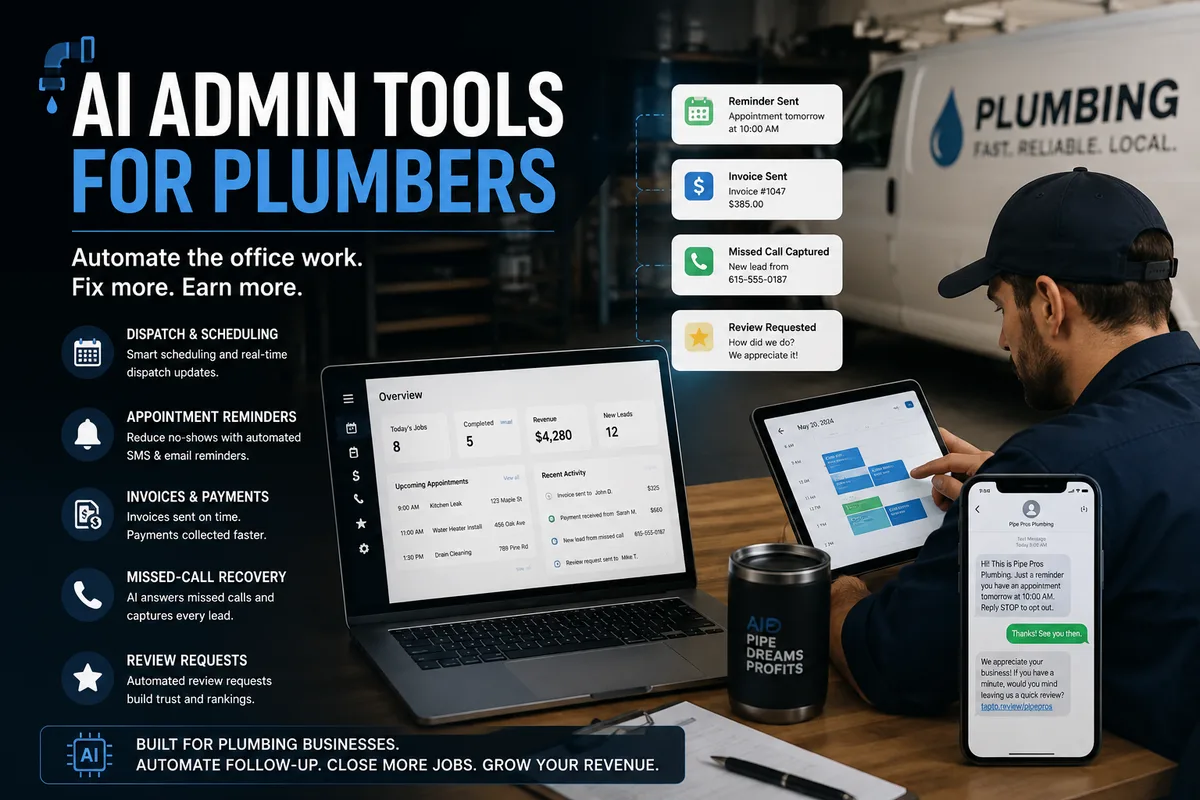
AI Admin Tools for Plumbers: What They Are and How to Choose
AI admin tools automate dispatch, reminders, invoicing follow-up, missed calls, and review requests for plumbers. What they do and how to choose.
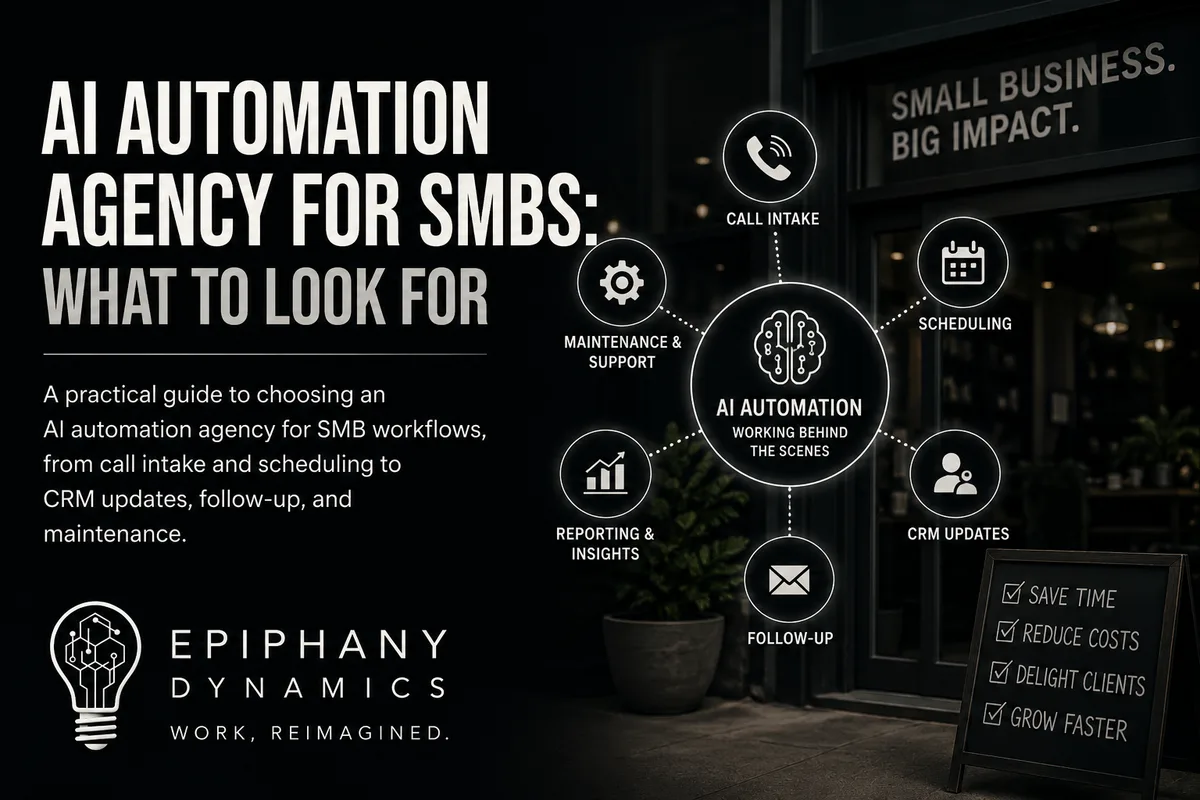
AI Automation Agency for SMBs: What to Look For
A practical guide to choosing an AI automation agency for SMB workflows, from call intake and scheduling to CRM updates, follow-up, and maintenance.

Best AI Receptionist for Small Business: How to Choose
The best AI receptionist for a small business is the one that answers quickly, books or routes correctly, escalates cleanly, and fits the tools your team.