
Business Growth
How Much Does AI Hallucinate? Real Rates and Real Risk in 2026
AI hallucination rates vary widely by model and task. Here's what public benchmarks suggest about model accuracy, where the risk is highest, and how to deploy.
The free 30-minute AI Operations Audit is a conversation about a normal week in your business and where the work piles up. We find the one change that would give you the most time back and send you a plain-English plan for it. No forms and no pitch.
Book a free AI audit
Patrick Gibbs
AI hallucination rates vary widely depending on the task and model. Grounded summarization tasks produce far fewer errors than open-ended factual queries, and legal citations and medical Q&A are among the riskiest categories. The task type matters more than the model choice in most real-world deployments.
If you're running AI in any part of your business and you haven't thought hard about hallucination rates, you're flying blind. And the number of businesses in that position is surprisingly high. The conversation around AI often skips straight from "here's what it can do" to "here's what to buy" without answering the question that actually matters: how often does it get things wrong, and what does wrong look like?
This isn't a reason to avoid AI. It's a reason to use it smarter. The businesses getting measurable ROI from AI automation right now are the ones that understand where the failure modes live and built their systems around that knowledge.
What AI Hallucination Actually Looks Like
Hallucination is when an AI model generates a response that sounds confident and coherent but is factually wrong. It's not a glitch or a crash. The model produces fluent, structured output with zero indication that it made something up. For a business, that's the problem: the output looks exactly like correct output.
The term "hallucination" comes from the way large language models work. They don't retrieve facts from a database. They predict the next likely word based on patterns learned during training. When a model doesn't "know" something, it doesn't say "I don't know" by default. It generates the most statistically plausible continuation, and that continuation can be completely fabricated.
The classic example is legal citations. A lawyer asked ChatGPT for case citations in 2023 and received six cases in return. Every single one was made up. The names, the dockets, the cited holdings. All fabricated, delivered with complete confidence. That case made national news, but the pattern repeats every day in less visible ways: a wrong product spec, a made-up policy number, a customer told something incorrect by a chatbot. The danger isn't that the model is wrong. It's that wrong and right look identical in the output.
Understanding this isn't about fear. It's about deployment logic. If you know where AI hallucinates and at what rate, you can build systems that catch or prevent it. That's the whole game.
Hallucination Rates by Task Type
Hallucination frequency isn't uniform. Text summarization with a source document produces relatively few errors for leading models. Open-ended factual queries with no grounding fail far more often, and medical question answering and legal citation retrieval are among the worst categories in public testing. The more the model has to draw from internal "knowledge" rather than a document you gave it, the worse the rate gets.
Public hallucination benchmarks that test models specifically on summarization have measured rates that vary widely by model, with the strongest models making relatively few errors. These are tasks where the model has source text in front of it and is asked to summarize it. Remove that safety net and rates climb fast. Ask the model to recall facts it learned during training, especially anything that changes over time, and you're in much more dangerous territory.
Here's how hallucination risk breaks down across common business use cases:
| Task Type | Estimated Hallucination Rate | Business Risk Level |
|---|---|---|
| Summarization (with source document) | 3-6% | Low |
| Email drafting (structured input) | 5-8% | Low-Medium |
| Customer FAQ responses (with knowledge base) | 4-10% | Low-Medium |
| General factual Q&A (no source provided) | Substantially higher | High |
| Medical and clinical question answering | 35-43% | Very High |
| Legal citation retrieval | 35-45% | Very High |
| Code generation (logic and factual errors) | 15-25% | Medium-High |
Ranges are rough illustrative estimates, not measured benchmark results.
The pattern is consistent. When the model can read the answer from something you provided, hallucination drops sharply. When you ask it to recall facts from training, it fabricates at rates that should concern any business owner. This is why RAG (Retrieval Augmented Generation) setups, where the model fetches relevant documents before answering, consistently cut hallucination rates significantly in controlled benchmarks. The architecture decision matters more than the model selection.
How Different Models Compare in 2026
Frontier models from OpenAI, Anthropic, and Google are the best performers on standard hallucination benchmarks, making relatively few errors on grounded tasks in 2026. Smaller open-source models fail noticeably more often on the same benchmarks. The gap between top-tier and budget models on factual accuracy is real and measurable, not marketing copy.
It's worth saying plainly: the best models today are meaningfully better at avoiding hallucination than they were two years ago. Leading models score meaningfully better on adversarial factual-accuracy benchmarks than they did two years ago. That's real progress. But strong benchmark accuracy still leaves a meaningful share of answers wrong, which matters a lot when your business relies on those answers without a review step in place.
Model size correlates with accuracy, but it's not the whole story. A smaller, fine-tuned model with a well-structured knowledge base can outperform a larger general-purpose model on domain-specific tasks. A dental practice using a model built on verified clinical protocols will see far fewer hallucinations than one running a generic chatbot and hoping it behaves. This is exactly why dental practice workflow automation built on structured knowledge sources performs so differently from off-the-shelf chat tools. The model matters less than the data it's working from.
One more variable worth tracking: hallucination rates tend to increase with context window length. The longer the conversation or document, the more the model's attention drifts and the more it fills gaps with plausible-sounding fabrications. For business workflows involving long intake forms, extended customer conversations, or document review, this matters. Chunking long inputs and running them through the model in structured sections reduces this effect significantly.
What Hallucinations Actually Cost Your Business
The cost of an AI hallucination depends entirely on where it lands. A wrong customer FAQ answer costs a frustrated support call. A wrong answer in a medical intake or legal brief can trigger liability and regulatory review. The downstream cost isn't in the error itself. It's in what happens next.
Think about a service business running an AI chatbot for inbound inquiries. If the bot tells a customer that a service costs $150 when the actual price is $275, you now have an expectation problem to manage on every call where that customer shows up. Multiply that by the volume an AI tool handles in a week and it becomes a real operational headache. Now consider a higher-stakes context: a medical office where an AI intake tool tells a patient that a medication has no common interactions when it does. In that scenario, the hallucination rate is irrelevant. One mistake is one too many.
This is the framework that actually helps businesses make deployment decisions. Map your workflows. For each one, ask: if the AI is wrong here, what happens next? For most administrative tasks like scheduling, appointment reminders, or eliminating manual data entry, the answer is "someone notices and corrects it at low cost." For clinical decisions or legal guidance, the answer might be "we face liability." The deployment decision flows from that assessment, not from an abstract hallucination percentage. That's the honest way to think about this.
How to Cut Hallucination Risk Without Cutting AI Out
Four interventions reduce AI hallucination in business settings: grounding the model in a verified knowledge base, constraining output format to limit open-ended generation, adding human review for high-stakes outputs, and monitoring for accuracy drift over time. Each reduces error rates on its own. Combined, they make hallucination a manageable design constraint rather than a dealbreaker.
The single biggest lever is grounding. When you give the model a document and say "answer from this," hallucination rates drop sharply for most tasks. When you let the model answer from general knowledge, error rates climb several-fold. That's not a marginal difference. Before deploying any AI system in your business, the first question should be: where is this model getting its information? If the answer is "from its training data," that's a red flag for any workflow where accuracy matters. Build the knowledge base first, then build the bot.
Structured outputs help a lot too. Asking a model to fill in a form rather than write an essay shrinks the surface area for hallucination considerably. "What is the patient's appointment date?" is far less likely to produce a fabrication than "write a summary of the patient's situation." Constraining the output format constrains the failure mode. This is one reason why testing your AI automation before it goes live should include adversarial prompting specifically designed to probe where the model starts making things up, not just testing the happy path.
Human review doesn't have to mean reviewing every output. It means identifying the outputs where a wrong answer has real consequences, and putting a checkpoint there. Route those to a person. Let the AI handle the low-stakes volume without interruption. That hybrid approach is how most successful AI deployments in service businesses actually work, and it's a far more honest framing than pretending the model is infallible, which is still a common mistake in implementation planning.
Monitoring for drift is the piece most businesses skip entirely. Models grounded in a knowledge base can still hallucinate when queries fall outside that base's scope. Tracking the rate of "I don't know" responses versus substantive answers, and spot-checking the substantive answers periodically, gives you an early signal when the system starts slipping. This matters especially for businesses scaling up voice AI call handling, where volume makes manual review impractical and automated monitoring becomes the primary accuracy check.
The Honest Bottom Line
AI hallucination is a manageable risk, not a reason to avoid the technology. The businesses getting burned are the ones that deployed without mapping their failure modes first. The ones getting results matched the model's capabilities to the task, grounded it in verified data, and built review processes scaled to the stakes of each specific workflow.
The hallucination rate question doesn't have one universal answer because it's the wrong starting question. The right question is: in my specific workflow, with my specific model configuration, how often does a wrong answer cause damage I can't absorb? Start there, build your deployment logic around that answer, and hallucination becomes a design constraint you work around rather than a reason to stay on the sideline.
If you've been hesitant about AI because of hallucination concerns, that hesitation is reasonable. But the answer is calibration, not avoidance. The real blockers to AI adoption in local service businesses almost never end up being the technology itself. They're usually about not knowing how to define what "working well enough" looks like for a specific situation. Set that standard first, build to it, and monitor it. Everything else follows from there.
Frequently Asked Questions
Q: Which AI models hallucinate least?
Task type matters more than the specific model choice in determining hallucination rates. A top-tier model handling simple summarization makes relatively few errors, while the same model tackling complex factual retrieval fails far more often. Choose your model based on your use case rather than chasing a "hallucination-proof" AI, which doesn't exist.
Q: What percentage of ChatGPT responses are hallucinations?
ChatGPT's hallucination rate depends heavily on the task: straightforward summarization and simple content generation produce relatively few errors, while complex factual queries, legal citations, and specialized domain questions fail far more often. Historical cases like the fake legal citations demonstrate that even confident-sounding outputs require verification before use in high-stakes scenarios.
Q: Does AI hallucinate more on medical and legal information?
Yes, significantly. Medical Q&A and legal citation tasks rank among the highest-risk areas for AI hallucination in public testing. These fields require precise factual recall rather than pattern-based generation, causing models to produce plausible-sounding but entirely fabricated information instead of acknowledging knowledge gaps.
Q: How can you detect if AI is actually hallucinating?
The core problem is that hallucinations are indistinguishable from accurate output: both arrive with identical confidence and fluency. Detection requires external verification: fact-checking responses against authoritative sources, running AI on low-stakes tasks first, or pairing AI output with human review in high-risk domains like legal and medical work.
Patrick Gibbs
AI Automation Expert
Patrick Gibbs helps professional practices implement AI automation that captures more leads, books more appointments, and scales without adding overhead. He's the founder of Epiphany Dynamics and creator of the AI Front Desk system.
Related Solutions
Build this into a real workflow
Related Posts
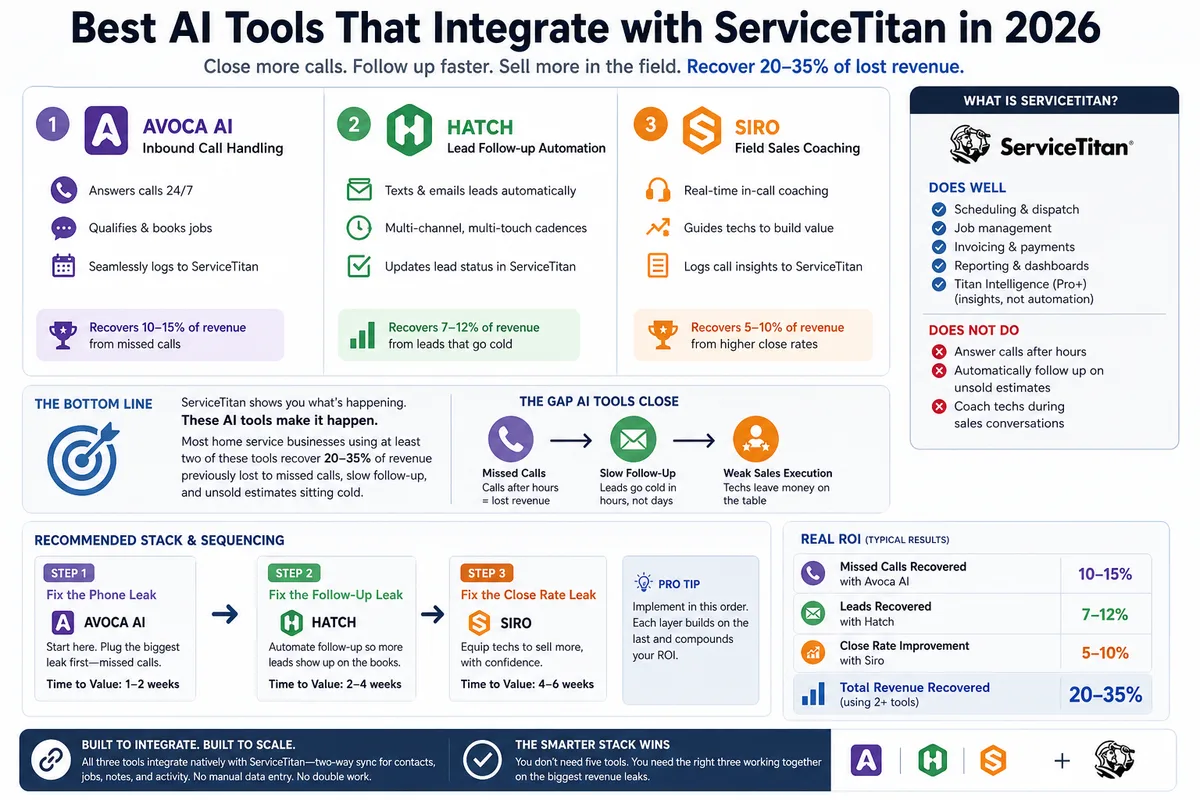
Best AI Tools That Integrate with ServiceTitan in 2026
Most ServiceTitan shops miss a meaningful share of inbound calls and leave most estimates unsold. These AI tools close those gaps inside ServiceTitan.
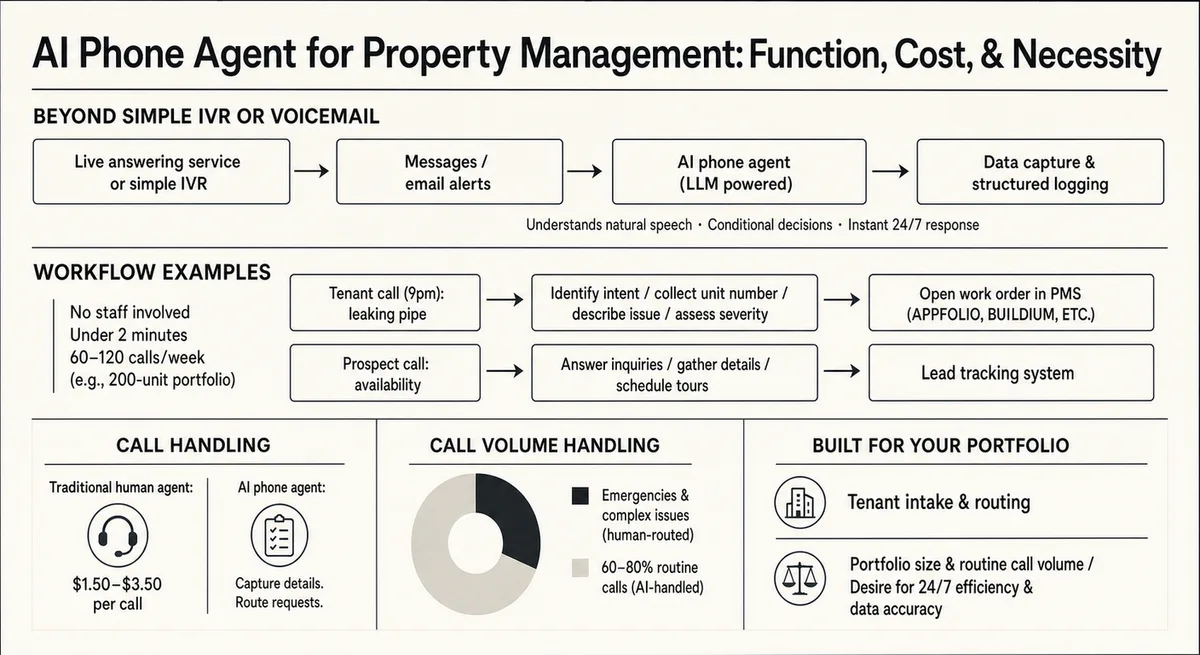
AI Phone Agent for Property Management: What It Does, What It Costs, and Whether You Need One
Property managers field heavy call volume, and a large share arrives after hours. AI phone agents answer, route, and log calls without adding live staff.
AI Automation for Construction Contractors: What Works in 2026
Construction contractors lose time to phone tag, missed leads, and manual follow-up. Here's which AI automation workflows usually matter first and how to.