
How Salon Automation Increases Client Lifetime Value
A typical salon loses a meaningful share of its client base to passive churn every year, turning what could be a long-term client relationship into a one-visit transaction. Automation (automated rebooking prompts, personalized follow-ups, and retention sequences) is the most reliable way to close that gap without burning out the people delivering services.
The average salon quietly loses a big share of its client base to passive churn every year. Here's how automation closes that retention gap and how to evaluate.
Epiphany Dynamics is an AI automation agency: we help businesses find and fix operational bottlenecks with AI receptionists, lead follow-up, and workflow automation.
The free 30-minute AI Operations Audit is a conversation about a normal week in your business and where the work piles up. We find the one change that would give you the most time back and send you a plain-English plan for it. No forms and no pitch.
Book a free AI audit
Patrick Gibbs
A typical salon loses a meaningful share of its client base to passive churn every year, turning what could be a long-term client relationship into a one-visit transaction. Automation (automated rebooking prompts, personalized follow-ups, and retention sequences) is the most reliable way to close that gap without burning out the people delivering services. This post breaks down the CLV logic your booking software isn’t showing you and the specific automation moves that move the needle on retention.
The Revenue Most Salon Owners Never See
A first-time client who books once and drifts is worth one visit. That same client, retained consistently, can be worth a long-term relationship across repeated services, product purchases, referrals, and loyalty moments. The gap between those two outcomes is client lifetime value, and most salon businesses are leaving the majority of it on the table.
The industry tends to fixate on acquisition: ads, referral promotions, social content. None of that is wrong, but it’s incomplete. Acquiring a new customer consistently costs several times more than retaining an existing one. In a service business with meaningful annual client churn, the math is clear: retention is the priority. And automation is the most reliable way to operationalize retention without burning out the people delivering the services. Our guide to client retention automation for beauty salons covers the five-layer automation stack in detail.
The CLV Math Your Booking Software Isn’t Showing You
Client lifetime value has a straightforward formula that most salon owners have never applied to their own numbers:
CLV = Average Ticket Value multiplied by Annual Visit Frequency multiplied by Average Client Lifespan
Use your booking history for the inputs. The point is not to copy an industry benchmark. The point is to see how much value changes when clients return more often and stay longer.
Here’s what that looks like across common retention scenarios:
| Retention Level | Client Pattern | Automation Role | CLV Effect |
|---|---|---|---|
| Low (no systems) | Clients drift unless someone remembers to follow up | None or inconsistent manual effort | Value depends mostly on chance and stylist memory |
| Moderate (basic reminders) | Clients receive reminders and easy rebooking prompts | Appointment reminders and post-visit follow-up | More return visits and fewer forgotten rebooks |
| High (full automation stack) | Clients receive service-aware reminders, education, and win-back messages | Segmented retention automation across the client lifecycle | Higher lifetime value through consistency between visits |
Moving from the “low” column to the “high” column doesn’t require raising prices or launching a new service menu. It requires consistent follow-through on the relationship between visits. Automation is the only mechanism most salons have to do that reliably at scale: a stylist with a large active client book physically cannot remember who needs a nudge and when. A system can.
Where Salons Leak Revenue Without Knowing It
The majority of salon churn is passive. Clients don’t have a bad experience and storm out. They have a fine experience, get busy, and drift. Enough time passes that it feels awkward to return, and they find someone closer or more convenient. Most client loss happens through this kind of passive churn, and most of it is preventable with timely, well-targeted follow-up.
The core issue is what you might call the follow-up gap. There’s a narrow window after each visit where a client is still warm, satisfied, and receptive. Most salons miss this window entirely because they’re focused on the next day’s appointments, not on systematically reaching back into yesterday’s client list. Without a triggered system, that window closes and the relationship cools.
No-shows compound the problem in ways that are easy to underestimate. Even free automated appointment reminder tools can reduce this loss substantially. Use your own no-show rate, average ticket, and appointment volume to calculate the revenue tied up in missed or late-canceled slots before accounting for the opportunity cost of blocked chair time that could have served a paying client.
What Salon Automation Actually Does (and Doesn’t Do)
Automation in the salon context isn’t robots giving haircuts. It’s the systematic, software-triggered execution of the relationship-maintenance behaviors that directly influence whether clients return: delivered at the right time, personalized to the individual, without requiring anyone on staff to remember to do it.
The highest-impact automation touchpoints break down like this:
- Pre-visit reminders: A reminder sequence before the appointment reduces no-shows in most real-world implementations. SMS consistently outperforms email at every stage of client communication because texts actually get opened. The format matters: confirmation plus reminder, not a single message blast.
- Post-visit follow-up: A message sent soon after a service, checking how the client is feeling, offering to address any concerns, and including a direct rebooking link, closes the loop while the experience is still fresh. Clients who receive structured post-visit follow-up rebook at measurably higher rates than those who receive nothing after checkout.
- Interval-based rebooking prompts: When a client’s natural return window is approaching, an automated prompt surfaces the option to book before they’ve thought to look elsewhere. This is the most direct lever for increasing annual visit frequency across the client base.
- Lapsed client reactivation: Clients who haven’t booked past their expected return window represent recoverable revenue. A targeted reactivation sequence, especially one that references their specific stylist and past services rather than sounding like a mass blast, can recover a meaningful share of lapsed clients who would otherwise be permanently lost. Our guide to win-back campaign automation for inactive clients covers the sequence logic that drives these recoveries.
The Rebooking Window: Your Highest-Use Trigger
Of all the automation touchpoints available, the immediate post-service period is both the most valuable and the most consistently underutilized. Clients who schedule a return appointment before leaving consistently show far higher retention than those who walk out without one. In a busy salon, stylists can’t always have that rebooking conversation at checkout. Automation fills the gap reliably.
The mechanics are straightforward: when a service is marked complete in the booking system, a triggered message goes out soon after checkout, thanking the client, inviting feedback, and presenting a direct link to rebook at the interval appropriate for their service type. The message can reference what they actually had done (“Time to book your next color touch-up?”), which makes it feel personal rather than automated, even though it is.
When a rebooking suggestion is embedded directly into the post-checkout confirmation flow, a meaningful share of clients accept a next appointment offered proactively at that moment. Without the prompt, far fewer do. The difference isn’t the quality of service: it’s whether the ask was made at the right time.
Personalization at Scale: Loyalty and Upsell Without Manual Work
A mature automation stack uses the data that already lives in your booking system to send the right message to the right client at the right time, without any manual effort per client. A color client receives different communications than a cut-only client. A client with a birthday next week responds to a different message than someone on their second visit. Segmentation is what separates outreach that feels relevant from outreach that feels like noise.
The highest-ROI personalization triggers for most salons are:
- Birthday messages: Sent before the date, not on it, so clients have lead time to actually book. Clients in a celebratory mindset consistently book larger services and add-ons. A modest birthday offer tied to a direct booking link reliably drives above-average ticket appointments.
- Retail purchase follow-ups: A message sent after enough time has passed for the client to use the product, asking how it’s working and offering to replenish or recommend a complementary product, generates repeat retail revenue that most salons leave completely untouched. The timing mirrors natural product usage cycles, which is what makes it feel helpful rather than pushy.
- Service education prompts: Clients who’ve only ever booked one service type can receive brief informational messages about complementary offerings relevant to their service history before their expected return. These aren’t hard sells. They’re timed education. A client who’s never tried a gloss might book one after a short, well-timed note explaining what it does and how it would interact with their existing color.
The cumulative effect of these touchpoints can be a modest but consistent per-visit ticket increase across the client base. That sounds small until you scale it across your active client count and annual visit frequency. The gain is generated with no additional advertising spend and no new staff.
Building the Stack: A Practical Build Order
Salon owners who implement automation effectively, rather than layering on tools randomly, tend to follow a consistent build sequence. Each layer builds on the last:
Start with appointment reminders. This is often the fastest ROI in the entire stack because it targets no-shows and late cancellations directly.
Add post-visit follow-up next. A simple follow-up with a rebooking link is the highest-use retention move after reminders. Most major booking platforms (Vagaro, Boulevard, GlossGenius, Mindbody) support this natively or via basic automation integrations.
Then add interval-based rebooking prompts. Map your primary service categories to their natural return windows and set triggers for each. This is where annual visit frequency starts to measurably climb across the client base.
After that, build lapsed client reactivation. Set sequences around your expected return windows and let them run continuously. These recover clients who would otherwise be permanently lost without ever generating a single staff task.
Add personalization layers last. Birthday offers, retail follow-ups, and service education messages can be built incrementally once the foundational layers are running cleanly.
The common mistake is attempting to build the entire stack simultaneously, getting overwhelmed, and implementing nothing. If reminders and post-visit follow-up increase annual visit frequency, the revenue lift is your active client count multiplied by your average ticket and the added visits. That is the most direct formula for estimating impact without changing prices, services, or marketing spend.
Retention Is the Product
The salons building durable businesses, not just busy ones, understand that retention isn’t just a result of good service. It’s a system. Great service gets a client to come back once. Systems get them to come back for years. Automation extends the relationship-building capacity of every stylist on the floor to every client in the database, not just the ones who came in last week.
Run the CLV formula against your own numbers. Estimate your actual annual churn rate. Then look honestly at whether your current process, whatever it is, systematically captures those high-value, multi-year client relationships, or leaves them to chance. The math, once it’s sitting in front of you with your actual averages in it, tends to make the case for building better systems more clearly than any outside argument can.
For salons looking to implement these systems without building from scratch, AI-driven client communication platforms and front-desk automation tools, including solutions from boutique automation agencies like Epiphany Dynamics, can significantly compress the build timeline. But the fundamentals laid out here apply regardless of which platform or approach you use. The principles are the point.
Frequently Asked Questions
Q: What is the actual client lifetime value difference between a salon with no retention system and one with full automation?
The difference is whatever your own CLV formula says: average ticket multiplied by annual visit frequency multiplied by average client lifespan. A salon with no retention system depends on chance for return visits. A salon with reminders, rebooking prompts, and win-back sequences has more chances to extend the relationship between visits.
Q: What is the typical no-show rate at salons without automated reminder systems, and what does it cost?
Salons without automated reminder systems can see no-show and late cancellation rates become a material revenue leak. Use your average ticket and weekly appointment volume to estimate the cost of missed slots before accounting for the opportunity cost of blocked chair time. A reminder sequence gives the salon a clear before-and-after metric to track.
Q: What is the highest-ROI single automation for a salon that is just getting started?
Appointment reminders. A simple SMS reminder sequence is often the easiest place to start because it targets a visible revenue leak: no-shows and late cancellations. Most major booking platforms (Vagaro, Boulevard, GlossGenius, Mindbody) support this natively or via basic automation integrations. Start here, measure the improvement, then build the post-visit follow-up layer.
Q: How much incremental annual revenue can interval-based rebooking prompts generate for a salon?
Use this formula: active clients multiplied by average ticket multiplied by added annual visits per client. Interval-based rebooking prompts are powerful because they influence visit frequency across the entire client base without requiring more ad spend.
Q: How does lapsed client reactivation automation work, and what recovery rate should a salon expect?
Lapsed client reactivation sequences target clients who have passed their expected return window with a targeted outreach campaign, specifically one that references their stylist by name and past services rather than sounding like a mass blast. A well-designed reactivation sequence running continuously can recover a meaningful share of lapsed clients who would otherwise be permanently lost. The value is your recovered client count multiplied by your average ticket and future visit frequency, with no new acquisition cost.
Patrick Gibbs
AI Automation Expert
Patrick Gibbs helps professional practices implement AI automation that captures more leads, books more appointments, and scales without adding overhead. He's the founder of Epiphany Dynamics and creator of the AI Front Desk system.
Related Solutions
Build this into a real workflow
Related Posts
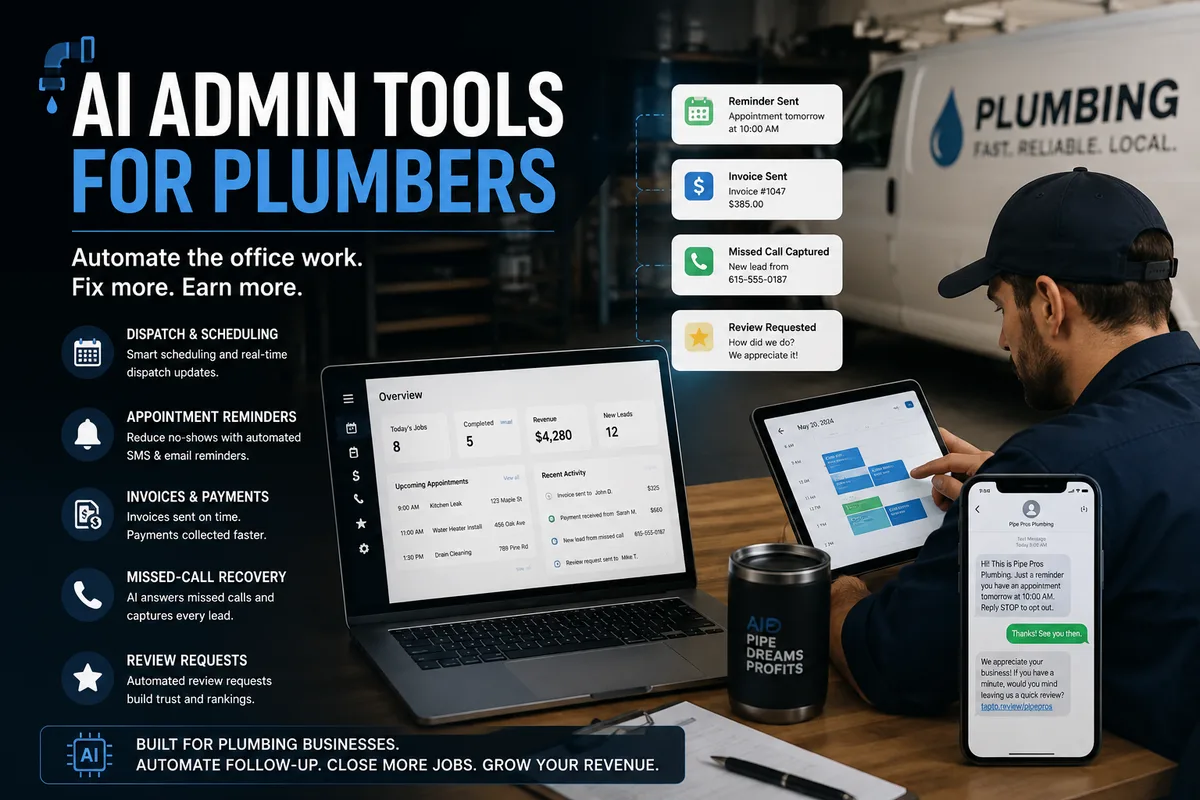
AI Admin Tools for Plumbers: What They Are and How to Choose
AI admin tools automate dispatch, reminders, invoicing follow-up, missed calls, and review requests for plumbers. What they do and how to choose.
Insurance Eligibility Automation for Physical Therapy Clinics
Eligibility automation for physical therapy clinics verifies benefits before the patient arrives, cuts front desk phone work, and can lower claim denial risk.
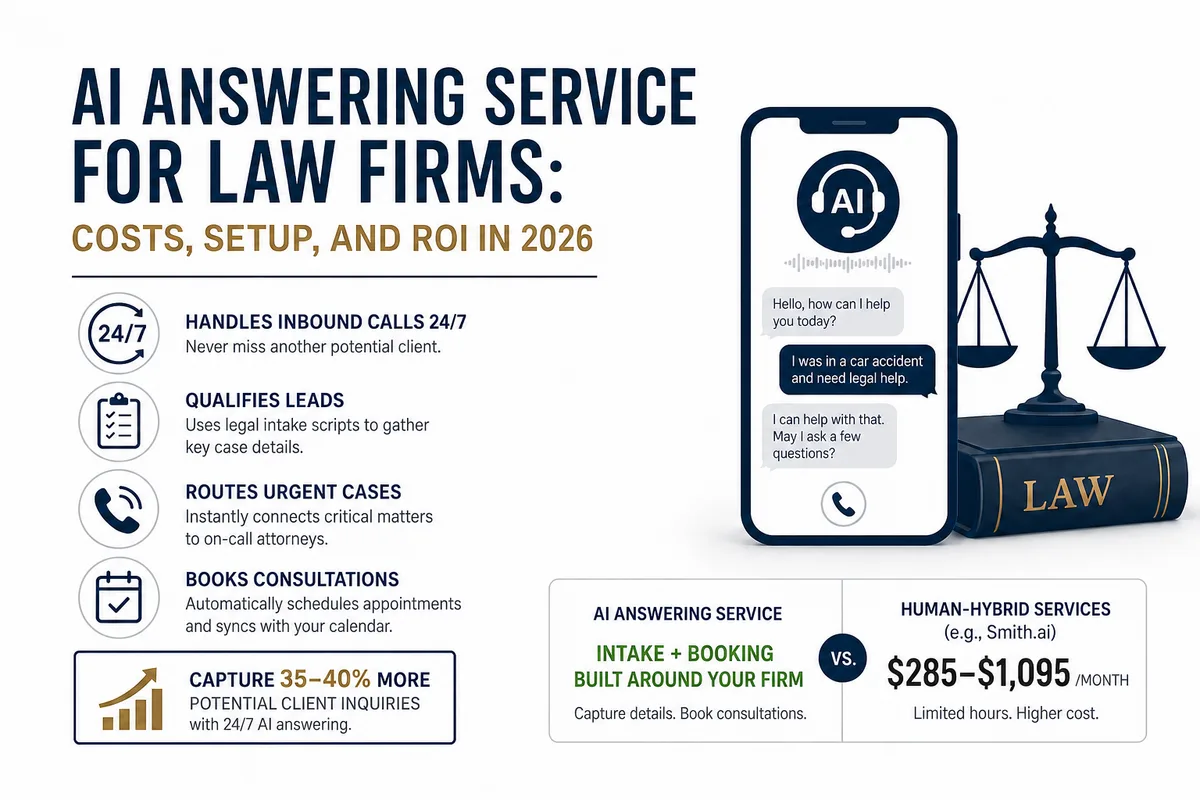
AI Answering Service for Law Firms: Costs, Setup, and ROI in 2026
Law firms miss a large share of inbound calls, most of them after hours. Here's what an AI answering service actually does, what it costs versus human.