
How to Recover Revenue from Missed Calls: A Business Owner's Guide
Small and mid-sized businesses miss a large share of inbound calls, and most of those callers never leave a voicemail. They hang up and dial your competitor.
Businesses miss a large share of inbound calls, and most of those callers never leave a voicemail. Here's how to calculate your actual revenue leak and build a.
Epiphany Dynamics is an AI automation agency: we help businesses find and fix operational bottlenecks with AI receptionists, lead follow-up, and workflow automation.
The free 30-minute AI Operations Audit is a conversation about a normal week in your business and where the work piles up. We find the one change that would give you the most time back and send you a plain-English plan for it. No forms and no pitch.
Book a free AI audit
Patrick Gibbs
Small and mid-sized businesses miss a large share of inbound calls, and most of those callers never leave a voicemail. They hang up and dial your competitor. This guide shows you how to calculate your actual revenue leak, why voicemail and answering services don’t solve it, and how to build a system that genuinely recovers what you’re losing.
Every Missed Call Is a Closed Door, With Money Walking Out Behind It
Every unanswered phone call is a revenue leak. Not a potential one: an actual, measurable one. Industry research consistently finds that phone calls are the highest-converting inbound lead source for local service businesses, with most owners ranking calls above web forms, walk-ins, and social media inquiries. Call-tracking studies also consistently find that small and mid-sized businesses miss a large share of incoming calls, depending on industry, staffing, and time of day.
Do the math on your own operation: monthly missed calls x answered-call conversion rate x average first-transaction value x realistic recovery share. The problem is rarely negligence: most operators know missed calls are bad. The problem is that the traditional systems designed to catch those calls were built for a different era. This guide breaks down how to quantify your actual revenue leak, why the standard fixes don’t work, and how to build a system that genuinely recovers what you’re losing.
Step One: Quantify the Revenue Gap Before You Fix Anything
The first mistake businesses make is skipping the audit. Voicemail feels like a safety net: a passive catch for anything that slips through. It isn’t. Consumer research consistently finds that only a small minority of callers leave a voicemail when they can’t reach a live person. The rest hang up and immediately call the next option in their search results. In competitive verticals (dental, legal, home services, medical aesthetics, HVAC), that next option is often listed directly below you on Google.
Use this framework to estimate your monthly revenue leak before touching any technology:
- Total inbound calls/month: pull this from your VoIP dashboard or phone carrier
- Estimated miss rate: use your observed miss rate from phone records; after-hours and overflow are the main culprits
- Caller-to-customer conversion rate: use your own answered-call conversion rate or start with a conservative planning assumption
- Average first-transaction value: what does a new customer spend on their first visit or job?
Planning worksheet for a medical aesthetics practice:
| Variable | Use Your Number |
|---|---|
| Monthly inbound calls | From call logs |
| Miss rate (after-hours + overflow) | Observed from phone data |
| Missed calls per month | Total calls x miss rate |
| Conversion rate (answered calls) | From answered-call history |
| Avg. first-visit revenue | From invoices or booking data |
| Monthly revenue leak | Missed calls x conversion x average value |
| Annual revenue leak | Monthly leak x annualization period |
Use our cost of missed calls calculator to find your exact number. Most businesses that run this calculation are genuinely surprised because the compounding effect of missed leads is rarely visualized.
Why Calls Get Missed: The Actual Root Causes
The reflexive answer is “we’re busy.” The data tells a more specific story. Call-tracking studies consistently find that a substantial share of inbound calls arrive outside normal business hours. For service businesses especially, high-intent purchase decisions don’t respect office schedules. A prospective client deciding on a home renovation after dinner or a dental patient researching implants on a weekend is ready to act, not ready to wait until Monday.
The second major factor is overflow during peak hours. Lunch hours, early mornings, and late afternoons see concentrated call spikes. If your front desk has one operator, parallel calls go directly to voicemail. This is where the 5-minute rule becomes critical: lead-response research consistently finds that your odds of contacting a lead fall off sharply within the first minutes after an initial inquiry, and the longer the wait, the worse those odds get. Every minute of delay is compounding lost probability.
The third factor is the follow-up gap. Even when voicemails are left, callback workflows in most small businesses are ad-hoc at best. There’s no service level agreement, no tracking, no accountability. A voicemail left at 2 PM may not get a callback until the following morning, by which point the caller has already booked with a competitor who answered on the first ring.
Why Traditional Solutions Don’t Solve the Problem
Voicemail is not a solution. It’s a delay mechanism that filters out most of your prospects before you ever speak to them. Live answering services are closer, but come with their own failure modes. The operator often can’t access your booking system, can’t answer service-specific questions, and can’t make real-time decisions about urgency. You’re paying for message-taking, not lead recovery.
Call center solutions scale better but introduce latency, variability in agent quality, and limited contextual knowledge of your business. Turnover in call centers is notoriously high, which means the person answering your calls today may have started recently.
| Solution | Cost Profile | 24/7 Coverage | Can Book Appointments | Consistent Quality | Business-Specific Knowledge |
|---|---|---|---|---|---|
| Voicemail | Low direct cost, high opportunity cost | Passive only | No | N/A | No |
| Live Answering Service | Recurring service fee | Sometimes | Rarely | Variable | Partially |
| Call Center | Higher recurring service fee | Often | Sometimes | Variable | Rarely |
| AI Voice Agent | Subscription and usage based | Yes | Yes | High | Yes (trained) |
The fundamental constraint with human-staffed solutions isn’t motivation. It’s concurrency. A person handles one call at a time. An AI voice agent can handle concurrent calls after hours, on holidays, and during rush periods with no hold queue.
There is more on this in Missed Call Text Back Automation: Build It Right in 2026.
How Modern AI Voice Systems Actually Work
Modern AI voice agents are not the phone trees of the early 2000s. They’re built on large language models paired with real-time speech synthesis and natural language understanding, capable of conducting fluid, context-aware conversations that the vast majority of callers cannot distinguish from a human. The interaction isn’t scripted in a rigid flowchart sense; the AI understands intent, handles interruptions, manages unexpected responses, and adapts mid-conversation the way a trained receptionist would.
The missed call recovery workflow typically looks like this:
- Trigger: A call arrives after hours, or all lines are occupied during peak volume
- Interception: The AI agent answers quickly, identifies itself and the business by name
- Intent qualification: Open-ended questions surface what the caller actually needs: booking, pricing, emergency, general inquiry
- Action or escalation: The agent either books directly via calendar integration, routes urgent calls to a mobile number, or captures detailed lead information with context
- Immediate notification: A real-time SMS or email summary is sent to the business owner with the call transcript
- Caller follow-up: An automated SMS confirms the appointment or next steps to the caller within seconds
The practical difference from older IVR (interactive voice response) systems is that the AI doesn’t fail when a caller goes off-script. If someone says “I need to reschedule, not make a new appointment,” the system understands that and adjusts. If someone is upset and wants to speak to a manager, the system recognizes the escalation signal and routes accordingly.
A Six-Step Framework for Implementing Missed Call Recovery
Step 1. Audit Your Current Miss Rate
Pull recent call data from your phone system or VoIP provider. Compare total inbound calls to answered calls. Break it down by time of day to identify your peak miss windows. If you don’t have call tracking yet, choose a tool that provides total calls, answered calls, missed calls, and attribution data. This alone often reveals more than the AI system itself.
Step 2. Map Your Five Core Call Intents
For most service businesses, a large share of inbound calls fall into five categories: new appointment booking, pricing inquiry, existing appointment questions, directions or hours, and genuine emergencies. Your AI system must handle all five competently before going live. Document the ideal response for each, including what questions to ask and what information to capture.
Step 3. Define Escalation Rules Before Deployment
Not every call should be handled identically. A new patient inquiry can be resolved end-to-end by AI. A genuine medical or home emergency should route immediately to a live person. A billing dispute may need a callback from management. Build this logic explicitly. Don’t assume the AI will infer it without clear instructions.
Step 4. Integrate With Your Booking and CRM Systems
An AI that can only take messages is marginally better than voicemail. The real value is real-time booking directly into your calendar. Most modern AI voice platforms integrate with Calendly, Google Calendar, Mindbody, Jane App, Acuity, and other scheduling tools. If your CRM is HubSpot, Salesforce, or GoHighLevel, configure the integration so every AI-handled call logs automatically with a transcript.
Step 5. Set Notification Workflows
You should know quickly when the AI handles a high-value inbound call. Configure SMS alerts for new booking attempts, escalation triggers, and any call where the AI was unable to resolve the inquiry. This keeps you in the loop without requiring you to monitor a dashboard manually.
Step 6. Monitor and Tune After Launch
Listen to call recordings during the early rollout. Look for patterns: where do callers get confused? Where does the AI’s phrasing feel unnatural? Where are calls escalating that shouldn’t be? Most platforms allow prompt or script adjustments without rebuilding from scratch. Expect to refine the system as real callers expose edge cases. That’s normal, not a sign of failure.
What to Realistically Expect During Early Rollout
Most businesses should expect recovery to come first from after-hours calls that previously went to voicemail. The recovery rate won’t be perfect: some callers simply won’t engage with an AI regardless of how natural the experience is. In practice, a properly configured and well-integrated system can recover a meaningful share of previously missed calls.
Use this worksheet instead of borrowing someone else’s example:
| Metric | Your Input |
|---|---|
| Previously missed calls/month | From your call audit |
| Recovery rate (AI-handled) | Your planning assumption |
| Recovered call attempts | Missed calls x recovery assumption |
| Conversion to booked appointment | Your answered-call conversion rate |
| New patients/month recovered | Recovered attempts x conversion rate |
| Revenue recovered/month | Recovered customers x average value |
| AI system cost/month | Your vendor quote |
| Net monthly gain | Recovered revenue minus system cost |
If your worksheet shows recovered revenue above the system cost, the project deserves a serious pilot. The ceiling continues to rise as you tune the AI’s responses and expand coverage to additional phone lines or locations. Beyond pure revenue recovery, businesses can also see a secondary benefit: staff time freed from routine intake calls, which compounds the ROI further when that time redirects toward higher-value work.
The Takeaway: Your Calls Are Already Worth Recovering
Recovering revenue from missed calls is not a technology problem at its core. It’s a systems problem. The revenue is already being generated by your marketing, your reputation, and your Google presence. It’s just not being captured at the moment of highest intent. Understanding the true cost of unanswered business calls makes the urgency clear. The audit, the escalation logic, the integrations, and the 30-day tuning cycle matter as much as the AI itself. Get those foundations right and the technology delivers on its promise.
The barrier to entry has dropped dramatically. AI voice solutions no longer require enterprise budgets or dedicated hardware for many small businesses. If you haven’t run a recent call audit, that’s the place to start: not with a vendor demo, but with your own data. The number you find will tell you everything you need to know about urgency. For businesses ready to move from audit to implementation, working with an experienced AI deployment partner, such as Epiphany Dynamics, can compress that timeline significantly and reduce the trial-and-error cycle.
Frequently Asked Questions
Q: What percentage of callers who reach voicemail will actually leave a message?
Consumer research consistently finds that only a small minority of callers leave a voicemail when they cannot reach a live person. The rest hang up and immediately call the next option in their search results. This makes voicemail a delay mechanism that filters out your highest-intent prospects, not a safety net that preserves the lead.
Q: How do I find out how many calls my business is actually missing each month?
Pull recent data from your VoIP provider, phone carrier, or call tracking platform. You need total calls, answered calls, missed calls, and enough attribution detail to separate business-hours, after-hours, and overflow misses. Divide missed by total to get your miss rate.
Q: What are the five core call intents that an AI voice agent needs to handle reliably before going live?
For most service businesses, a large share of inbound calls fall into five categories: new appointment booking, pricing inquiry, existing appointment questions, directions or hours, and genuine emergencies requiring live transfer. Your AI system must handle all five competently before going live on your primary number. Document the ideal response and required data capture for each intent before touching any vendor configuration.
Q: How long does it take for an AI missed call recovery system to pay for itself?
The payback timeline depends on your missed-call volume, conversion rate, average transaction value, and vendor quote. Many businesses see meaningful revenue recovery from after-hours calls that previously went to voicemail, but the only defensible answer is the one produced by your own call audit.
Q: What is the most important difference between modern AI voice agents and older IVR phone tree systems?
Modern AI voice agents do not require callers to navigate menus or use specific keywords. They understand natural language intent, handle interruptions, manage unexpected responses, and adapt mid-conversation the way a trained receptionist would. When a caller says “I need to reschedule, not make a new appointment,” the AI understands and adjusts rather than looping or failing. This fundamental behavioral difference is what drives the conversion improvement over legacy systems.
Patrick Gibbs
AI Automation Expert
Patrick Gibbs helps professional practices implement AI automation that captures more leads, books more appointments, and scales without adding overhead. He's the founder of Epiphany Dynamics and creator of the AI Front Desk system.
Related Solutions
Build this into a real workflow
Related Posts
Best AI Receptionist for Small Business: How to Choose
The best AI receptionist for a small business is the one that answers quickly, books or routes correctly, escalates cleanly, and fits the tools your team.
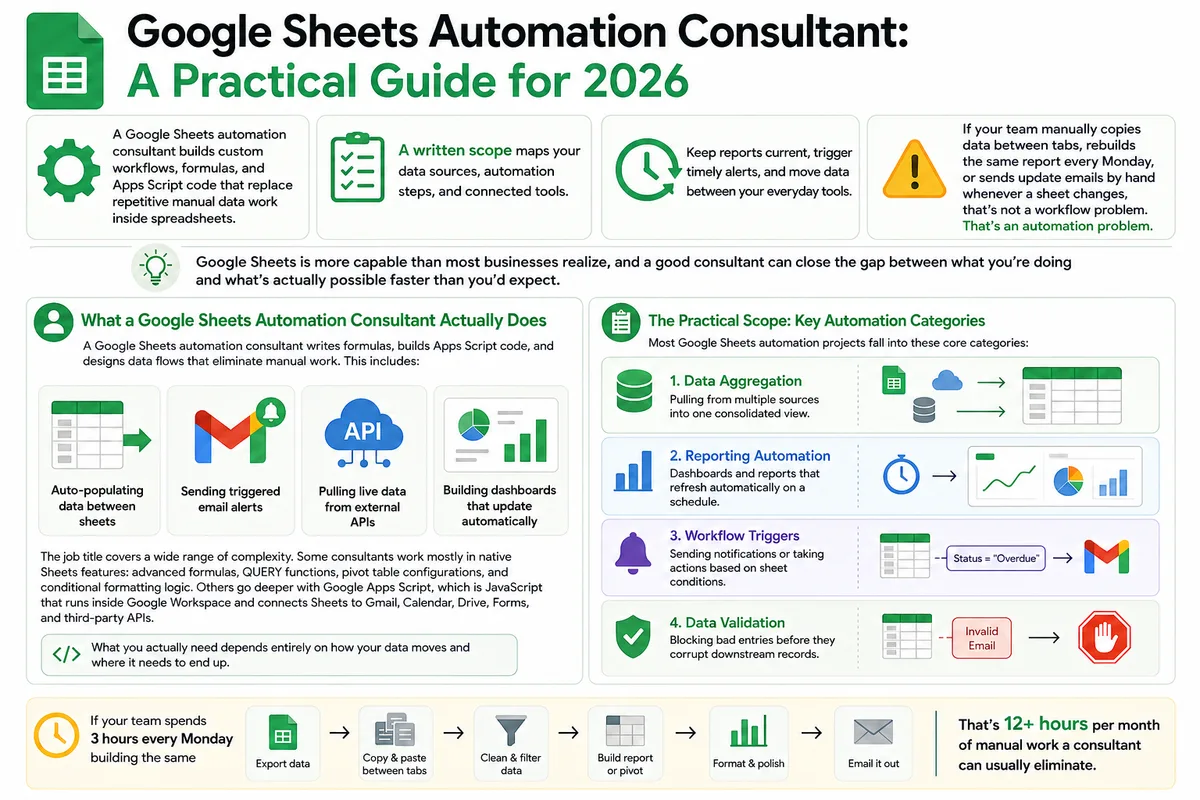
Google Sheets Automation Consultant: A Practical Guide for 2026
Most businesses don't track what spreadsheet work actually costs them. Here's what a Google Sheets automation consultant does in 2026, how to judge the value.

Business Process Automation Consultant for Small Business
Hiring the wrong automation consultant wastes thousands. Here's what small business owners need to know about process, cost, ROI, and how to vet the right one.