
Business Growth
How HVAC Companies Scale With AI Automation
Inside the systems that successful HVAC contractors use to handle heavy call volume, book appointments automatically, and scale without hiring armies of office.
The free 30-minute AI Operations Audit is a conversation about a normal week in your business and where the work piles up. We find the one change that would give you the most time back and send you a plain-English plan for it. No forms and no pitch.
Book a free AI audit
Patrick Gibbs
AI automation supports HVAC business growth by removing the manual front-office bottlenecks that collapse under scale. Automating call answering, lead qualification, scheduling, and dispatch intake helps contractors handle more demand without increasing overhead at the same pace.
The HVAC Growth Paradox
You started your HVAC business to do great work and make great money. But as you grow, you find yourself spending less time on jobsites and more time managing chaos:
- Phones ringing off the hook during summer heat waves
- Dispatchers struggling to keep up with scheduling
- Leads falling through the cracks because you can’t call them back fast enough. The 5-minute rule for speed-to-lead shows why the first responder usually wins the job
- Good techs leaving because they’re tired of the administrative mess
Here’s the paradox: The more successful you become, the harder it gets to maintain the quality and responsiveness that made you successful in the first place.
Unless you have the right systems in place.
Breaking the Ceiling
The HVAC companies that scale cleanly tend to share one pattern: they automate the front office before call volume overwhelms the team. Calls are answered, qualified, routed, scheduled, and followed up without depending on a dispatcher to manually touch every step.
The Anatomy of a High-Performing HVAC Call Flow
Stage 1: Instant Response
Every call gets answered immediately by an AI receptionist that:
- Greets the caller with your company’s custom greeting
- Determines if it’s a service call, sales inquiry, or emergency
- For emergencies: Immediately escalates with full context
- For service/sales: Begins qualification process
Stage 2: Intelligent Qualification
The AI asks the questions that matter:
- “Are you the homeowner or a tenant?”
- “Is this for heating, cooling, or both?”
- “How old is your current system?”
- “What’s your timeline for this project?”
- “What’s the best email to send you a confirmation?”
All of this information is captured and synced to your CRM automatically.
Stage 3: Automated Scheduling
For standard service calls:
- AI checks your calendar in real-time
- Offers available time slots
- Books the appointment immediately
- Sends confirmation SMS and email
- Adds the job to your dispatch board
For complex sales inquiries:
- AI qualifies the lead thoroughly
- Books a consultation for the next available slot
- Sends pre-appointment information
- Notifies your sales team with full lead context
Stage 4: Follow-Up Automation
After booking:
- Pre-appointment reminder with technician details when available
- “We’re on our way” notification before arrival
- After-completion review request and maintenance plan offer
- Seasonal maintenance reminder based on service history
Scaling Without the Headcount
Traditional growth in the HVAC industry means hiring:
- More dispatchers
- More office managers
- More sales coordinators
With AI automation, call handling, booking, and follow-up can work together around your existing tools.
What the Math Looks Like
The scenarios below are illustrative of patterns across service businesses, not specific client engagements.
A regional HVAC company running multiple dispatchers and receptionists spends six figures a year on phone coverage alone. Moving routine answering, booking, and dispatch intake to AI typically means one dispatcher overseeing the system instead of a full front-office rotation, with payroll savings to match.
A commercial and residential shop that lets after-hours calls roll to voicemail is handing emergency jobs to competitors every week. With AI answering around the clock, those calls get captured instead, and a single recovered after-hours emergency can pay for months of the system’s ongoing cost.
The Emergency Call Goldmine
HVAC emergencies don’t happen on a schedule. They happen at night, on weekends, during heat waves, and on holidays when the customer’s comfort or safety problem feels urgent.
Every emergency call you miss is a customer who will:
- Call your competitor
- Pay whatever they ask
- Become their customer for life
AI automation helps capture emergency calls that would otherwise go to voicemail. The value depends on your missed-call volume, average emergency-ticket value, service area, and ability to dispatch quickly. See the full breakdown of how HVAC companies capture after-hours calls and prevent missed jobs.
Integration That Actually Works
The best HVAC automation systems integrate smoothly with:
- ServiceTitan, Housecall Pro, or Jobber for job management
- Google Calendar or Outlook for scheduling
- QuickBooks or Xero for invoicing
- Your existing phone system for smooth call routing
- SMS platforms for customer communication
No double data entry. No switching between apps. Everything flows automatically.
The Maintenance Agreement Machine
The most profitable HVAC companies have high maintenance agreement penetration. AI automation improves this by:
- Offering maintenance plans during every service call booking
- Following up automatically after installations
- Sending seasonal reminders with one-click enrollment
- Tracking expiration dates and renewal sequences
Many companies find that automated enrollment and renewal sequences help grow their maintenance agreement base. Our HVAC voice automation guide outlines how operators implement this exact playbook.
For a broader view, see From Voicemail to Victory: How Nashville HVAC Operators Scale with AI Voice.
What Scaling HVAC Companies Do Differently
Successful HVAC operations usually separate themselves through systems discipline, not just bigger ad budgets or more trucks.
They Treat Every Call Like Gold
High-performers understand that missing a call isn’t just losing that job: it’s wasting the marketing spend that generated the call. They use AI to make answer coverage more consistent during busy windows, after-hours periods, and overflow spikes.
They Qualify Before They Quote
Wasting time on unqualified prospects kills profitability. AI pre-qualification ensures your techs only visit homes where there’s a real opportunity.
They Follow Up Relentlessly
HVAC customers typically contact several companies before making a decision. Automated follow-up sequences ensure you’re the company that stays top-of-mind.
They Maximize Lifetime Value
One service call should lead to a maintenance agreement, which leads to a replacement, which leads to referrals. AI nurtures customers through this entire lifecycle automatically.
Implementation Roadmap
Foundation: Deploy AI voice assistant for call answering Booking layer: Add automated SMS sequences for confirmations and reminders Post-job layer: Implement follow-up and review request automation Retention layer: Launch maintenance agreement enrollment sequences Seasonal layer: Add seasonal campaign automation Optimization layer: Refine routing, scripts, and reporting based on data
The Bottom Line
The HVAC companies winning now aren’t always the ones with the most trucks or the biggest ad budgets. They’re the ones with the best systems. They’re capturing more leads, following up more consistently, and maximizing customer lifetime value, all while their competitors are still playing phone tag.
AI automation isn’t the future of HVAC business operations. It’s the present. And the companies that embrace it now will dominate their markets for years to come.
Frequently Asked Questions
Q: What is the ceiling that prevents most HVAC companies from scaling?
The primary ceiling is the front office: manual call answering, manual scheduling, and manual data entry collapse under volume. When the owner and dispatcher are handling every call and booking, the business cannot grow faster than they can personally work. AI automation helps break this ceiling by handling routine call flow and routing while the team focuses on judgment calls.
Q: How much can HVAC companies save by replacing dispatchers and receptionists with AI?
An AI voice system can take over much of the routine phone coverage that previously required additional front-office staffing. In the strongest cases, the dispatcher becomes the person overseeing exceptions, escalations, and schedule quality instead of answering every routine call manually.
Q: How quickly do HVAC companies recover their AI automation investment?
The payback depends on missed-call volume, average ticket value, staffing cost, and how many bookings the system captures that would otherwise be lost. The higher your call volume and the more expensive each missed opportunity is, the stronger the business case becomes.
Q: What is the maintenance agreement opportunity with AI automation?
AI voice assistants offer maintenance plans during every appropriate booking call, something human staff frequently skip when busy. Automated enrollment and renewal sequences can grow a maintenance agreement base substantially over time, creating predictable recurring revenue that stabilizes cash flow.
Q: Do larger HVAC companies use AI differently than smaller contractors?
Yes. Larger companies layer in predictive scheduling, dynamic route optimization, automated inventory management, and business intelligence dashboards on top of the core AI call answering. The foundation (AI voice automation) is the same, but larger companies add advanced analytics and multi-location management systems that require clean data infrastructure.
Patrick Gibbs
AI Automation Expert
Patrick Gibbs helps professional practices implement AI automation that captures more leads, books more appointments, and scales without adding overhead. He's the founder of Epiphany Dynamics and creator of the AI Front Desk system.
Related Solutions
Build this into a real workflow
Related Posts
AI Phone Answering for Contractors: Costs, Features, and ROI in 2026
Contractors miss a large share of inbound calls while techs are on job sites. Here's how AI phone answering services work, what they cost, and when they.
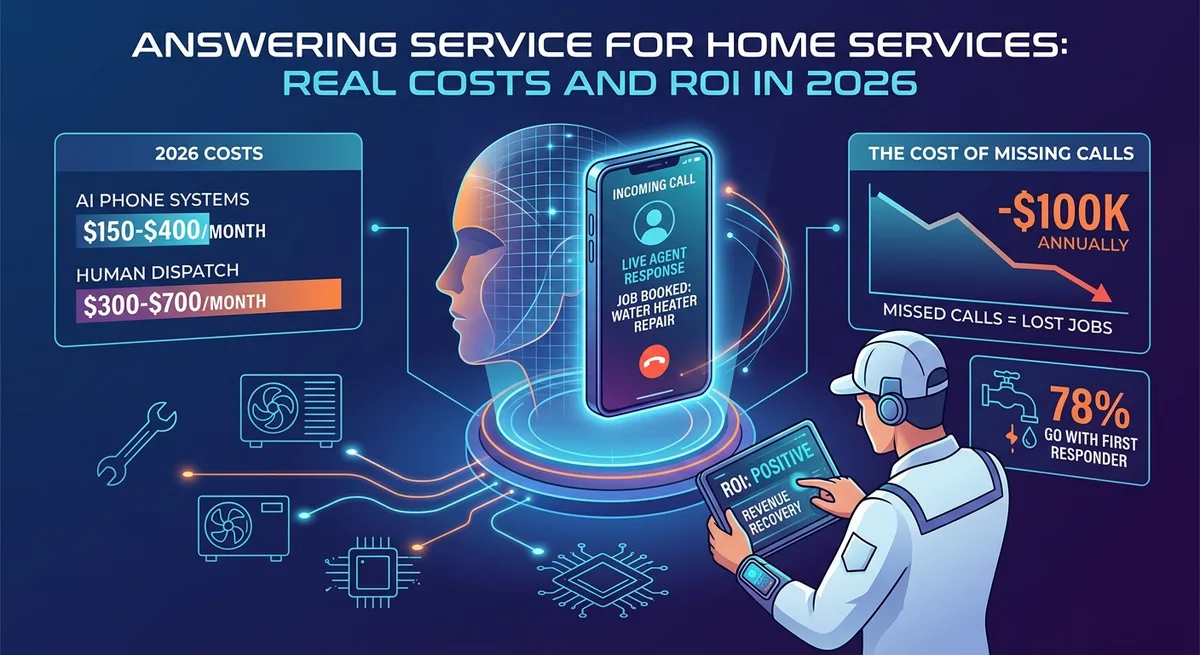
Answering Service for Home Services: Real Costs and ROI in 2026
Most callers who reach voicemail won't leave a message. For home service contractors, every missed call is a job going to a competitor.

What Is a Lead Capture System? The Honest 2026 Breakdown
Most businesses have some version of lead capture running. Most of it leaks. Here's what a real lead capture system actually includes, what it costs to run.