
ServiceTitan AI Integration: Automating Your HVAC Workflow
ServiceTitan AI integration connects your AI voice assistant directly to your field service management platform, reducing manual data entry between them. The value comes from cleaner handoffs: every AI-booked appointment, customer detail, and call summary can flow into your ServiceTitan workflow instead of sitting in a disconnected inbox.
Discover how integrating AI voice assistants with ServiceTitan creates a smooth workflow: from first call to completed job.
Epiphany Dynamics is an AI automation agency: we help businesses find and fix operational bottlenecks with AI receptionists, lead follow-up, and workflow automation.
The free 30-minute AI Operations Audit is a conversation about a normal week in your business and where the work piles up. We find the one change that would give you the most time back and send you a plain-English plan for it. No forms and no pitch.
Book a free AI audit
Patrick Gibbs
ServiceTitan AI integration connects your AI voice assistant directly to your field service management platform, reducing manual data entry between them. The value comes from cleaner handoffs: every AI-booked appointment, customer detail, and call summary can flow into your ServiceTitan workflow instead of sitting in a disconnected inbox.
The Disconnect That’s Costing You Hours Every Day
Your phone rings. An AI voice assistant answers, qualifies the lead, and books the appointment. The customer hangs up satisfied. But then what?
For most HVAC companies, the answer is disappointing: someone manually enters that information into ServiceTitan. Maybe it’s the tech who just finished a job, sitting in his truck typing details into a tablet. Maybe it’s the office manager who already has a full queue of tasks. Either way, it’s a bottleneck that kills momentum and introduces errors.
For the full picture of what a connected front desk looks like in production, see our AI receptionist for ServiceTitan page. For businesses evaluating the dispatch side specifically, our guide to plumbing dispatch software covers platform selection and ROI at every scale. This is the hidden cost of disconnected systems. You’ve invested in AI to capture leads faster, but you’re still manually bridging the gap between your voice automation and your field service management.
The solution? Native ServiceTitan integration that turns your AI voice assistant into a true extension of your workflow, not just a front-end answering service.
What Is ServiceTitan Integration?
ServiceTitan integration connects your AI voice assistant directly to your field service management platform. Instead of the AI operating as a standalone tool that hands off information for manual entry, it becomes an automated data pipeline that:
- Creates customer records instantly
- Generates service tickets automatically
- Schedules appointments directly in your dispatch board
- Updates job statuses in real-time
- Triggers follow-up sequences without human intervention
The result is a closed-loop system where a customer call flows through qualification, booking, dispatch, and completion, without anyone retyping information or switching between apps.
ServiceTitan AI integration use cases
ServiceTitan AI integration is not one feature. It is a set of workflows that share the same connection to your account. The most common ones for home service companies are:
- AI receptionist booking jobs. Calls are answered, qualified, and booked straight into your dispatch board.
- After-hours call capture. Calls that used to roll to voicemail get answered, logged, and booked while your office is closed.
- Call summary to the customer record. Conversation summaries are written back to the right ServiceTitan customer, so the next person who picks up the account has context.
- Review request after job completion. A completed job triggers a review request automatically. See our guide to automating review requests on job completion.
- Estimate follow-up. Open estimates get a timely, polite nudge instead of going cold.
- Membership renewal reminders. Expiring agreements trigger outreach before the customer lapses.
- Dispatch handoff notes. Booking details and call context land with the technician, so nobody arrives unprepared.
Texting rides the same connection. Our guide to AI texting that works with ServiceTitan covers the SMS side, and the AI receptionist for ServiceTitan integration guide walks through how the connection is built.
Get a ServiceTitan Automation Map. We will map which of these workflows fit your account, what connects through ServiceTitan’s API, and where a person stays in the loop. Get a ServiceTitan Automation Map.
The Technical Architecture
Understanding how ServiceTitan integration works helps you evaluate whether your AI provider truly delivers smooth workflow automation or just basic API connections.
API-First Design
Modern ServiceTitan integration uses RESTful APIs to enable real-time data exchange:
Outbound from AI to ServiceTitan:
- Customer creation/lookup via phone number matching
- Location and property data population
- Service ticket generation with AI-captured details
- Appointment scheduling with technician availability checks
- Call logs and conversation transcripts attached to customer records
Inbound from ServiceTitan to AI:
- Real-time technician availability for accurate scheduling
- Job status updates for customer inquiry responses
- Customer history access for personalized service
- Warranty and membership information for upsell opportunities
Webhook-Driven Synchronization
The most sophisticated integrations use webhooks for instant updates rather than polling:
- New appointment booked → ServiceTitan dispatches notification to technician’s mobile app within seconds
- Technician marks job complete → AI automatically triggers review request and maintenance reminder
- Customer calls back → AI instantly accesses job history for context-aware conversation
Bidirectional Data Flow
True integration means data moves both ways automatically:
| Trigger | AI Action | ServiceTitan Update |
|---|---|---|
| Incoming call | Answers and qualifies | Logs call, searches existing customer |
| New customer confirmed | Captures contact details | Creates customer record |
| Service need identified | Books appointment | Creates job ticket, assigns technician |
| Appointment scheduled | Confirms with customer | Updates dispatch board, notifies tech |
| Day of service | Sends reminder SMS | Marks job as dispatched |
| Job completed | Requests review | Updates job status, triggers invoicing |
Real-World Efficiency Levers
The value of ServiceTitan integration comes from reducing repeated manual handoffs, not from a universal benchmark that applies to every shop.
Admin Work Removed From Each Job
| Task | Without Integration | With Integration | Time Saved |
|---|---|---|---|
| Customer data entry | Staff retype caller details | Customer details sync automatically | Less retyping |
| Appointment scheduling | Staff checks availability manually | AI checks availability before booking | Fewer handoffs |
| Job ticket creation | Staff creates the ticket after the call | Ticket is generated from captured call data | Less duplicate entry |
| Call logging | Notes are written after the fact | Call summary attaches to the customer record | Better context |
| Dispatch handoff | Details move through chat or memory | Details land in the job workflow | Cleaner handoff |
Measure the before-and-after difference in your own office: how often staff retype data, how many jobs need manual cleanup, and how many call details are missing when dispatch takes over.
Error Reduction
Manual data entry creates costly mistakes:
- Address typos → Technicians arrive at wrong locations
- Phone number errors → Can’t contact customers for confirmations
- Service description gaps → Techs unprepared for job scope
- Scheduling conflicts → Double-booked technicians, angry customers
Integration reduces these errors at the source. The AI captures information once, then the workflow pushes that data into the places your staff already uses.
Customer Experience Improvements
Beyond operational efficiency, integration transforms the customer journey:
Instant Recognition: When a returning customer calls, the AI immediately accesses their ServiceTitan history: “Hi Sarah, I see we serviced your AC unit last June. Are you having issues with it again?” That level of personalization builds loyalty.
Accurate Scheduling: The AI checks real-time technician availability before booking. No more “Let me check the schedule and call you back.” The appointment is confirmed during the first call.
Proactive Updates: Job status changes in ServiceTitan can automatically trigger customer notifications, such as technician en-route messages or post-job follow-ups.
The Setup Process: Easier Than It Looks When the Inputs Are Ready
Despite the sophisticated technology, ServiceTitan integration follows a predictable sequence when your credentials, workflow rules, and test scenarios are ready:
API Connection
- Generate ServiceTitan API keys
- Configure authentication and permissions
- Establish secure data pipeline
- Test basic connectivity
Workflow Mapping
- Map AI conversation flows to ServiceTitan data fields
- Configure business rules (appointment types, technician assignments)
- Set up webhook endpoints for real-time sync
- Define exception handling (emergency escalations, complex requests)
Testing and Refinement
- Run test calls through complete workflow
- Verify data accuracy in ServiceTitan
- Train AI on company-specific terminology
- Configure reporting dashboards
Soft Launch
- Enable integration for after-hours calls only
- Monitor data sync accuracy
- Refine AI responses based on real interactions
- Train staff on new workflow
Full Deployment
- Expand to all incoming calls
- Implement automated follow-up sequences
- Launch customer self-service features
- Establish ongoing optimization schedule
Advanced Integration Features
Once basic integration is operational, these advanced capabilities deliver additional ROI:
Dynamic Pricing Integration
The AI accesses your ServiceTitan pricebook for instant quote generation:
- Customer: “How much for a capacitor replacement?”
- AI: “Based on your system type and pricebook, I can confirm the service option and schedule that for tomorrow morning.”
No more “Someone will call you with pricing.” Instant answers lead to instant bookings.
Membership and Warranty Verification
Before scheduling, the AI checks ServiceTitan for:
- Active maintenance agreements (upsell opportunity if expired)
- Warranty status on equipment (affects pricing conversation)
- Payment history and account standing
- Preferred technician requests
Intelligent Dispatch Logic
Integration enables sophisticated scheduling decisions:
- Geographic optimization: Assigns technicians based on current location and route efficiency
- Skill matching: Routes complex jobs to senior techs, routine maintenance to junior techs
- Capacity balancing: Distributes workload evenly across team
- Emergency prioritization: Bumps urgent calls to front of queue automatically
Automated Follow-Up Sequences
Job completion in ServiceTitan triggers AI-driven follow-up:
- Immediately after completion: Satisfaction survey via SMS
- After the customer has time to respond: Review request with direct Google link
- When the service window makes sense: Maintenance plan enrollment offer
- Ahead of seasonal demand: Seasonal tune-up reminder
- At the right lifecycle moment: Equipment anniversary check-in
ROI Analysis: The Inputs That Matter
For a ServiceTitan integration, the ROI model should be built from your own account data:
Investment Inputs
- AI voice assistant platform quote
- Setup, integration, and training scope
- Ongoing monitoring or support cost
Return Inputs
Direct Time Savings:
- How much admin time is spent retyping call notes, creating jobs, and cleaning up dispatch details
- Loaded cost of the people doing that work
- How much of that work disappears after integration
Error Reduction:
- How often manual entry causes wrong addresses, phone-number errors, duplicate customers, or scheduling mistakes
- What those mistakes cost in callbacks, truck rolls, refunds, and customer frustration
Revenue Capture:
- How often fast booking, estimate follow-up, or pricebook access changes the outcome of a call
- How many recovered bookings can be attributed to the integrated workflow rather than normal demand
Use those inputs to compare recovered value against the actual system cost. The point is not to prove a universal ROI number. It is to find whether the integration removes a bottleneck that is already visible in your operation.
Common Integration Challenges (And Solutions)
Challenge 1: Data Field Mismatches
Your ServiceTitan may use custom fields that don’t map cleanly to standard AI data capture.
Solution: Modern integrations support custom field mapping. Work with your provider to create field-specific logic that captures information exactly as your workflow requires.
Challenge 2: Complex Scheduling Rules
If you have intricate dispatch logic (certain techs for certain zip codes, equipment-specific assignments), basic integrations may struggle.
Solution: Advanced integrations support conditional logic and rule-based routing. Map your decision tree into the AI workflow for accurate automated scheduling.
Challenge 3: Legacy System Compatibility
Older ServiceTitan instances may lack modern API capabilities.
Solution: Confirm your account’s current API access, marketplace permissions, and integration requirements before scoping the build. For accounts with limitations, a middleware layer may bridge some gaps without requiring a full platform change.
Challenge 4: Staff Change Management
Technicians and office staff may resist workflow changes.
Solution: Position integration as eliminating tedious data entry, not replacing judgment. The AI handles routine capture; humans focus on complex problem-solving and relationship building.
The Future: What’s Next for ServiceTitan + AI
Integration capabilities continue evolving rapidly:
Predictive Scheduling
AI analyzes ServiceTitan historical data to predict call volume and automatically adjusts technician availability recommendations.
Visual AI Integration
Customers text photos of equipment issues; AI analyzes images, populates ServiceTitan with preliminary diagnostics, and routes to appropriate specialist.
Brand-Matched Voice Experience
The AI can use a brand-matched voice and script style, creating a more familiar caller experience while still syncing with ServiceTitan.
Automated Upselling
Based on ServiceTitan purchase history, the AI suggests relevant add-ons during booking: “Since you’re due for a filter replacement, shall I include that with your service call?”
Is ServiceTitan Integration Right for Your Business?
Integration delivers maximum value for companies that:
- Process enough jobs that manual handoffs create visible drag (volume justifies automation investment)
- Use ServiceTitan as primary FSM (not just for invoicing)
- Have scheduling complexity (multiple techs, service areas, job types)
- Struggle with data entry bottlenecks (staff spending hours on admin)
- Want to scale without adding overhead (growth requires efficiency)
Integration may be premature for:
- Solopreneurs with low volume (manual entry manageable)
- Companies using basic ServiceTitan features only (integration complexity exceeds value)
- Businesses planning FSM switch (integrate after platform decision)
Getting Started
If you’re ready to complete your HVAC workflow with ServiceTitan integration:
-
Audit your current workflow: Map how customer calls flow from initial contact to job completion. Identify every manual handoff.
-
Calculate your integration ROI: Use the input model above with your actual numbers. Compare recovered admin time, fewer handoff errors, and attributed bookings against the system cost.
-
Evaluate AI providers: Our roundup of the best AI tools for service companies covers what to look for across each tool category. Look for proven ServiceTitan integration experience, not just API capability. Ask for references from similar-sized HVAC companies.
-
Start with after-hours: Test integration on overnight calls first. This lets you refine the workflow without disrupting business-hour operations.
-
Expand to full deployment: Once after-hours runs smoothly, enable integration for all calls and watch your administrative burden disappear.
The Complete Workflow Vision
ServiceTitan integration transforms your AI voice assistant from a standalone tool into the connective tissue of your entire operation:
Customer calls → AI answers and qualifies → ServiceTitan creates record → Job ticket generates → Technician receives dispatch → Job completes → Follow-up triggers automatically
No retyping. No app switching. No information gaps. Just a smooth flow from first call to satisfied customer review.
That’s not just automation: it’s operational transformation. Our service business workflow automation guide covers how this kind of integration fits into the broader five-workflow automation framework.
When custom API automation is needed
Not every business needs custom API automation on day one. A small shop with low call volume and simple scheduling can get a long way with the basics. Custom automation earns its place when:
- You run real volume and manual data entry between systems is eating hours every week.
- Your scheduling has rules that off-the-shelf tools cannot express, like zip-code routing or equipment-specific technician assignments.
- You want data to move both directions, not just one. Our guide to two-way sync between AI and ServiceTitan explains what can safely write back to ServiceTitan and what should only read from it.
- You need workflows that span booking, texting, reviews, and follow-up on a single connection instead of three disconnected tools.
A custom automation is built on ServiceTitan’s public API and authorized by your own administrator, not a certified ServiceTitan Marketplace app. Confirm your account’s current ServiceTitan API and Marketplace requirements before going live.
Frequently Asked Questions
Q: How long does ServiceTitan AI integration typically take to set up?
Setup timing depends on API access, credential readiness, workflow complexity, and how many test scenarios need to pass before launch. A typical rollout moves through API connection, workflow mapping, testing, soft launch, and expansion once the data flow is reliable.
Q: Does AI integration with ServiceTitan eliminate manual data entry?
It can eliminate the duplicate entry between the AI voice assistant and ServiceTitan for the workflows you automate. Customer records, service tickets, appointment bookings, and call logs can be created and populated automatically when the integration is configured correctly, while edge cases still need human review.
Q: What ServiceTitan versions are compatible with AI voice integration?
Compatibility depends on your ServiceTitan account configuration, API access, marketplace permissions, and the specific workflow being automated. Check with your AI provider and ServiceTitan administrator before assuming a connection is available.
Q: What is the ROI of ServiceTitan AI integration for a mid-sized HVAC company?
ROI depends on your current manual-entry workload, error rate, booking volume, average job value, and the cost of the integration. Use your ServiceTitan data to estimate admin time saved, handoff errors avoided, and bookings recovered, then compare that value against the actual quote.
Q: Can ServiceTitan AI integration handle dynamic pricing and membership verification?
Yes: advanced integrations pull your ServiceTitan pricebook in real time so the AI can quote specific services during the call instead of promising to call back. The AI also checks membership agreements, warranty status, and payment history before scheduling, enabling accurate pricing conversations and personalized service for every caller.
Ready to connect AI to your ServiceTitan workflow? We will map which workflows fit your account, what connects through ServiceTitan’s API, and where a person stays in the loop. Get a ServiceTitan Automation Map.
Patrick Gibbs
AI Automation Expert
Patrick Gibbs helps professional practices implement AI automation that captures more leads, books more appointments, and scales without adding overhead. He's the founder of Epiphany Dynamics and creator of the AI Front Desk system.
Related Solutions
Build this into a real workflow
Related Posts
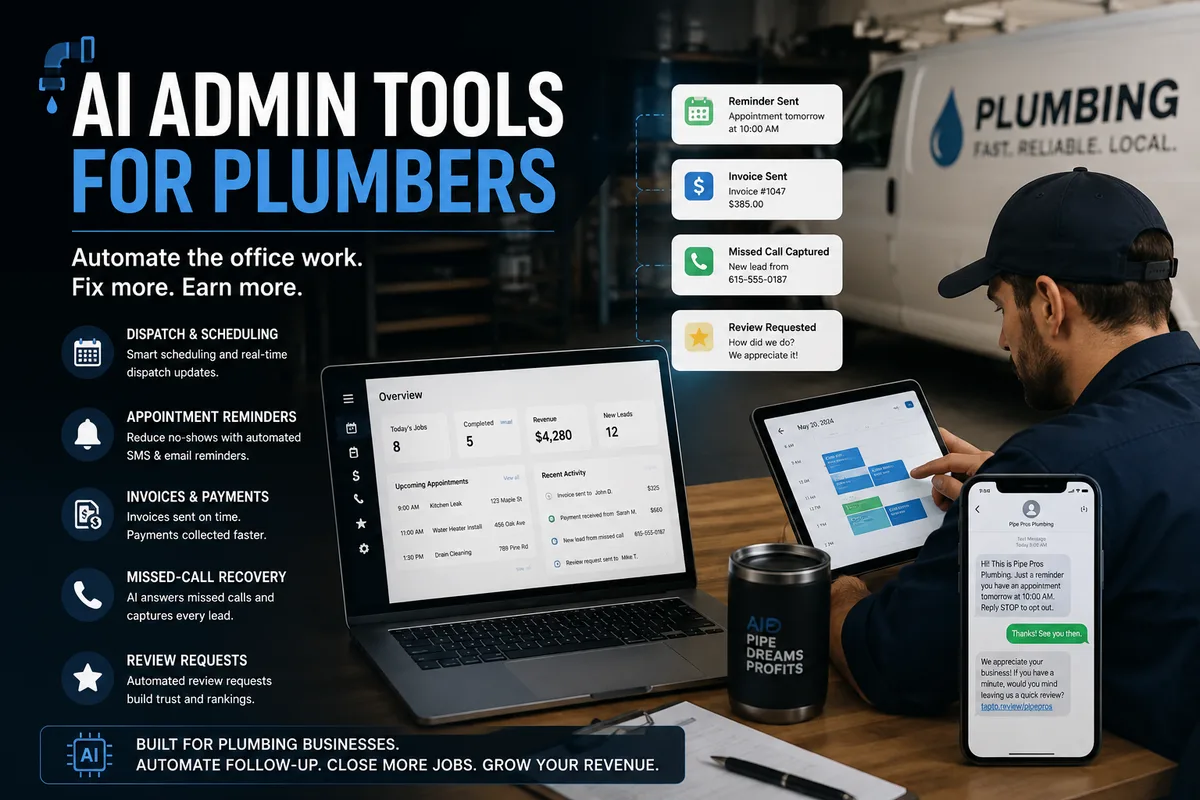
AI Admin Tools for Plumbers: What They Are and How to Choose
AI admin tools automate dispatch, reminders, invoicing follow-up, missed calls, and review requests for plumbers. What they do and how to choose.
Insurance Eligibility Automation for Physical Therapy Clinics
Eligibility automation for physical therapy clinics verifies benefits before the patient arrives, cuts front desk phone work, and can lower claim denial risk.

Business Process Automation Consultant for Small Business
Hiring the wrong automation consultant wastes thousands. Here's what small business owners need to know about process, cost, ROI, and how to vet the right one.