
Small Business AI Adoption Statistics 2026: U.S. Report
The narrative most people are reading about small business AI is wrong in two directions at once. The hype crowd says AI is everywhere, every owner is using it, and the laggards are falling behind.
See the latest 2026 small business AI adoption statistics from Census, NFIB, U.S. Chamber, JPMorgan, and more, with practical takeaways for SMB operators.
Epiphany Dynamics is an AI automation agency: we help businesses find and fix operational bottlenecks with AI receptionists, lead follow-up, and workflow automation.
The free 30-minute AI Operations Audit is a conversation about a normal week in your business and where the work piles up. We find the one change that would give you the most time back and send you a plain-English plan for it. No forms and no pitch.
Book a free AI audit
Patrick Gibbs
The narrative most people are reading about small business AI is wrong in two directions at once. The hype crowd says AI is everywhere, every owner is using it, and the laggards are falling behind. The skeptic crowd says small businesses are too resource-constrained to matter in the AI story. Both are off. The actual data shows a more interesting picture: adoption is accelerating faster than most benchmarks capture, the cost barriers that blocked SMBs two years ago have largely collapsed, and the gap that matters now isn't between small and large businesses - it's between the businesses treating AI as a free-tier toy and the ones actually embedding it in operations.
This post pulls together sourced statistics from U.S. government surveys, industry research, and primary survey data to build a clear picture of where small and mid-sized businesses actually stand with AI in 2026. Every number here has a real source. I've listed them all at the bottom. The goal is a document journalists and researchers can actually cite - not a marketing piece padding stats with affiliate links.
Key Statistics at a Glance
Every figure below is sourced in this article and listed in full in the Sources section. Jump to a topic: adoption rates, what SMBs use AI for, ROI, barriers, verticals by industry.
The figures below are industry ranges from published sources, not Epiphany Dynamics pricing. Epiphany Dynamics quotes every build as a fixed price after a free audit.
| Statistic | Figure | Source |
|---|---|---|
| U.S. firms that had adopted AI by year-end 2025 | about 18% | Federal Reserve / Census BTOS, 2026 |
| Small businesses using generative AI | 58% | U.S. Chamber of Commerce, 2025 |
| Small employers currently using AI tools | 24% | NFIB, 2025 |
| Small businesses using AI (up from 39% in 2024) | 55% | Thryv, 2025 |
| AI users reporting a positive impact on their business | 93% | Goldman Sachs, 2026 |
| AI users saving $500 to $2,000 per month | 66% | Thryv, 2025 |
| AI users saving more than 20 hours per month | 58% | Thryv, 2025 |
| Median small business monthly AI spend (down from roughly $80 (industry range) in 2022) | roughly $30 (industry range) | JP Morgan Chase Institute, 2025 |
| Businesses where AI is fully embedded in core operations | 14% | Goldman Sachs, 2026 |
| Construction AI adoption (among the lowest verticals) | 8.9% | JP Morgan Chase Institute, Dec 2025 |
| Information services AI adoption (the highest vertical) | 39.3% | JP Morgan Chase Institute, Dec 2025 |
Want these numbers turned into action? Join the Epiphany Dynamics newsletter for practical AI automation breakdowns built for service businesses. Join the Epiphany Dynamics newsletter.
What This Means for Service Businesses
The headline numbers are national and cross-industry, but the actionable signal for a service business is narrower. Three things stand out:
- The adoption gap is widening inside verticals, not just between big and small firms. Construction and trades sit near the bottom of the adoption range while professional services lead, which means an early-moving service business still has room to get ahead of local competitors.
- The ROI shows up at integration depth, not tool count. The owners reporting real time and cost savings are the ones who moved past one-off tool use into connected workflows. Picking one high-value problem and building around it beats scattering across a dozen apps.
- Customer communication is the lowest-friction entry point. Call handling, booking, and follow-up are where service businesses tend to see the clearest payback.
If you want to see what that looks like in a specific vertical, see our work on an AI receptionist for HVAC contractors, an AI receptionist for med spas, and insurance eligibility automation for physical therapy clinics, plus our roundup of the best AI tools for physical therapy. For the bigger question of whether this is worth doing now, see is AI automation in demand, and the overview of what an AI implementation engagement looks like. When you are ready to scope your own highest-value use case, you can book a working session.
How to Cite This Page
Journalists, researchers, and analysts are welcome to cite this roundup. Suggested citation:
Gibbs, Patrick. "The State of AI Adoption in U.S. Small and Mid-Sized Businesses in 2026." Epiphany Dynamics, 2026, https://epiphanydynamics.ai/blog/state-of-ai-adoption-us-small-business-2026/.
Every statistic on this page traces back to a primary source in the Sources section. When citing an individual figure, please reference the original source listed there.
How Many SMBs Are Actually Using AI
The short answer is "more than you think, less than the headlines suggest." The longer answer depends on how you define "using AI."
The U.S. Census Bureau's Business Trends and Outlook Survey (BTOS), which samples roughly 200,000 businesses per panel with data collection every two weeks, found that about 18% of firms had adopted AI as of year-end 2025, up from the low single digits in early 2024. Even before the Census broadened its definition in late 2025 to include AI use across any business function (not just production), the measured adoption rate had grown 68% over the prior year. The Federal Reserve's analysis of this data, published April 2026, puts current firm-level AI adoption at roughly 18% nationally.
That 18% figure sounds modest. But it represents a dramatic acceleration. In early 2025, only 6.3% of small businesses reported using AI, compared to 11.1% of large businesses - a 1.8x gap in the SBA Office of Advocacy analysis of BTOS data. By the most recent 2025 readings, small business usage had reached 8.8% while large business adoption had actually declined slightly, with the gap nearly closed. The JP Morgan Chase Institute, analyzing small business banking data, found that AI adoption among newly-started small businesses accelerated from a 1.2% first-month adoption rate in 2019 to 6.5% in 2025 - more than a five-fold increase in initial uptake.
Survey data tells a different story from transaction data, primarily because it asks different questions. The U.S. Chamber of Commerce's 2025 Empowering Small Business report found that 58% of small businesses say they use generative AI, up from 40% in 2024 and more than double the 2023 rate. The NFIB's Small Business and Technology Survey (2025) found a more conservative 24% of small employers currently using AI tools like ChatGPT, Grammarly, and Canva. Thryv's 2025 survey of 540 small business decision-makers found 55% using AI, up from 39% in 2024 - a 41% jump year-over-year.
The variance between these numbers isn't dishonesty. It reflects different survey populations, different definitions of "AI," and different response biases. NFIB surveys small employers (businesses with at least one employee). Thryv surveys their customer base, which skews toward service businesses actively managing technology. Census BTOS samples a broader population that includes nonemployer firms. Each is measuring something real. My synthesis of the Federal Reserve, NFIB, Thryv, and U.S. Chamber data: somewhere between 20% and 55% of U.S. small businesses are using at least one AI tool in a meaningful way as of early 2026, with the range tightening as definitions standardize.
Chart sources: Federal Reserve / Census BTOS, NFIB, Thryv, and U.S. Chamber of Commerce.
What's consistent across all sources: the trajectory is sharply upward. The 2025 cohort of new small businesses reached 10% AI adoption in just six months, compared to 77 months for the 2019 cohort - a 13-fold acceleration in speed of initial uptake, according to the JP Morgan Chase Institute.
What SMBs Are Using AI For
Adoption numbers are less useful without knowing what owners are actually doing with these tools. The NFIB's 2025 survey breaks this down for small employers currently using AI:
- Communications (email, memos, documents): 29%
- Marketing or advertising: 27%
- Business analysis or predictive analysis: 14%
- Customer service: 9%
- Accounting: 4%
- Process automation: 4%
- Cybersecurity or fraud detection: 4%
Thryv's 2025 survey of its small business customer base found different priorities, reflecting that service businesses use tools differently: data analysis topped the list at 62%, followed by content generation at 55%, and customer engagement or chatbots at 46%.
The spread makes sense when you think about where small business owners feel the most immediate pain. Writing is a daily task for almost every owner - proposals, emails, social posts, job listings. That's where AI delivers a near-instant win with zero integration work. Customer service automation requires more setup but has one of the clearer ROI paths: a chatbot or voice agent that handles after-hours inquiries doesn't replace an employee, it covers hours you never staffed to begin with.
Among marketing functions specifically, HubSpot's 2026 State of Marketing report found that the large majority of marketing teams now use AI in at least a few marketing areas, with content creation the most common use case.
What's notably thin in the current adoption data: AI embedded in core operations. The Goldman Sachs 10,000 Small Businesses survey (2026) found that while 76% of small businesses report using AI, only 14% say AI is fully embedded in their core operations. The gap between "we use it sometimes" and "it's how we work now" is where the real productivity divide lives.
What the ROI Signal Actually Shows
The ROI data on small business AI is genuinely strong - with a catch. The catch is that most of the positive numbers come from businesses that went past surface-level tool usage into actual workflow integration.
Among Thryv's 2025 survey respondents who use AI regularly:
- 58% report saving over 20 hours per month
- 66% say AI saves their business between $500 and $2,000 (industry range) monthly
- 63% use AI daily
Salesforce's SMB Trends survey (3,350 SMB leaders surveyed) found that 91% of SMBs using AI say it boosted their revenue. The same survey found that 75% of SMBs are at least experimenting with AI, with growing businesses leading adoption at 83%; it also found that 78% of growing SMBs planned to increase AI investment the next year, compared with 55% of declining peers. Causation still runs both ways.
Goldman Sachs's 2026 small business survey found that 93% of small business owners currently using AI say it has had a positive impact on their business, with 84% citing increased efficiency and productivity as the primary benefit.
At the individual task level, the direction is consistent: professionals draft documents meaningfully faster with AI writing assistance, customer service agents handle more inquiries per hour with AI support tools, and deployments that add AI triage cut first response times from hours to minutes.
The NFIB data is more muted, which makes sense given it surveys a broader, less tech-forward population: 30% of current AI users reported increased productivity, 23% noted improved product or service quality, 8% saw lower operating costs, and 5% reported increased revenue. Nearly all small businesses currently using AI (98%) reported no change in the number of employees - meaning adoption isn't primarily driving layoffs at this scale.
Chart sources: Goldman Sachs, Salesforce, and Thryv.
At the workforce level, Gallup's workplace data found that 65% of employees say AI has improved their productivity and efficiency, and that AI-adopting organizations are 6 percentage points more likely to be hiring or expanding than non-adopting ones. That is not a clean small-business ROI multiple, but it supports the same directional point: measurable benefits tend to appear when AI gets absorbed into regular work rather than treated as a one-off writing tool.
The honest caveat: most of these surveys capture self-reported outcomes from owners who chose to adopt and are generally positive about their tools. Survivorship bias is real. The businesses that tried AI tools, got frustrated, and quietly abandoned them don't show up prominently in the ROI statistics.
Where Adoption Breaks Down - The Real Barriers
The barriers to AI adoption among small businesses are well-documented and haven't changed much in structure, though their relative weight has shifted as costs dropped.
The belief that AI doesn't apply to their business. This is the most common barrier among the smallest SMBs. Among businesses with fewer than five employees, nearly 82% of non-adopters cite "AI is not applicable to my business" as their primary reason for non-adoption in the SBA Office of Advocacy analysis. This isn't ignorance - it's partly rational. A two-person landscaping operation with a full schedule and no time to learn new tools has a different calculus than a 30-person professional services firm.
Skills and training gaps. Goldman Sachs's 2026 survey found owners citing a lack of technical expertise and difficulty choosing the right tools among their leading challenges. Among non-adopters in the SBA data, the next most reported concerns after relevance were lack of knowledge about AI and privacy concerns. Skills gaps, not tool availability, are where adoption friction now concentrates.
Cost - but less than it used to be. The JP Morgan Chase Institute found that entry-level AI spending among small businesses dropped from a median of $50 per month in 2019 to $20 per month by 2024 - a 60% reduction in baseline cost. This is largely because SaaS tools have embedded AI capabilities (Canva, Google Workspace, HubSpot, QuickBooks) that don't require separate AI subscriptions. GPT-4 class inference costs have dropped dramatically since 2024. The OECD notes that a lack of financial resources remains one of the main barriers in the digital transition of SMEs - suggesting cost still blocks the most capital-constrained operators.
Time and attention. Owners consistently report lacking the time or resources to properly explore tools. This is different from cost. An owner working 60 hours a week running operations doesn't have bandwidth to evaluate three competing AI tools and choose the right one. The learning curve is a time cost, not just a financial one.
Data readiness and integration. Data readiness issues come up as a barrier across SMB surveys. AI tools are most useful when they can access a business's actual data - CRM records, customer history, product catalog, appointment schedule. Getting that data into a format AI tools can use requires work most small businesses haven't done.
Also on the blog: How to Choose AI Tools for Your Business: A Practical Selection Framework (2026).
Vertical Breakdown - Where AI Is Taking Hold and Where It Isn't
AI adoption across SMB verticals is anything but uniform. The Federal Reserve and JP Morgan Chase industry breakdowns tell a consistent story: professional services leads, trades and food service lag.
Professional and technical services. The highest adoption vertical across all sources. JP Morgan Chase found 30.3% of professional services firms had adopted AI by December 2025, second only to information services at 39.3%. Financial services shows 63% work-related GenAI adoption among workers, with firm-level adoption in the sector at roughly 30% in the Federal Reserve's 2026 analysis.
Healthcare and medical practices. A 2025 review of U.S. ambulatory practices found that about half already use at least one AI tool. The same review summarized physician survey data showing 72% AI use among hospital-employed physicians versus 64% for private-practice physicians - the independent practice gap mirrors the small business gap seen in other verticals.
Retail and e-commerce. Retailers appear in the higher-adoption cluster across multiple surveys, especially where personalization, content, and customer communication are central. Thryv's data shows that among businesses with 10-100 employees (where much of e-commerce SMB volume sits), AI adoption jumped from 47% to 68% year over year.
Manufacturing. The exact SMB manufacturing picture is harder to verify cleanly than knowledge-work sectors. The stronger sourced signal is the Federal Reserve's industry breakdown, which shows work-related GenAI adoption in manufacturing moving upward quickly even as firm-level adoption remains easier to verify in broader sectors.
Home services, construction, and trades. JP Morgan Chase found construction at just 8.9% AI adoption by December 2025 - one of the lowest rates across all tracked industries. Transportation and warehousing sits at 5.4%. The barriers here are real: complex, variable job scopes don't lend themselves to AI scripting as naturally as standardized service businesses do. Voice AI for call handling is the clearest early use case in these verticals, and adoption among HVAC and pest control operators (where call volume is high and inquiries are more standardized) runs ahead of general contractors and electrical firms.
Chart sources: JP Morgan Chase Institute, Federal Reserve, and IntuitionLabs healthcare review.
Hospitality and food service. Among the lowest adoption verticals. The Federal Reserve found accommodation and food services at roughly 8% BTOS-measured adoption, though work-related GenAI use among workers in these sectors runs at 21%. The disconnect reflects the reality that front-line workers use AI personally, but the businesses themselves haven't integrated it into operations.
The Mid-Market Gap
This is the adoption story that gets the least coverage, and it's arguably the most important one for businesses in the 10-250 employee range.
The OECD's 2025 analysis of AI adoption across its member countries found that while 40% of firms with 250 or more employees were using AI in 2024, only 20.4% of firms with 50-249 employees and 11.9% of firms with 10-49 employees used AI. Firms with 10-49 employees were less than one-third as likely to use AI as large firms. The U.S. data mirrors this, though the gap is narrowing faster here than in most OECD countries.
The mid-market problem is structural. A business with a real team is too complex for the free-tier tools that work for solo operators. The owner can't just use ChatGPT to write a few emails - they need AI that integrates with their CRM, their scheduling system, their accounting software, their team workflows. But they're also too small and too cost-sensitive to afford the enterprise AI implementations that large companies deploy, which typically require dedicated technical staff and six-figure implementation budgets.
JP Morgan Chase's data shows the cost picture is improving. By 2025, 63% of AI-spending small businesses were in the bottom spending tier ($1-$40 per month), 22% in the medium tier ($41-$150), and only 16% spending over $150 monthly. The median monthly AI spend across the small business population dropped from about $80 in 2022 to roughly $30 in 2025. Pre-trained foundation models embedded in existing SaaS tools (Salesforce Einstein, HubSpot AI, QuickBooks AI) are doing a lot of that work without requiring separate AI budgets.
But the integration gap persists. The Goldman Sachs 2026 survey found that 73% of small businesses say they would benefit from additional access to training and implementation resources. Only 14% say AI is fully embedded in their core operations, which leaves the large majority still outside full operational integration. The businesses that clear this hurdle - that get past "we use ChatGPT for emails" into "our customer intake runs through AI, our follow-up is automated, our scheduling syncs with voice AI" - are seeing the ROI numbers that make everyone else take notice.
This gap also shows up in multi-tool adoption. JP Morgan's data found that 72.5% of AI-using small businesses rely on a single AI service. Only 9.4% use three or more. Enterprise AI adopters, by contrast, typically run AI across multiple functions simultaneously. The businesses moving from single-tool experimentation to multi-system integration are the ones closing the mid-market gap on their own terms.
The Workforce and Employment Picture
The fear that AI would quickly displace small business employees hasn't materialized in the data - yet. The picture is more nuanced.
NFIB found that 98% of small employers using AI reported no change in their number of employees. Goldman Sachs's 2026 survey found 87% say AI augments rather than replaces employees, and the U.S. Chamber's report found 82% of small businesses using AI increased their workforce over the past year. Gallup's workplace data found that only 18% of all U.S. employees fear job elimination within five years from AI or automation, though that number rises to 23% in organizations that have already adopted AI tools.
Pew Research (March 2026) found that 21% of U.S. workers now use AI at work, up from 16% in 2024. About 65% of workers still say they don't use AI much or at all in their jobs.
The Gallup data shows AI-adopting organizations are 6 percentage points more likely to be hiring or expanding (34% vs 28%) than non-adopting ones. They're also more likely to report disruptive workplace changes (27% vs 17%) and more likely to have reduced workforce (23% vs 16%). The net employment effect is not simply "AI kills jobs" - the picture is more like "AI adoption accelerates organizational change, and some of that change involves both growth and contraction depending on the business."
For small businesses specifically, the workforce dynamic is different from enterprises. A five-person operation can't reduce headcount much without breaking core operations. The more common pattern is that AI handles tasks the owner was doing personally - late-night email responses, first-draft marketing copy, data entry from forms - freeing up owner time for higher-value work rather than eliminating a paid position.
Where This Is Headed - 2026 Through 2028
The trajectory indicators point in one clear direction: faster adoption, cheaper tools, and increasing pressure on businesses that delay past 2027.
The Federal Reserve's April 2026 analysis found that over 20% of firms expect to use AI in the first half of 2026, up from 18% at year-end 2025. Enterprise surveys show most large organizations now use AI in at least one business function, with adoption climbing steeply year over year. That progression will likely take a few years to fully translate to the SMB market, but it's coming.
The 2025 cohort of new small businesses started at 6.5% AI adoption on day one - more than five times the rate of businesses started in 2019. New businesses entering the market are AI-native in a way their predecessors weren't. This creates competitive pressure on incumbents that is slower-moving but durable.
Most small business owners already using AI expect it to become essential to how they operate within the next few years. The Salesforce data shows that 75% of SMBs are at least experimenting with AI, with growing businesses leading adoption at 83%. It also shows growing SMBs are more likely than declining peers to increase AI investment, which doesn't prove causation but does show that the correlation between AI adoption and business performance is strong enough that non-adoption is increasingly a strategic risk, not just a missed opportunity.
The structural driver behind continued SME adoption is clear: pre-trained foundation models embedded in existing software tools remove the need for custom AI development, making enterprise-grade capabilities accessible to businesses with no dedicated technical staff.
The cost curve alone argues for urgency. Capabilities that once required separate paid tools are now embedded in subscriptions most businesses already pay. That cost compression doesn't reverse. Businesses waiting for AI to "mature" before adopting are largely waiting for a window that's already passed.
Practical Takeaways for SMB Owners
The data points toward a few things that are actually actionable, rather than just interesting to read about.
The starting point matters less than the integration depth. Whether you start with ChatGPT for email drafts or a purpose-built voice agent for your phones, the businesses seeing real ROI are the ones that went from a single tool to integrated workflows. If you've been using AI for a while but only for one task, that's the signal to audit what else in your operations has an AI use case.
The free tier is a starting point, not a destination. JP Morgan's data shows the median small business AI spender is at roughly $30 per month - but the businesses reporting the biggest time savings are generally spending beyond the free tier or working with purpose-built tools for their industry. Operational integration can still stay far below the cost of a part-time employee, but the right budget depends on the workflow, data access, and support burden.
Marketing and customer communication are the fastest payback areas. The data consistently shows this is where small businesses start and where the friction is lowest. Content generation, email drafting, social posts, first-draft proposals. If you haven't systematized AI use in your customer communication stack, that's the lowest-friction entry point regardless of vertical.
Voice AI and after-hours coverage are underpenetrated. Only 9% of NFIB survey respondents use AI for customer service - and most of those are likely text-based chatbots. Voice AI for after-hours call handling, appointment booking, and inquiry routing has clear ROI math in any business where calls arrive outside business hours. The after-hours coverage gap - where service business calls go unanswered - is a directly quantifiable revenue problem that voice AI addresses directly.
Training gaps are the primary operational barrier now, not cost. Goldman Sachs found 73% of small businesses say they would benefit from additional access to training and implementation resources. That's the bottleneck. The tools exist. The cost has dropped. The businesses that invest in understanding how to actually deploy AI - not just sign up for accounts - are the ones pulling away from competitors still treating it as optional.
In my work with small businesses across service verticals, the pattern I see repeatedly is that owners underestimate what AI can do for their specific operation because they're comparing it to generic demos rather than use cases scoped to their workflows. The businesses making real progress aren't the ones using the most AI tools - they're the ones that picked the highest-value problem in their operation and built around that first.
The data supports a straightforward conclusion: AI adoption among U.S. small businesses is accelerating faster than most benchmarks show, the cost barriers are largely gone, and the gap between businesses that have integrated AI into core operations and those experimenting on the periphery is widening. That gap shows up in the productivity numbers, the ROI numbers, and the hiring numbers. The window to get ahead of competitors in most SMB verticals is still open - but based on the adoption trajectory data, it won't stay open for another two years.
For more on AI deployment in specific business contexts, see our work on reducing administrative overhead with AI workflow automation, voice AI adoption in home service businesses, and our overview of what an AI implementation engagement actually looks like.
Frequently Asked Questions
Q: What percentage of U.S. small businesses are using AI in 2026?
Estimates range from 18% to 58% depending on source and definition. The Federal Reserve's analysis of Census BTOS data found about 18% of firms had adopted AI by year-end 2025. The U.S. Chamber of Commerce's survey found 58% of small businesses report using generative AI. The difference reflects broader vs. narrower definitions and different survey populations. My synthesis of the available sources: somewhere between 20% and 55% of U.S. small businesses are actively using at least one AI tool, with adoption accelerating sharply from 2024 levels.
Q: What are small businesses using AI for most commonly?
The most common use cases are communications and writing assistance (29% of AI-using small businesses per NFIB), marketing and advertising content (27%), and business analysis (14%). Among service businesses with higher overall adoption, data analysis (62%), content generation (55%), and customer engagement or chatbots (46%) lead usage in Thryv's 2025 survey. Marketing automation and customer communication consistently appear at the top across all surveys.
Q: Is small business AI adoption delivering real ROI?
Among businesses that have moved beyond surface-level adoption, yes. Goldman Sachs found 93% of small business owners using AI report a positive impact on their business. Thryv found 66% save $500 to $2,000 monthly, and 58% save over 20 hours per month. Salesforce found 91% of SMBs using AI report revenue increases. The important caveat: these numbers come primarily from businesses that actively adopted and are generally positive about their tools - survivorship bias is real, and outcomes vary significantly based on integration depth.
Q: What are the biggest barriers to AI adoption for small businesses?
The primary barrier for the smallest firms (under 5 employees) is the belief that AI doesn't apply to their business - cited by nearly 82% of non-adopters in the SBA Office of Advocacy analysis. For businesses that are aware of AI but haven't deployed it fully, lack of technical expertise, difficulty choosing the right tools, and lack of time to explore options are the leading obstacles. Cost has dropped significantly as a barrier, with the median AI spend for small businesses falling from about $80/month in 2022 to roughly $30/month in 2025, according to the JP Morgan Chase Institute.
Q: Which industries have the highest small business AI adoption?
Information services leads at 39.3% adoption, followed by professional and technical services at 30.3% in JP Morgan Chase Institute data from December 2025, with the Federal Reserve putting financial services at approximately 30%. Healthcare practices show about 50% using at least one AI tool in one 2025 ambulatory-practice review. The lowest rates are in construction (8.9%), transportation and warehousing (5.4%), and accommodation and food services (roughly 8%). The pattern holds internationally in OECD data as well.
Q: Will AI eliminate jobs at small businesses?
Current data says no, mostly. NFIB found 98% of small employers using AI reported no change in employee count. Goldman Sachs's 2026 survey found 87% say AI augments rather than replaces employees, and the U.S. Chamber found 82% of small businesses using AI increased their workforce. Gallup found 18% of U.S. employees fear job elimination from AI within five years, rising to 23% in AI-adopting organizations. The more common pattern at the small business scale is AI handling tasks the owner was doing personally, freeing time for higher-value activities rather than replacing a paid role.
Q: How fast is small business AI adoption growing?
The JP Morgan Chase Institute found that new small businesses reached 10% AI adoption in just 6 months in 2025, compared to 77 months for businesses started in 2019 - a 13-fold acceleration. The U.S. Chamber of Commerce found generative AI use among small businesses more than doubled between 2023 and 2024, reaching 58% in 2025. The Federal Reserve's analysis found BTOS-measured adoption grew 68% year-over-year prior to the late-2025 question revision. All signals point to continued rapid acceleration.
Sources
All statistics cited above are drawn from the following primary sources. No statistics in this article were fabricated or extrapolated.
- U.S. Federal Reserve - "Monitoring AI Adoption in the U.S. Economy" (April 2026): https://www.federalreserve.gov/econres/notes/feds-notes/monitoring-ai-adoption-in-the-u-s-economy-20260403.html
- U.S. Census Bureau - "Business Trends and Outlook Survey (BTOS) Data" (January 2026): https://www.census.gov/data/experimental-data-products/business-trends-and-outlook-survey.html
- JP Morgan Chase Institute - "Understanding the Use of AI Among Small Businesses" (2025): https://www.jpmorganchase.com/institute/all-topics/business-growth-and-entrepreneurship/understanding-ai-use-by-small-businesses
- NFIB - "NEW NFIB REPORT: How Small Businesses Incorporate Tech and AI Advancements" (June 2025): https://www.nfib.com/news/press-release/new-nfib-report-how-small-businesses-incorporate-tech-and-ai-advancements/
- U.S. Chamber of Commerce - "Empowering Small Business: The Impact of Technology on U.S. Small Business" (2025): https://www.uschamber.com/technology/artificial-intelligence/u-s-chambers-latest-empowering-small-business-report-shows-majority-of-businesses-in-all-50-states-are-embracing-ai
- Goldman Sachs - "Survey: Small Businesses Embrace AI But Need Training and Support" (2026): https://www.goldmansachs.com/pressroom/press-releases/2026/small-businesses-embrace-ai-but-need-training-and-support-to-fully-harness-it
- Salesforce - "New Research Reveals SMBs with AI Adoption See Stronger Revenue Growth" (December 2024): https://www.salesforce.com/news/stories/smbs-ai-trends-2025/
- Thryv - "AI Adoption Among Small Businesses Surges 41% in 2025" (July 2025): https://www.businesswire.com/news/home/20250717239434/en/AI-Adoption-Among-Small-Businesses-Surges-41-in-2025-According-to-New-Survey-from-Thryv
- Pew Research Center - "Key Findings About How Americans View Artificial Intelligence" (March 2026): https://www.pewresearch.org/short-reads/2026/03/12/key-findings-about-how-americans-view-artificial-intelligence/
- Gallup - "Rising AI Adoption Spurs Workforce Changes" (2025): https://www.gallup.com/workplace/704225/rising-adoption-spurs-workforce-changes.aspx
- SBA Office of Advocacy - "Research Spotlight: AI In Business: Small Firms Closing In" (September 2025): https://advocacy.sba.gov/wp-content/uploads/2025/09/Research-Spotlight-AI-in-Business-Small-Firms-Closing-In_-092425.pdf
- OECD - "AI Adoption by Small and Medium-Sized Enterprises" (2025): https://www.oecd.org/content/dam/oecd/en/publications/reports/2025/12/ai-adoption-by-small-and-medium-sized-enterprises_9c48eae6/426399c1-en.pdf
- HubSpot - "2026 State of Marketing Report": https://blog.hubspot.com/marketing/hubspot-blog-marketing-industry-trends-report
- IntuitionLabs - "AI in Private Practice: 2025 Adoption Trends and Statistics": https://intuitionlabs.ai/articles/ai-adoption-private-medical-practice
Patrick Gibbs
AI Automation Expert
Patrick Gibbs helps professional practices implement AI automation that captures more leads, books more appointments, and scales without adding overhead. He's the founder of Epiphany Dynamics and creator of the AI Front Desk system.
Related Solutions
Build this into a real workflow
Related Posts
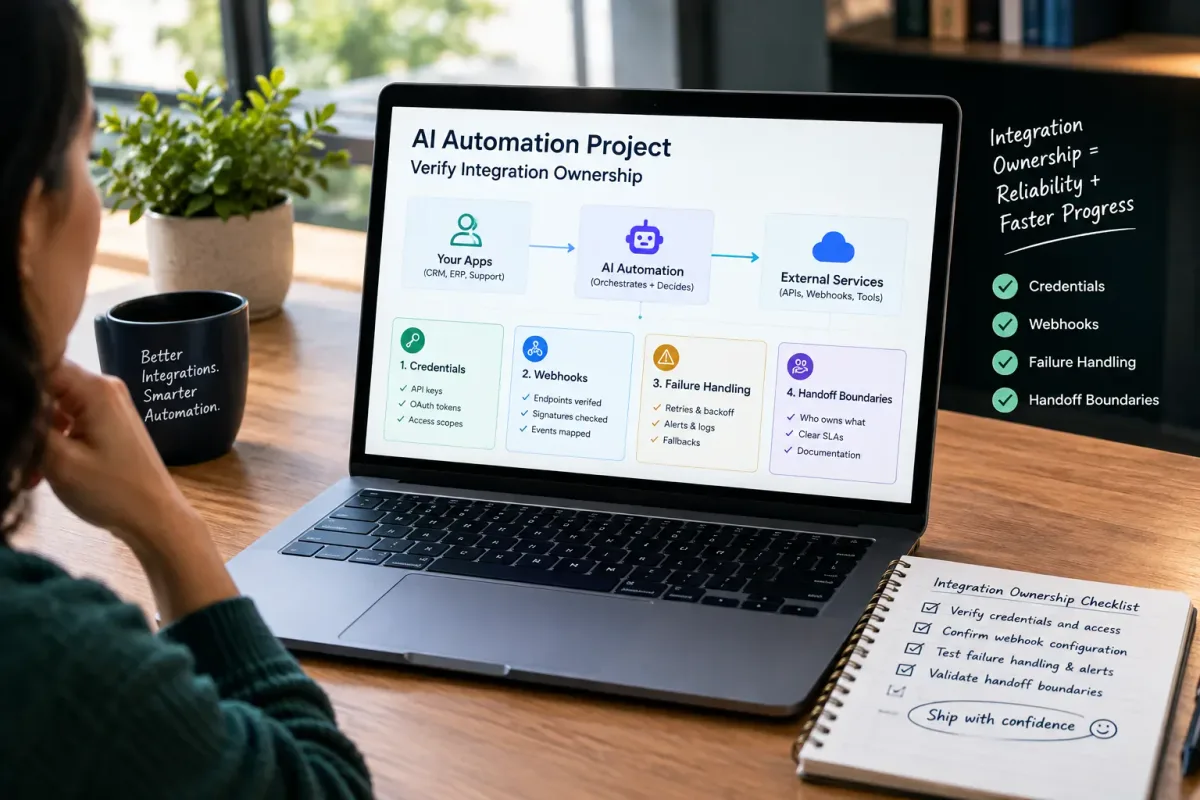
How Do I Verify Integration Ownership in an AI Automation Project?
Learn how to verify integration ownership in an AI automation project, including credentials, webhooks, failure handling, and handoff boundaries.

Is Epiphany Dynamics Legitimate for AI Automation?
Is Epiphany Dynamics legitimate for AI automation? Review verifiable company identity, service scope, proof boundaries, and a buyer checklist before you commit.
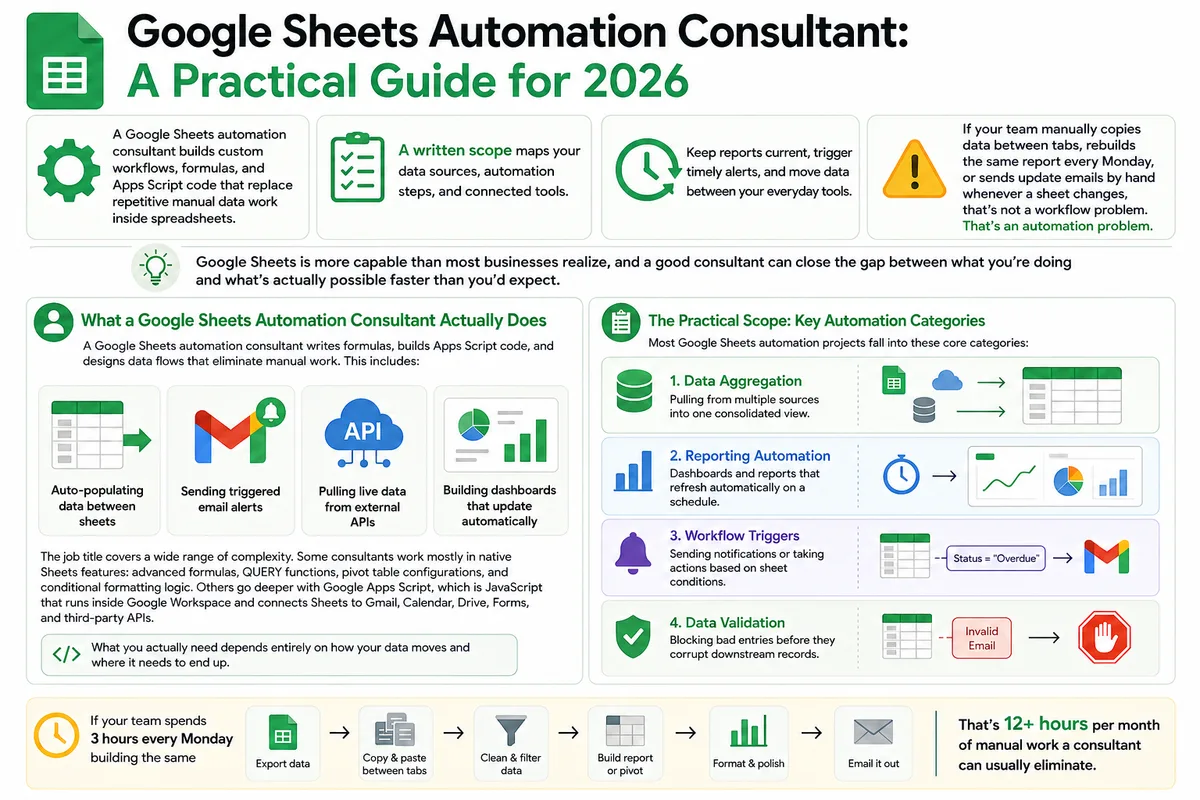
Google Sheets Automation Consultant: A Practical Guide for 2026
Most businesses don't track what spreadsheet work actually costs them. Here's what a Google Sheets automation consultant does in 2026, how to judge the value.