
How to Get More Leads for Your Construction Company in 2026
Construction companies that generate leads consistently do three things well: they appear where buyers search online, they follow up within minutes, and they convert satisfied clients into referral sources. Most contractors are strong at the work itself.
Most construction companies run feast-or-famine pipelines because they rely on chance, not systems. Here's what changes when you fix your Google presence.
Epiphany Dynamics is an AI automation agency: we help businesses find and fix operational bottlenecks with AI receptionists, lead follow-up, and workflow automation.
The free 30-minute AI Operations Audit is a conversation about a normal week in your business and where the work piles up. We find the one change that would give you the most time back and send you a plain-English plan for it. No forms and no pitch.
Book a free AI audit
Patrick Gibbs
Construction companies that generate leads consistently do three things well: they appear where buyers search online, they follow up within minutes, and they convert satisfied clients into referral sources. Most contractors are strong at the work itself. The gap is almost always in systems, not skills. Fix those systems and the leads follow.
Most construction company owners have the same complaint: "We do great work, but we're feast or famine." One month the pipeline is packed; the next they're scrambling for bids. That's not a quality problem. It's a consistency problem. Great work alone doesn't generate leads. What generates leads is showing up in the right places at the right moment, responding faster than your competitors, and systematically turning existing relationships into new business.
This guide covers what actually moves the needle for construction companies in 2026, with practical tactics and decision criteria you can use to choose where to spend your time and budget.
Fix Your Online Presence Before You Spend on Ads
A construction company's Google Business Profile and website are its two highest-ROI lead assets. Companies with fully optimized GBP listings, including regular photo uploads, review responses, and correct service categories, attract meaningfully more profile views than incomplete listings and generate far more calls. Most contractors skip this step entirely.
Your Google Business Profile is the first thing a local buyer sees when they search "construction company near me" or "general contractor [city]." If your profile has thin photos, few reviews, and the wrong service categories, you're essentially invisible compared to a competitor who took the time to set it up properly. Start there. Upload a strong set of project photos. List every service you offer, not just "construction." Respond to every review, good and bad. Google's algorithm rewards active profiles, and so do buyers who scroll past incomplete ones without a second thought.
Your website matters almost as much. It doesn't need to be elaborate, but it needs to load fast on mobile, show proof of past work with real photos, and make it simple to contact you. Most local contractor searches come from buyers who are ready to act, not just browse. If someone can't quickly find your phone number or estimate request form on mobile, they're gone. Check your site's load speed at Google PageSpeed Insights and fix anything that makes the page feel slow or hard to use.
Reviews deserve their own system, not just good intentions. Construction buyers are making serious decisions. They read reviews carefully. A contractor with a deep, recent review profile will often look safer than a competitor with a perfect-looking but thin profile. Volume matters as much as rating. Build a simple habit: send every completed client a review link after the job wraps. Done consistently, that compounds into a real competitive edge that no ad budget can replicate.
Build a Referral System, Not Just Happy Customers
Referrals drive a large share of new business for residential contractors, yet very few have a documented referral process. A follow-up sequence sent after project completion, paired with a clear incentive (cash, gift card, or service credit), can increase inbound referral opportunities without adding another ad channel.
Most contractors hope for referrals. They finish a job, the client is happy, and they assume that client will naturally tell their network. Sometimes it happens. Usually it doesn't, because the client gets busy, forgets, or doesn't realize you're actively looking for work. A referral system removes hope from the equation and replaces it with a repeatable process.
Here's a version that works without being pushy: after project completion, send a short text or email along these lines: "Hey [Name], how's everything holding up since we finished your [project type]? If you know anyone planning something similar, I'd really appreciate the referral. We offer a thank-you gift for every referral that turns into a booked job." Send a shorter reminder later if the relationship is still warm. That's the whole system. The ask is direct, the incentive is specific, and the timing works because the client has had time to live with the results but the project is still fresh enough to mention to friends. Understanding the principles behind converting prospects into long-term referral sources helps here too, since the same follow-up logic that applies to cold leads applies to warm past clients.
For commercial clients or general contractors you want as ongoing referral partners, quarterly check-ins work better than one-time asks, and a percentage-of-project incentive often lands better than a flat fee. Treat those relationships like partnerships, not transactions.
Paid Ads for Construction: What Works and What Drains Budget
Google Local Services Ads can be a strong fit for construction companies because they charge on a lead basis and show trust signals directly in search. Standard Google Search Ads can still work, but they require tighter keyword control, landing pages, and follow-up discipline because click costs can move fast in competitive metros.
If you haven't set up Google Local Services Ads, put them on the shortlist. LSAs appear above standard search results, show your reviews and phone number directly, and carry Google's "Guaranteed" badge. That badge matters in construction because clients are inviting you onto their property for significant work. The pay-per-lead model also protects your budget from people who clicked out of curiosity and had no intention of hiring anyone. You pay when someone calls or messages through the listing, which changes the unit economics compared to standard search ads.
| Ad Type | Cost Pattern | Payment Model | Best For |
|---|---|---|---|
| Google Local Services Ads | Market-sensitive, lead-based | Per verified lead | Local residential, high-trust services |
| Google Search Ads | Can rise quickly in competitive metros | Per click | Specific project types, commercial bids |
| Facebook/Instagram Ads | Usually cheaper intent, weaker buyer urgency | Per form fill | Brand awareness, lower-intent prospects |
| Nextdoor Ads | Highly local, varies by neighborhood | CPM or per click | Hyper-local residential, neighbor trust |
The mistake most contractors make with paid ads is running them without a fast follow-up process in place. A lead from Google LSAs who doesn't hear back quickly may call the next contractor on the list. Before you add any paid channel, make sure your response system can actually handle the volume. If you want to put a number on what slow follow-up is costing you, an automation ROI calculator built for service businesses makes the math concrete fast.
Facebook and Instagram ads work for construction, but they work differently than search. They're better for building awareness among homeowners who aren't actively searching yet. A before-and-after video of a recent project with a simple lead form attached is the most reliable format. Expect lower intent than Google leads, so your follow-up sequence needs to be more patient and educational. Start with a contained test budget. Measure cost per lead, not just impressions. Cut what doesn't produce real conversations after a fair test period.
Lead Response Speed Is Your Actual Competitive Edge
Contractors who contact new leads quickly are far more likely to reach them while the buyer is still in decision mode. In residential construction, where buyers often submit requests to several companies at once, the contractor who responds first often controls the conversation.
This is where most construction companies lose leads they already paid to generate. The inquiry comes in while you're on a job site. Nobody sees it until later. Someone calls back after the buyer has already booked a walkthrough with the competitor who responded first. The lead wasn't lost on price or quality. It was lost on response time, which is completely fixable.
Fixing this doesn't always mean hiring office staff. What it means is that no inquiry should sit untouched during business hours. If you're on site all day and can't answer calls, that's a system problem. What contractors in similar positions are doing to capture those calls automatically, without keeping someone on standby, is worth understanding: the guide to AI phone answering for home service businesses covers the practical setup in detail. The core logic is simple: a missed call in construction is almost never just a missed call. It's a prospect trying to line up estimates who just crossed you off the list.
At minimum, set up an automated text response the moment a new web lead comes in: "Hey, this is [Name] from [Company]. Got your message. I'll call shortly to set up a free estimate. What time works best?" That single message keeps the lead warm while you wrap up on site. It signals responsiveness before you've even spoken to them, which in a market where many contractors go silent, is already a differentiator.
Continue with How Plumbing Contractors Use AI to Grow Revenue Without Adding Headcount.
Track Where Your Leads Come From (Most Contractors Don't)
Contractors who track lead sources by channel, close rate, and revenue per lead typically allocate budget far more efficiently than those who don't. The highest-volume channel is rarely the highest-ROI channel. Referrals tend to close at several times the rate of paid leads, which changes the math on where to invest time and money significantly.
If you don't know which channel is generating your best jobs, you're guessing at where to put your budget. Start with something basic. When a new lead comes in, ask: "How did you hear about us?" Log it somewhere: source, project type, estimated value, whether it closed. After a consistent tracking period, you'll see patterns. Maybe your best revenue is coming from referrals and neighborhood channels, but you've been pouring money into Google Ads that generate calls from price-shoppers who never book. Knowing that changes everything about where you invest next quarter.
The close rate gap between lead sources is usually bigger than people expect. A referred lead may be worth far more than a paid lead because trust is already partially built before the first call. That's the kind of insight that should reshape how you allocate time, not just budget. The complete 2026 guide to AI automation for small businesses covers how service contractors are automating this tracking so it doesn't require logging every call manually.
One more metric worth pulling: response time versus close rate. Compare leads you responded to quickly against the ones that sat too long. In most service businesses, faster response correlates directly with higher close rate. That correlation is the clearest argument for treating speed as a business system, not something that happens when you happen to be available. The contractors who are consistently busy aren't necessarily better at the work. They're better at showing up fast, following up consistently, and making it easy for satisfied clients to send them more business. Build those systems, and the pipeline takes care of itself.
If you're looking for help building these systems without hiring a full marketing team, there are agencies that specialize specifically in lead generation and automation for trade and construction companies worth exploring.
Frequently Asked Questions
Q: How quickly should construction companies respond to leads?
Construction companies that respond while the buyer is still actively comparing options are far more likely to reach and win the conversation than those responding after the opportunity has gone cold. Speed of response is often more important than perfection of response.
Q: What's the average customer acquisition cost for a construction company?
Customer acquisition cost varies heavily by service type, market, lead source, and close rate. General contracting tends to be more expensive than smaller repeat-service work because the stakes are higher and the buyer journey is longer. Companies that systematize referrals can lower acquisition cost by converting satisfied clients into repeat and referred business. Your CAC directly determines profitability on smaller contracts.
Q: How many Google reviews do construction companies need to be competitive?
There is no universal review count that guarantees competitiveness. What matters is having enough recent, specific, verified reviews to look credible against the other contractors in your market. Consistency and quality matter more than raw volume: responding to reviews shows active engagement and builds trust. Most competitive markets require ongoing review generation to maintain ranking position.
Q: What percentage of construction leads come from referrals?
Referrals drive a large share of construction leads for most contractors, yet most don't have a systematic referral process. Turning even a small portion of past clients into referral sources can lower acquisition cost and generate better-qualified leads. This makes past client relationships one of the highest-ROI assets most contractors neglect.
Patrick Gibbs
AI Automation Expert
Patrick Gibbs helps professional practices implement AI automation that captures more leads, books more appointments, and scales without adding overhead. He's the founder of Epiphany Dynamics and creator of the AI Front Desk system.
Related Solutions
Build this into a real workflow
Related Posts
Best AI Receptionist for Small Business: How to Choose
The best AI receptionist for a small business is the one that answers quickly, books or routes correctly, escalates cleanly, and fits the tools your team.

What Two-Way Sync Between AI and ServiceTitan Looks Like in Practice
Two-way sync between AI and ServiceTitan means data flows both directions: the AI reads live job and customer data from ServiceTitan, and writes new bookings.
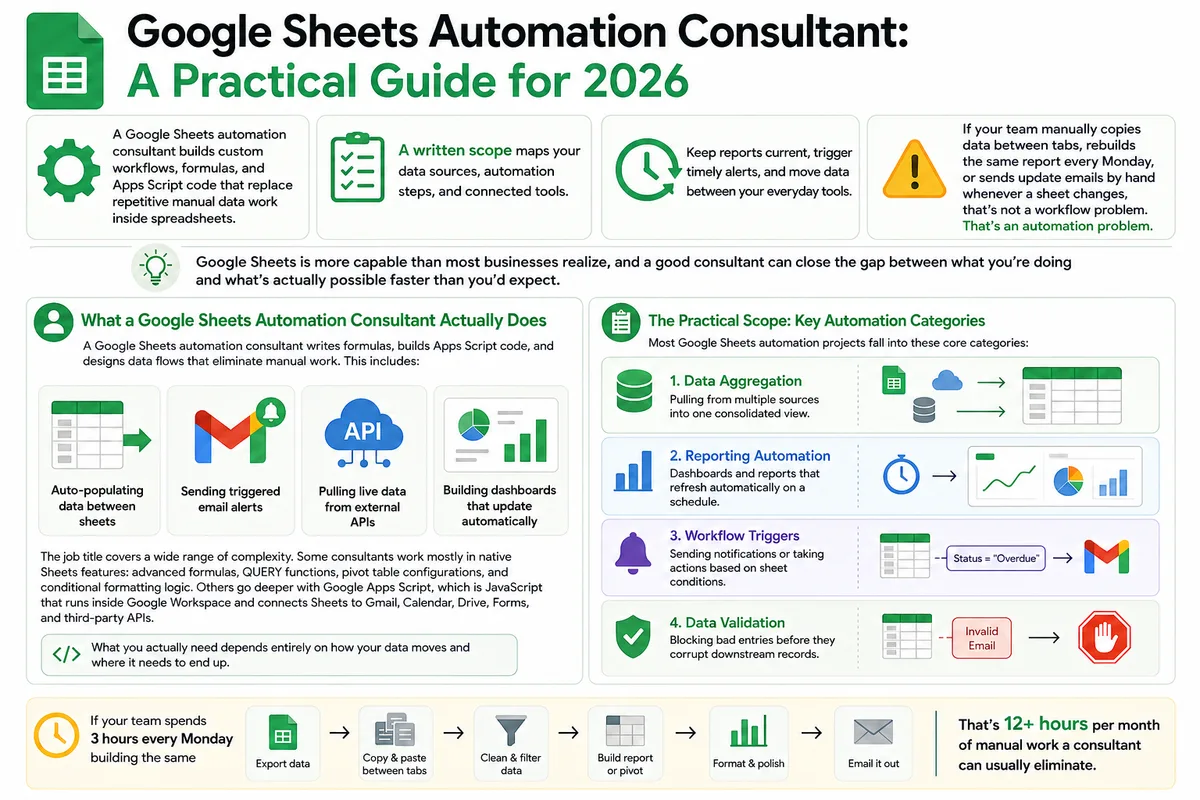
Google Sheets Automation Consultant: A Practical Guide for 2026
Most businesses don't track what spreadsheet work actually costs them. Here's what a Google Sheets automation consultant does in 2026, how to judge the value.