
How to Quantify the Annual Cost of Missed Business Calls
Small and mid-size businesses often miss a meaningful share of inbound calls, and many of those callers hang up without leaving a voicemail and call a competitor, a structural revenue leak most owners have never quantified in dollars. This article walks through a straightforward four-variable formula, illustrative industry planning benchmarks, and the audit process you can run this week to find your specific number.
A service business with a meaningful missed-call problem can quietly leak significant revenue, and most owners have never run the math.
Epiphany Dynamics is an AI automation agency: we help businesses find and fix operational bottlenecks with AI receptionists, lead follow-up, and workflow automation.
The free 30-minute AI Operations Audit is a conversation about a normal week in your business and where the work piles up. We find the one change that would give you the most time back and send you a plain-English plan for it. No forms and no pitch.
Book a free AI audit
Patrick Gibbs
Small and mid-size businesses often miss a meaningful share of inbound calls, and many of those callers hang up without leaving a voicemail and call a competitor, a structural revenue leak most owners have never quantified in dollars. This article walks through a straightforward four-variable formula, illustrative industry planning benchmarks, and the audit process you can run this week to find your specific number.
The Revenue Leak Most Business Owners Never Measure
For example, if a plumbing company pulls recent data from its VoIP dashboard and finds a consistent missed-call pattern, the math gets uncomfortable quickly. The exact revenue exposure depends on the company’s call volume, conversion rate, average job value, and how often voicemail callers reconnect. That is not a marketing problem. It is an answering problem. Use our cost of missed calls calculator to find your own number.
This is not an unusual pattern. Small and mid-size businesses routinely let meaningful call volume slip through because staff are busy, after-hours coverage is thin, or overflow routing is weak. Most business owners have a vague sense that some calls slip through, but they’ve never put a dollar figure on it. This article gives you the framework to do exactly that, with real calculations, illustrative benchmarks, and a practical audit process you can run this week.
Why the Problem Is Bigger Than It Looks
Call-answering studies consistently find that a meaningful share of calls to businesses go unanswered even during business hours, and the miss rate climbs sharply after hours and on weekends. For industries where customers call with an immediate need (HVAC, plumbing, legal, medical, auto repair), every unanswered ring is a prospect who has already decided to spend money and is actively choosing who to give it to.
The assumption most owners make is that missed callers leave a voicemail and wait. Caller-behavior research consistently contradicts this: most callers who reach voicemail hang up without leaving a message and call a competitor instead. That’s not a rounding error; it means most missed calls are permanently gone, not temporarily delayed. The minority who do leave messages don’t always get called back promptly, and many have already booked elsewhere by the time they’re reached.
The core issue isn’t negligence. It’s capacity. Front desk staff get tied up, phones ring during other calls, and after-hours coverage is expensive to staff. The result is a structural answering gap that compounds every single week.
Building Your Missed Call Cost Formula
Quantifying your annual exposure requires four inputs. All of them are findable with basic data most businesses already have or can retrieve within a week:
- Total inbound calls per month: from your carrier, VoIP dashboard, or a call tracking tool
- Your miss rate: missed calls divided by total calls. If you don’t have this, start with a conservative planning assumption and replace it with real call data as soon as possible
- Call-to-booking (or call-to-sale) conversion rate: what percentage of answered inbound calls result in a booked appointment, quote, or sale. If unknown, start with a conservative baseline and refine it once you have real data
Figures in this section are illustrative planning assumptions, not measured industry data.
- Average transaction value: revenue per job, appointment, or sale from your own recent history
The Core Calculation
Apply this formula sequentially:
- Missed Calls/Month = Total Calls × Miss Rate
- Permanently Lost Leads = Missed Calls × 80% planning assumption for voicemail non-recovery, then replace that assumption with your own callback data
- Lost Revenue/Month = Permanently Lost Leads × Conversion Rate × Average Value
- Lost Revenue/Year = Monthly Figure × annualization period
To keep this defensible, make every number in the worksheet yours. Pull call volume from your phone system, calculate the miss rate from actual unanswered calls, use your own close rate, and use your own average transaction value. If a data point is missing, mark it as a planning assumption instead of letting it masquerade as measured fact.
Industry Benchmarks: What Each Missed Call Actually Costs
The dollar cost of a missed call varies dramatically by industry, based on average transaction value, sales cycle length, and the urgency of the caller’s need. Use the table below as a worksheet prompt rather than a benchmark table:
| Industry | Value Driver | Missed-Call Risk | What to Model |
|---|---|---|---|
| Home Services (HVAC, Plumbing) | Emergency or urgent repair value | After-hours and overflow calls | Job value x booked-call rate x missed-call pattern |
| Medical / Dental | New patient value and recurring care | Scheduling friction and voicemail abandonment | First visit value plus realistic lifetime value |
| Legal (PI, Family Law) | Case value and intake urgency | Slow intake response | Qualified inquiry value x consultation conversion |
| Auto Repair | Repair order value | Busy bays and front-desk overflow | Service order value x missed-booking pattern |
| Beauty / Med Spa | Treatment value and repeat visits | After-hours research and appointment friction | First treatment value plus rebooking potential |
| Real Estate | Commission and referral value | Lead speed and trust window | Qualified lead value x contact success rate |
These prompts are intentionally not market benchmarks. They exist to help you choose the right inputs for your own call audit.
The Hidden Multipliers: Lifetime Value and Referrals
The direct revenue calculation above is the floor, not the ceiling. Two factors consistently make the actual damage larger than the first-transaction math suggests.
Customer Lifetime Value (CLV): A missed call doesn’t just lose one appointment: it can lose every future appointment that customer would have booked. Apply a realistic CLV multiplier from your own retention history to see whether the first-transaction calculation understates the true loss.
Referral Value: Loyal customers refer. If referrals matter in your business, model the referral effect separately instead of pretending a single first-transaction number captures the full damage.
The After-Hours Window Is Especially Costly
Most businesses operate on business hours. Callers don’t. A meaningful share of service-based business searches happen in the evening and on weekends. These aren’t casual browsers: people searching for a plumber after dinner or calling a med spa outside office hours often have high-intent, immediate needs. Whoever answers first wins the job.
The conversion rate for after-hours calls from first-contact callers is typically higher than business-hours calls precisely because the urgency is greater and the comparison shopping phase is compressed. HVAC companies experience this acutely, missing a large share of after-hours emergency calls. A caller with a weekend HVAC emergency isn’t going to leave three voicemails and wait until Monday. They’re going to call down a list until someone picks up. If your business is closed more hours than it’s open, which is true of nearly every small business, you are systematically losing your highest-intent leads to competitors who made themselves available.
How to Run Your Own Missed Call Audit
You don’t need expensive tools to get a defensible number. Here’s a practical five-step process:
- Step 1. Pull recent phone data. Your carrier, VoIP provider, or call tracking platform will show total calls, answered calls, and missed calls. Divide missed by total to get your miss rate.
- Step 2. Establish your call-to-close rate. How many calls actually result in a booked appointment or sale? Pull this from your CRM or booking system. If you genuinely don’t have this data, start with a clearly labeled hypothetical 30% planning assumption and replace it when real data exists.
- Step 3. Find your average transaction value. Use recent revenue divided by total customers, or pull the figure directly from your invoicing system.
- Step 4. Apply the formula. Missed Calls/Month × 80% planning assumption for voicemail non-recovery × Conversion Rate × Average Value × annualization period = Annual Revenue at Risk.
- Step 5. Segment by time of day. Most VoIP systems can show missed calls by hour. Determine what percentage fall outside business hours: this shapes which solution type will have the highest ROI.
Most businesses that run this audit find their number is larger than they expected. That’s not an accident. It’s why the audit matters. You cannot make a rational investment decision about fixing an answering gap until you know what the gap actually costs.
What the Number Tells You About Solutions
Once you have a concrete annual cost, the question becomes: what’s worth paying to close the gap? The math on available options is straightforward.
Compare each solution against the specific gap you measured. A full-time receptionist adds human judgment and accountability, but still has schedule limits, lunch breaks, sick days, and concurrent-call constraints. Traditional answering services add overflow coverage, but often lack context about your business, can’t book appointments, and may frustrate callers with scripted responses that feel impersonal and unhelpful.
AI voice agents have become a practically viable option for many service businesses. Unlike a phone tree or IVR, modern AI voice handles natural conversation, answers business-specific questions, collects caller information, books appointments directly into your scheduling system, and operates around the clock with concurrent-call capacity. The limiting factor is not just whether the technology works; it is whether your measured missed-call exposure is large enough to justify the investment.
The Bottom Line
Missed calls are a quantifiable revenue problem, not a vague operational inconvenience. The businesses that treat the answering gap as a real line item (calculate it, own the number, invest accordingly) consistently outperform those that treat it as background noise. Understanding the true revenue cost of unanswered calls is the first step to fixing it. Run the audit. Get your number. Then make a rational decision about what it’s worth to close the gap. Here’s a practical guide on how to recover revenue from missed calls once you have your data. For businesses exploring AI voice as part of that solution, firms like Epiphany Dynamics specialize in deploying AI front desk systems built specifically for service-based industries.
Frequently Asked Questions
Q: What percentage of missed business calls result in a permanent revenue loss?
Caller-behavior research consistently shows that most callers who reach voicemail hang up without leaving a message and call a competitor instead. That means most missed calls are permanently gone rather than temporarily delayed, making voicemail a delay mechanism rather than a safety net.
Q: How do I calculate the annual revenue at risk from my business’s missed calls?
Use this formula: Missed Calls per Month x Assumed Permanent Loss Rate x Your Conversion Rate x Average Transaction Value x annualization period. Treat the permanent-loss rate as a planning assumption until you have callback and booking data from your own phone system.
Q: What industries face the highest revenue risk from unanswered calls?
Legal services and real estate often face high per-incident costs because each qualified inquiry can carry a high transaction value. Medical and dental practices can face meaningful lifetime-value loss. Home services and beauty businesses may have lower per-call values but can still see the exposure compound when missed-call volume is high.
Q: Why are after-hours calls especially costly to miss for service businesses?
A meaningful share of service-based business searches happen in the evening, and a further slice land on weekends. These callers have higher intent and more urgency than business-hours browsers: they are not comparison shopping, they are actively looking for whoever answers first. The conversion rate for after-hours first-contact calls is typically higher than business-hours calls precisely because the urgency is greater and the comparison shopping window is compressed.
Q: What is the most cost-effective solution for closing a business’s missed call gap?
AI voice agents can be a cost-effective option for many service businesses when the measured missed-call leak is larger than the platform, setup, and management costs. They handle natural conversation, answer business-specific questions, collect caller information, book appointments directly into scheduling systems, and operate around the clock with concurrent-call capacity.
Patrick Gibbs
AI Automation Expert
Patrick Gibbs helps professional practices implement AI automation that captures more leads, books more appointments, and scales without adding overhead. He's the founder of Epiphany Dynamics and creator of the AI Front Desk system.
Related Solutions
Build this into a real workflow
Related Posts
Best AI Receptionist for Small Business: How to Choose
The best AI receptionist for a small business is the one that answers quickly, books or routes correctly, escalates cleanly, and fits the tools your team.
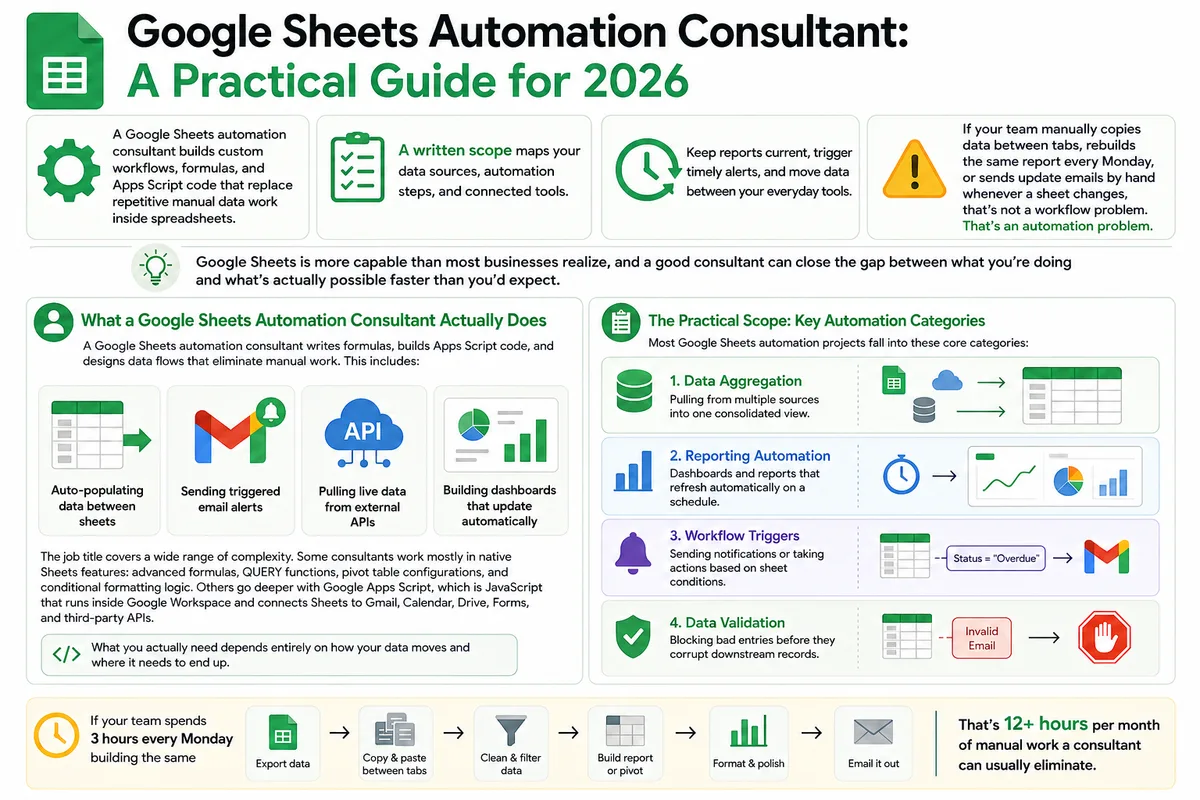
Google Sheets Automation Consultant: A Practical Guide for 2026
Most businesses don't track what spreadsheet work actually costs them. Here's what a Google Sheets automation consultant does in 2026, how to judge the value.

Business Process Automation Consultant for Small Business
Hiring the wrong automation consultant wastes thousands. Here's what small business owners need to know about process, cost, ROI, and how to vet the right one.